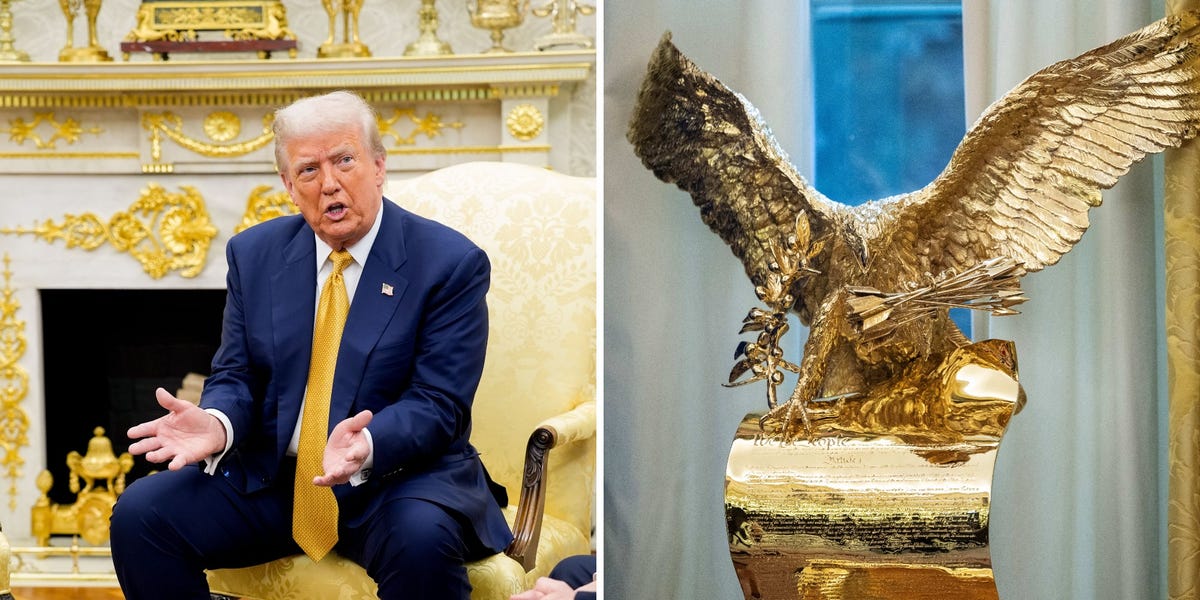
President Donald Trump has made a series of changes to the White House's artwork during his second term, adding more than a dozen new pieces across the Rose Garden, Oval Office, and other rooms. The additions include gold furnishings, statues of historical figures, and multiple portraits of himself, according to a review of White House statements and photographs.
White House spokesman Davis Ingle told Business Insider that Trump is "implementing long-overdue and necessary renovations to beautify the People's House as we celebrate our great Nation's 250th anniversary of independence." Ingle added that "thanks to the Builder-in-Chief, the White House will be properly glorified and remain in excellent condition for generations to come."
One of the most prominent pieces is a painting of Trump with his fist raised after the July 2024 assassination attempt in Butler, Pennsylvania. The portrait was painted by Elena Ruseva, who goes by the name MAGA Langelo. Trump also uses a version of the image, overlaid with an American flag and titled "Free America. Trump," as his Truth Social profile photo.
Five new bronze statues have been placed in the Rose Garden. One depicts Trump with his fist raised, created by sculptor Stan Watts. A group called the Trump Statue Project is raising funds for a nine-foot version of that statue. Another statue, "The American Patriot" by Lorenzo Ghiglieri, shows an eagle carrying an olive branch in one talon and 13 arrows in the other. It was originally commissioned in 2006 by Mark Russo, founder of Foundry Michelangelo.
The Rose Garden also received a statue of George Washington, a reproduction of a marble piece by Jean-Antoine Houdon that was created in 1785 after Houdon visited Washington at Mount Vernon to take measurements and capture a plaster cast, according to the Virginia General Assembly. The White House said the statues were on loan from a private citizen's collection; the Washington Post identified the donor as Harlan Crow, a billionaire Republican donor and board chair of Crow Holdings.
A statue of Christopher Columbus, a replica of a piece that was toppled into Baltimore's Inner Harbor during the 2020 Black Lives Matter protests, was also added. It was gifted by the Italian American Organizations United. The pedestal reads that it was "destroyed" on July 4, 2020, "resurrected" in 2022, and "rededicated by President Donald J. Trump, October 13, 2025." The White House said in a statement after installation that "in this White House, Christopher Columbus is a hero, and President Trump will ensure he's honored as such for generations to come."
A fifth statue, "Freedom's Charge" by Benjamin Fagan, depicts two Revolutionary War soldiers: a Continental soldier with a rifle and a Minuteman militia member holding a Battle of Bunker Hill flag, according to Carolina Bronze Sculpture, the foundry where Fagan is the resident artist. Trump appointed Fagan to the US Commission of Fine Arts during his first term.
In the Oval Office, Trump added portraits of George Washington, Ronald Reagan, Benjamin Franklin, Franklin D. Roosevelt, and William Henry Harrison. He also brought in gold urns and baskets dating from the 1800s, gold medallions for the walls, and gold cherubs from his Mar-a-Lago estate. The New York Times reported in the book "Regime Change" that Trump reportedly superglued the gold furnishings onto the fireplace mantel himself.
The Cabinet Room received new presidential portraits from the White House vault. In July 2025, Trump told reporters he had selected the portraits himself and was "very proud of it." He chose James K. Polk because Polk was "a very good president" and "a real estate guy," and added portraits of George Washington, John Adams, Andrew Jackson, Abraham Lincoln, Franklin D. Roosevelt, and Dwight Eisenhower.
In the Palm Room, a lobby connecting the Rose Garden to the Oval Office, a black-and-white photo by White House photographer Daniel Torok is on display at the National Portrait Gallery. The room also includes a sculpture of Thomas Jefferson's writing box, created by James Lundeen. Lundeen said the box is "the centerpiece of this composition" and that the National Library in Washington gave him photographs and measurements to make the box authentic. "Designed by Jefferson, this box holds its place in history as the place the Declaration of Independence was written," Lundeen said.
White House press secretary Karoline Leavitt told reporters in December 2025 that Trump himself wrote the text on plaques summarizing former presidents' administrations. Trump used the display to criticize Joe Biden's use of an autopen, displaying a photo of the device instead of a portrait of Biden.
Trump also added a painting of himself titled "Free America. Trump" in the Oval Office, and the painting by Ruseva hangs in the White House. The additions have drawn attention from art historians and political commentators, though the White House has framed them as part of a broader effort to preserve and beautify the building during the nation's 250th anniversary year.
A bronze statue of Christopher Columbus, a replica of a piece toppled in Baltimore in 2020, was installed in the Rose Garden. The White House said it was "rededicated by President Donald J. Trump" on October 13, 2025.