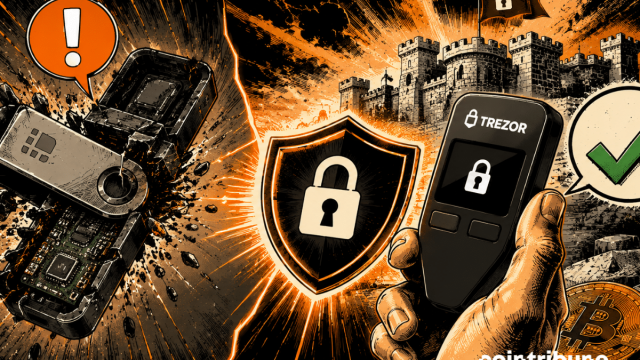
Ledger's Donjon team found a vulnerability in Trezor Safe 7's TROPIC01 chip, but private keys remain safe. Here's how layered security works and what this means for the hardware wallet sector.
Trezor confirmed a vulnerability in the TROPIC01 chip of its Safe 7 hardware wallet. Ledger’s Donjon security research team discovered the flaw during a controlled lab audit. Trezor states that no private keys or wallet backups can be compromised through this vulnerability.
The finding triggered a rare public collaboration between direct competitors. Donjon passed its results to Trezor, and Tropic Square – the chip designer – identified a related flaw that could expose additional data stored on the chip. The episode raises a practical question for anyone holding crypto: how much does a single chip flaw matter when the wallet has multiple security layers?
Donjon bypassed certain protections on the TROPIC01 secure element under laboratory conditions. The chip is one component in Trezor’s layered security architecture, which separates cryptographic operations from key storage. Tropic Square later found that the same chip could leak extra data under specific attack scenarios.
Trezor CEO Matej Žák acknowledged the discovery publicly:
I believe that the open process through which this vulnerability was discovered, examined, and disclosed is the model that the industry should follow.
To turn this vulnerability into a real attack, a hacker would need:
Physical possession of the target device. Expensive laboratory equipment to interface with the chip at a hardware level. Advanced technical skills in microelectronics and side-channel analysis.
Trezor categorised the exploitability as “very theoretical”. No real-world exploitation has been observed.
The Safe 7 architecture layers multiple independent security zones. Even if TROPIC01 is fully compromised, the wallet’s private keys and seed phrase remain protected by separate hardware and software barriers. Trezor uses a split-key model where the chip handles signing operations but never exposes the raw private key to an attacker who has only breached the secure element.
This is not unique to Trezor. Most hardware wallets use a defence-in-depth approach: a breach in one layer does not automatically propagate to the key storage layer. The practical implication for holders is that a single chip vulnerability, while serious in theory, does not trigger an immediate need to migrate funds.
Ledger and Trezor compete directly in the hardware wallet market. Security teams at rival companies rarely share proprietary findings. Donjon’s decision to disclose the flaw to Trezor – and Trezor’s prompt, transparent response – sets a precedent.
Transparency raises the bar. If other manufacturers adopt similar disclosure norms, users can expect faster patching cycles and better public auditing. The downside is that every disclosed vulnerability, even low-risk ones, may erode confidence among less technical buyers.
Layered security is the real product. The episode reinforces that the robustness of a hardware wallet depends less on any single chip and more on how well the overall system isolates sensitive data. For traders evaluating wallets, the security architecture matters more than the brand name.
Trezor will release a firmware update to address the TROPIC01 flaw. Users who do not apply the update remain exposed to the theoretical attack vector. Physical security of the device also becomes more important: an attacker who steals a Safe 7 and has lab resources could attempt chip-level attacks. Trezor recommends protecting the recovery phrase and keeping the device in a secure location.
No hardware wallet is invulnerable. The relevant metric is how quickly a manufacturer responds to discovered flaws and how deep their security layers go. Trezor’s response – fast, public, and collaborative – suggests a disciplined engineering culture.
For any hardware wallet, the seed phrase remains the single point of failure. A chip flaw that does not expose the seed phrase should not trigger a panic sale or a wallet swap. The decision to switch brands should depend on the wallet’s overall security track record, update history, and transparency, not on any one disclosure.
Bottom line for traders: the Trezor Safe 7 vulnerability is a controlled, theoretical finding that does not put funds at risk. It does, however, highlight why layered security architecture and cross-industry transparency matter. For deeper context on the discovery, see Ledger Finds Chip Flaw in Trezor Safe 7; No Funds at Risk.
Prepared with AlphaScala editorial tooling from the source reporting linked above. Indexable analysis may include a cited Alpha Score value. Publishing checks screen each story before release. Educational coverage, not personalized advice.