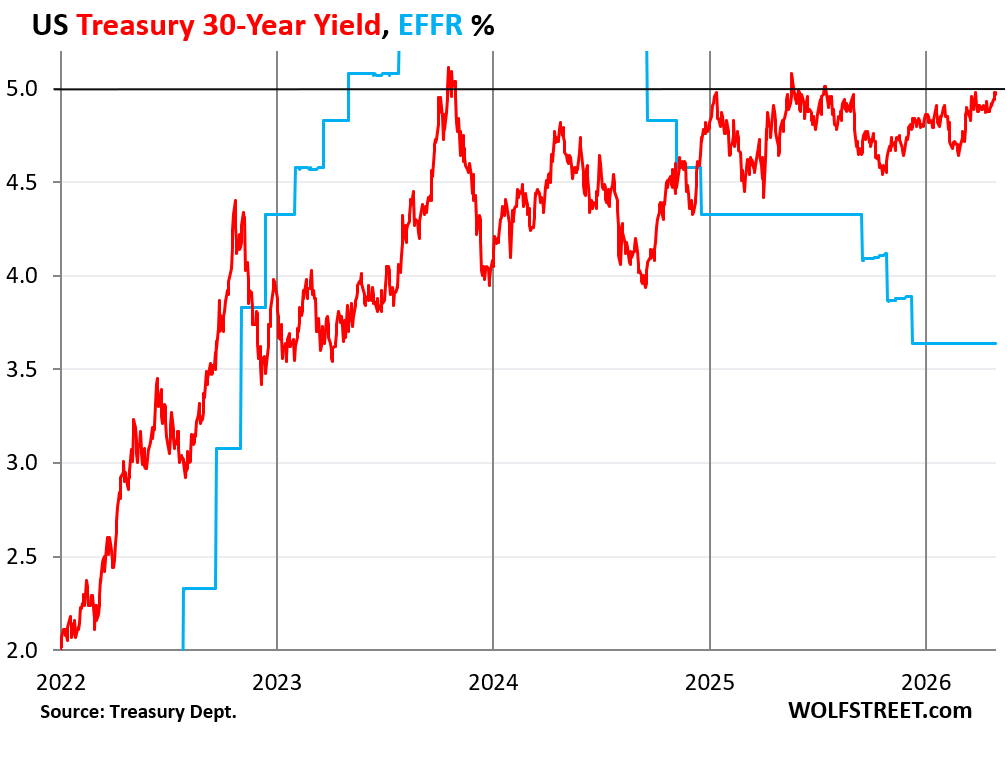
The U.S. Treasury Department successfully auctioned $723 billion in securities this week, a massive liquidity event that tested investor appetite amid a backdrop of persistent inflationary pressure. The sheer volume of supply, coupled with recent data showing an uptick in inflation, has forced a repricing across the yield curve. Investors are now demanding higher term premiums to absorb the influx of government debt, pushing the 30-year Treasury yield toward the critical 5% threshold.
Yield Curve Dynamics and Inflation
The market reaction suggests a growing skepticism regarding the Federal Reserve's ability to maintain a dovish stance. If inflation continues to accelerate, the prospect of a rate cut becomes increasingly difficult to justify without risking a further spike in long-term borrowing costs. The 30-year yield is currently testing technical resistance levels, and a breakout above 5% would signal a significant shift in market expectations for long-term interest rates. This movement is not occurring in a vacuum, as the transmission mechanism from Treasury auctions to broader financial conditions remains highly sensitive to supply-demand imbalances.
Impact on Financial and Telecom Sectors
Rising yields create a complex environment for capital-intensive sectors. For companies like MetLife Inc. (MET), higher yields can potentially improve investment income on their portfolios, though they also pressure the valuation of fixed-income assets. MetLife currently holds an Alpha Score of 61/100, reflecting a moderate outlook as the firm navigates this volatile interest rate environment. You can track their performance on the MET stock page.
Similarly, AT&T Inc. (T) faces the challenge of managing debt servicing costs in a higher-for-longer rate environment. With an Alpha Score of 60/100, the company remains in a moderate position as it balances capital expenditure requirements against the rising cost of debt. Further details on their positioning are available on the T stock page.
Market Linkages and Next Steps
This week's auction results serve as a barometer for fiscal sustainability and investor confidence. As the Treasury continues to manage a heavy issuance calendar, the focus shifts to the next set of CPI prints and the subsequent Federal Open Market Committee meeting. If the 30-year yield sustains a move above 5%, it will likely exert downward pressure on equity valuations, particularly in growth-oriented sectors that rely on low discount rates. Investors should monitor the spread between short-term T-bills and long-term bonds, as any further inversion or rapid steepening will provide the next signal regarding the health of the broader economy. For more on how these shifts impact specific sectors, visit our market analysis section.