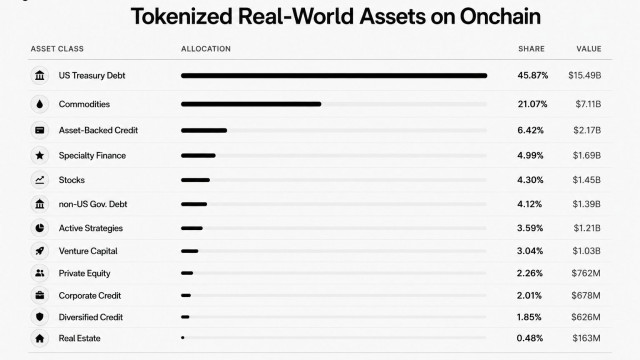
Tokenized real-world assets crossed **$33.78 billion in on-chain value during May 2026, a new all-time high. The milestone extends a rally that began near $21 billion earlier this year and now sits roughly 60% higher. The composition of that record reveals a market still heavily tilted toward the safest, most liquid instruments – a contrast that matters for anyone tracking the institutional narrative around blockchain finance.
The $33.78B Milestone and Its Composition
U.S. Treasury debt dominates the sector with $15.49 billion, or 45.87% of total tokenized RWA allocation. Commodities follow at $7.11 billion, while asset-backed credit sits just above $2.17 billion. The structure mirrors a cautious institutional approach: yield-generating, low-volatility assets first, riskier alternatives a distant second.
| Category | Value (USD) | Share of Total |
|---|
| U.S. Treasury Debt | $15.49B | 45.87% |
| Commodities | $7.11B | 21.06% |
| Asset-Backed Credit | $2.17B | 6.43% |
| Other | $9.01B | 26.64% |
Ondo Finance’s Surge
Ondo Finance (ONDO) stands out as the fastest-growing protocol. The project added more than $2 billion in tokenized market capitalization within a single month, pushing its eight-month growth rate above 236%. That pace suggests Ondo’s product suite – which wraps Treasuries and other institutional-grade collateral into blockchain-native tokens – is gaining traction among funds seeking settlement efficiency without sacrificing credit quality.
BlackRock and Franklin Templeton Lead the Treasury Wave
BlackRock’s BUIDL fund and Franklin Templeton’s BENJI have become the default picks for tokenized Treasury exposure. Combined, tokenized U.S. Treasuries have climbed toward $13 billion – with some estimates now placing them above $15 billion as of mid-May. These products operate on permissioned or semi-permissioned chains and rely on Chainlink (LINK) for oracle feeds and net asset value (NAV) calculations.
The Simple Read: Institutional Adoption Accelerates
The straightforward interpretation is that tokenized RWAs are working. Demand is real. Growth is exponential. The biggest names in asset management are committing capital. For traders looking at the crypto market as a whole, this trend supports the thesis that real-world utility – not just speculation – is drawing in fresh money. The $33.78 billion figure is a clear signal that institutions see blockchain infrastructure as more than a trading venue.
The Better Market Read: Concentration and Infrastructure Dependency
A deeper look reveals two risks that the headline number obscures.
Treasury Overweight Exposes Fragility
If regulations change or if yield dynamics shift (e.g., a Fed pivot that compresses Treasury spreads), the entire tokenized RWA stack could face rebalancing pressure. Nearly half the market sits in one asset class. That is not diversification – it is a levered bet on one type of risk. A selloff in Treasuries would cascade through protocols like Ondo and funds like BUIDL, potentially triggering redemption queues or oracle disruptions.
Infrastructure Concentration
Chainlink provides pricing feeds, NAV calculations, and cross-chain coordination for most major tokenized products. A technical failure at Chainlink’s oracle network – whether technical, governance, or security – would affect the entire ecosystem. The same is true for the compliance rails that token issuers use to verify accredited investors. The RWA sector is only as resilient as its middleware.
Exposure: Which Tokens and Protocols Benefit
- ONDO: Direct beneficiary of Treasury tokenization growth. The pace of new issuance suggests continued demand, the protocol’s market cap is now tightly correlated with RWA narrative flows.
- LINK: Infrastructure provider with growing fee revenue from enterprise oracle services. Its value proposition is less about RWA speculation and more about recurring gas stations for institutional rails.
- BUIDL, BENJI, and similar funds: Not tradeable tokens, their expansion signals sustained demand for blockchain-based settlement. Monitor inflows as a leading indicator for the broader RWA category.
What Would Confirm the Trend
- New tokenized products outside Treasuries – for example, corporate bonds, structured credit, or real estate – achieving material scale (over $1 billion each).
- Regulatory clarity from the SEC, CFTC, or NCUA that explicitly permits credit unions or pension funds to custody tokenized assets. The NCUA’s recent stablecoin rules provide a template.
- A second infrastructure provider matching Chainlink’s coverage, reducing single-point-of-failure risk.
What Would Weaken the Thesis
- A prolonged crypto market downturn that drives risk-off sentiment across both volatile and yield-bearing tokenized assets. The thesis depends on steady growth during weak market conditions – something still unproven.
- A technical outage or hack at a major oracle or tokenization platform. The DeFi lending hack losses have been small per dollar deposited, RWA platforms face higher stakes per transaction.
- Regulatory action targeting tokenized securities as unregistered offerings, forcing issuers to delist or restrict transfers.
The Forward Angle
The $33.78 billion number is a snapshot of institutional appetite, not a ceiling. The mix matters. If tokenized RWAs are to become a lasting pillar of crypto markets, the allocation must broaden beyond Treasuries, and the infrastructure layer must harden. For now, the simplest trade is to watch Ondo and Chainlink as proxies – ONDO for sentiment, LINK for structural demand. A breakdown in either would signal that the milestone was more milestone than transformation.
For broader context on how institutional flows are shaping crypto markets, see the crypto market analysis section.