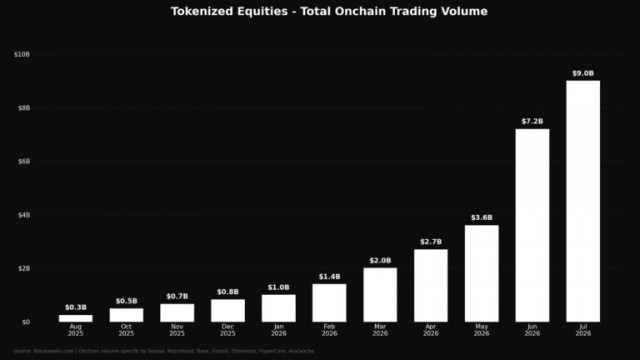
Tokenized equities have cleared $9 billion in onchain trading volume, according to Blockworks data. That number stood at $1 billion in January and $300 million a year ago. The category has grown roughly 800% year to date, making it the second-fastest-growing segment of real-world assets behind venture capital, which expanded about 270% in the same period, per RWA.xyz.
For most of the year the volume trend looked steady. April reached $2.7 billion. May hit $3.6 billion. June doubled to $7.2 billion. July added another 25%. Monthly gains of that size cannot come from existing users trading more. They come from new platforms bringing in millions of new users.
The spike lines up with two launches. Robinhood Chain went live in June. Binance introduced bStocks around the same time. Both products put tokenized equities inside brokerage and exchange front ends where users already had accounts. That collapsed the onboarding step.
Until last year, buying a tokenized Apple share meant finding the right liquidity pool on a crypto-native DEX, trusting an obscure issuer, and accepting wide spreads. Monthly volume stayed under $1 billion. The friction capped the category.
What changed is where the products sit. Tokenized stock moved into front ends with existing account relationships. The demand underneath is an access arbitrage. Nobody buys a tokenized Apple share because they cannot buy Apple. They buy the wrapper: 24/7 trading, fractional size, stablecoin settlement, and availability to users outside the US who cannot easily open a domestic brokerage account. That last group is the real volume driver, and it does not show up in US equity market data at all.
Regulation stopped being a blocker somewhere in that window. The GENIUS Act gave stablecoin settlement actual legal footing. A friendlier posture toward tokenized securities meant issuers stopped waiting for permission that was never going to arrive as a formal blessing.
Which brings up the awkward part of the growth story. Nasdaq plans to extend trading to 23 hours a day, five days a week, putting the largest regulated venue directly on top of the always-on argument tokenized equities have been built around.
If a regulated exchange offers near round-the-clock access with full settlement finality and no counterparty questions, the crypto-native advantage gets narrower. What survives is weekends, global access without a US brokerage relationship, fractionalization at very small sizes, and composability with DeFi protocols. That is a real list. It is a shorter list than it was.
Nasdaq compresses the moat rather than closing it. The question the next few prints answer is whether $9 billion was the start of a curve or the top of a venue-launch bump. August data is the first month where new-listing effects should have washed out.
For context, tokenized equities have already drawn attention from major brokers. Bybit added Meta and Tesla xStocks earlier this year as the category crossed $1.48 billion. Meanwhile, Mastercard tested single-audit stablecoin compliance with Borderless.xyz, a move that could strengthen the settlement rails underpinning these products.