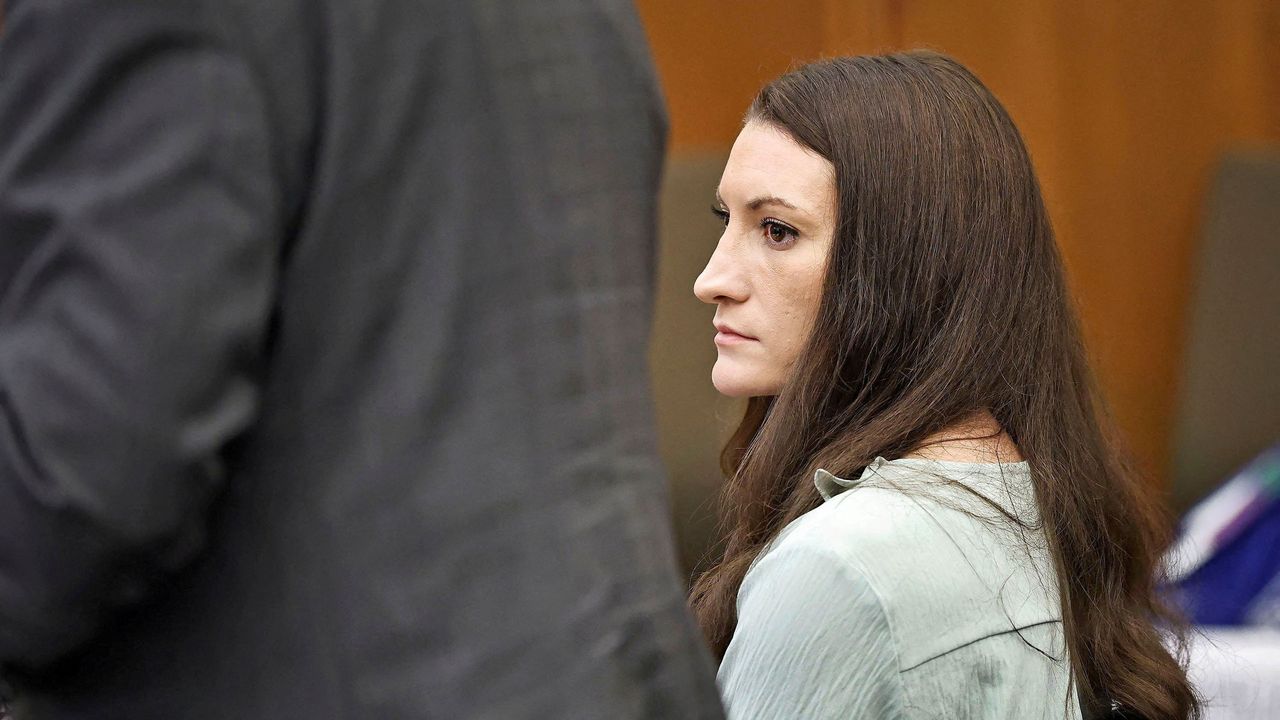
The trial of Lindsay Clancy has reached its fourth week. Clancy is accused of murdering her three young children, in 2023, while in the midst of a postpartum mental-health crisis. She is pleading not guilty by reason of insanity, but the prosecution is arguing that she operated "coldly and calculatingly" when she fatally strangled her children. In 2024, I interviewed Clancy's now ex-husband, Pat, for a piece about the case, and he told me, "I wasn't married to a monster–I was married to someone who got sick."
Pat agreed to speak with me then because he wanted to quash "lies and misinformation" about the tragedy that he saw circling online. Unfortunately, since the trial began, the misinformation has only multiplied. Social-media commentators have propagated conspiracy theories about the case, including a theory that Pat himself committed the killings. There is no evidence to support this idea. Both the prosecution and the defense agree that Lindsay killed her children. But the rampant proliferation of such theories speaks to the difficulty of making moral sense of a case like this one.
Part of what makes the tragedy so confounding is that, by all accounts, Clancy had been a devoted mom. She worked as a labor-and-delivery nurse, taking care of newborns, and several of her friends told me that she was "born to be a mother." Pat told me that after the killings, Lindsay described every day as the worst day of her life. "She misses her kids," he said. "Which I know sounds crazy to some people. But that's the reality."
Pat is a mild-mannered person, but he sounded openly angry when he talked about the online frenzy surrounding his family's story. He was aware that some observers would be eager to misconstrue whatever he said publicly about the case. I watched him deliver a speech at a memorial marking the one-year anniversary of his children's deaths. He told me afterward that he'd considered urging attendees to pray for Lindsay but decided against it, because he imagined people reading about the event in the news and thinking, "All he cares about is the wife." He moved to New York after the tragedy and tried to rebuild a life, but he was self-conscious about doing the things that normal people do. He said, "I have this worry that people will see me socializing and be, like, 'Shouldn't he be sad, because his whole family was just killed?'" What I saw in my time with Pat was a man who, after suffering an unimaginable loss and weathering enormous public scrutiny, is searching for some way to move forward and find peace.
The question in the case is not who killed the Clancys' children–this is not a true-crime whodunnit, as much as pundits on the internet might want it to be. The question is whether Clancy lacks criminal responsibility owing to her mental illness at the time of the killings. The defense is arguing that she was overmedicated and experiencing auditory hallucinations in which a male voice told her to kill the kids. Pat, who was the first witness to testify in the trial, told me that he sees the case as "crystal clear." But health-care providers have testified that Clancy didn't show obvious signs of psychosis.
The prosecution rested its case on Monday. Now it is the defense's turn to try to show the severity of Clancy's condition. Whatever the verdict, the trial is unlikely to resolve the discomfiting questions that this trial raises. The jury heard this week from a former co-worker of Clancy's who recalled talking to her about the case of Andrea Yates, a Texas woman who drowned her five children in a bathtub, in 2001, and was ultimately found not guilty by reason of insanity. The co-worker said that Clancy cried when she heard about the case: "She said, 'How could a mother hurt her children?'"
Khalil, a legal permanent resident, was one of the most visible pro-Palestine student activists at Columbia. In 2025, after Donald Trump returned to office, Khalil was arrested and sent to an ICE detention center in rural Louisiana, where he was held for more than a hundred days. Now the Administration is trying to kick him out of the country. Andrew Marantz reports.
P.S. In Patagonia, los puesteros look after other people's livestock for not very much money, and sometimes go months without seeing anyone else. See photographs of the lonely men at the end of the world.