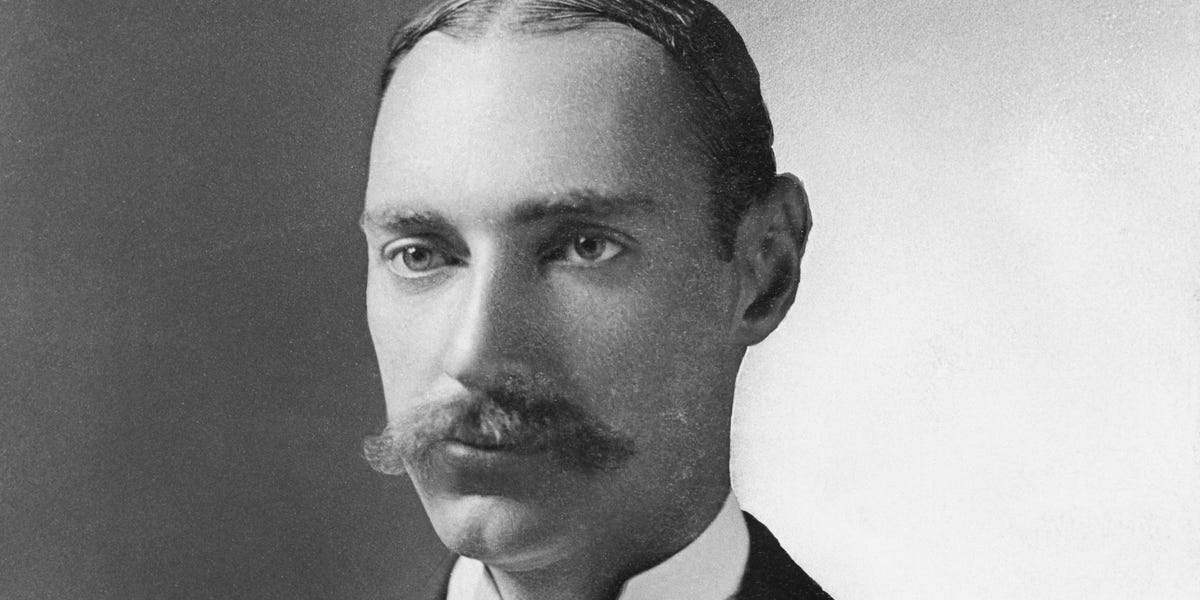
The Gilded Age’s Last Voyage: Revisiting the Financial Legacy of John Jacob Astor IV

We examine the financial legacy of John Jacob Astor IV, the wealthiest passenger on the RMS Titanic, whose 1912 death marked a turning point for one of America's most prominent Gilded Age fortunes.
A Titan of Industry Lost at Sea
When the RMS Titanic slipped beneath the freezing waters of the North Atlantic in the early hours of April 15, 1912, the world lost more than just a marvel of engineering. It lost one of the most significant financiers of the Gilded Age: John Jacob Astor IV. As the wealthiest passenger aboard the ill-fated vessel, Astor’s death marked the end of an era for the American aristocracy, sending shockwaves through the financial markets of the early 20th century.
Astor was not merely a passenger; he was a titan of real estate, a visionary inventor, and a scion of a family whose name was synonymous with American wealth. His presence on the Titanic was intended to be a return to luxury after a period of scandal-ridden travel, but it became a pivotal moment in maritime history that would forever alter the landscape of the Astor fortune.
The Architecture of a Fortune
To understand the magnitude of Astor’s loss, one must look at the foundation of his empire. The Astor family wealth was rooted in the fur trade, but under John Jacob Astor IV, the family pivoted aggressively into high-end real estate. He was the mastermind behind the construction of the Waldorf-Astoria Hotel, a landmark that defined the social and economic status of New York City’s elite.
At the time of his death, Astor’s personal net worth was estimated at roughly $87 million—an astronomical figure in 1912. Adjusted for inflation and the relative scale of the U.S. economy a century ago, his estate would be valued in the billions today. His death created an immediate power vacuum in the management of these vast assets, forcing his heirs to navigate complex legal and financial waters during a period of transition for the global economy.
A Personal Tragedy with Public Consequences
While the financial community mourned the loss of a prominent investor, the human element of the tragedy was equally profound. Astor was accompanied by his second wife, Madeleine Force, who was just 18 years old at the time and significantly younger than the then 47-year-old tycoon. Their marriage had been the subject of intense media scrutiny and social ostracization, which had prompted their extended travels through Europe and Egypt.
On the night of the disaster, Astor demonstrated a stoic adherence to the 'women and children first' protocol. He famously saw his pregnant wife safely aboard Lifeboat 4 before stepping back into the shadows of the deck. Madeleine survived the sinking, eventually giving birth to their son, John Jacob Astor VI, in August 1912. The survival of his heir ensured the continuation of the family line, but the loss of the patriarch fundamentally changed the strategic direction of the Astor family’s investments in the decade that followed.
Market Implications and Historical Context
For modern investors, the story of John Jacob Astor IV serves as a stark reminder of the volatility inherent in even the most established fortunes. In the early 1900s, wealth was heavily concentrated in land and physical infrastructure. The sudden loss of an individual who held singular control over such vast assets could trigger significant reallocation of capital.
While there was no direct 'stock market crash' triggered specifically by the sinking of the Titanic, the event served as a sobering check on the hubris of the Gilded Age. The loss of Astor, alongside other wealthy figures like Benjamin Guggenheim and Isidor Straus, signaled a shift in the social consciousness that would eventually influence the regulatory environment for large corporations and the wealthy in the years leading up to the First World War.
Looking Back to Move Forward
John Jacob Astor IV’s legacy remains a case study in the risks of centralization. His life and death illustrate how personal narratives can intersect with, and sometimes disrupt, the broader flow of capital. As we analyze the titans of today’s tech-driven markets, the story of the Titanic’s wealthiest passenger reminds us that even the most formidable financial empires are subject to the unpredictable currents of history.