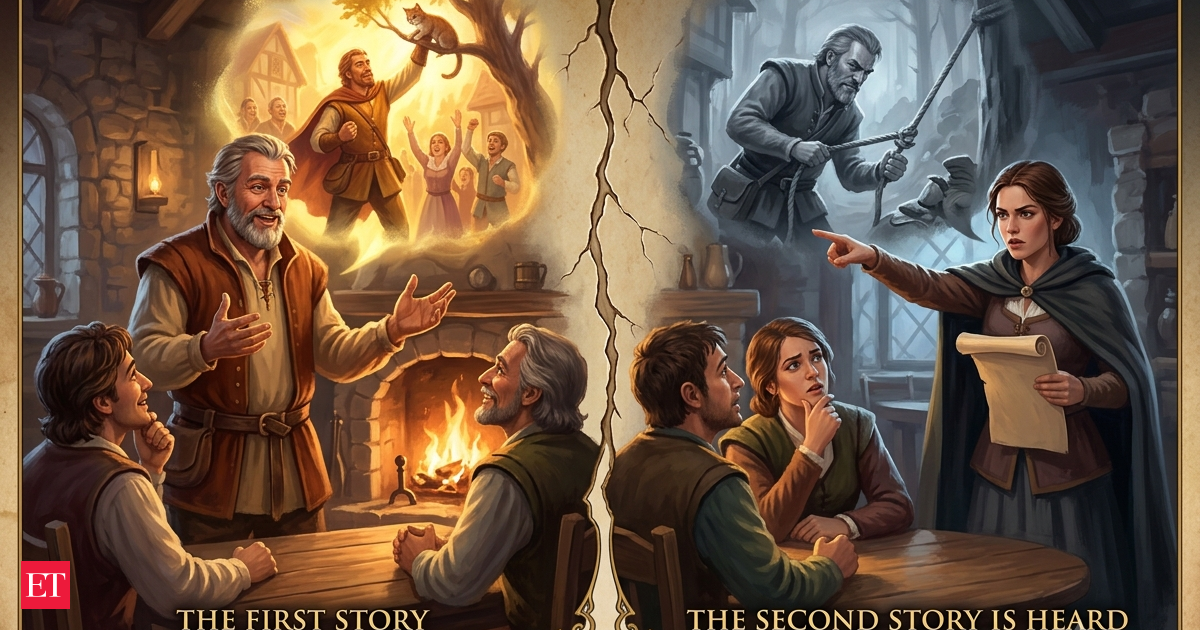
A French proverb says every story is good until another is told. For traders, that is a warning against acting on the first headline. The market rewards patience, not the impulse to interpret a move before the context is clear.
A stock drops 5% on a news alert. The first story writes itself: an earnings miss, a regulatory headwind, sector rotation. That version feels complete. It confirms biases. The trader who acts on it enters a position sized to that narrative.
Then the second story lands. The drop was a fat-finger trade. Or the company just filed a patent that resets the revenue outlook. The first explanation was plausible. The second one changed the trade. The trader who waited got a fill at the bottom. The one who chased the first story bought into a reversal.
The proverb is older than most financial instruments. It surfaces in French conversation as a check on certainty. “Tout histoire est bonne jusqu’à ce qu’on en raconte une autre” – the phrasing varies. The point holds: don’t anchor to the first explanation. Leave room for the revision.
In markets, the temptation to lock in a narrative is strong. A 2% move in a liquid stock generates instant commentary. News feeds, chat rooms, and algorithmic signals all reinforce the first story. The trader who waits for a second data point is fighting the machine. That delay often separates a good entry from a bad one.
The second story is not always the final one. Sometimes it is a third report that clarifies the picture. The principle is the same. The first version of events is rarely the last version. The edge lives in the gap between the first explanation and the full facts.
Marlon Brando once said, “If we are not our brother’s keeper, at least let us not be his executioner.” In trading, the equivalent is: if you cannot wait for the full story, at least do not act on half of it. The cost of being early is often higher than the cost of being late.
The lesson applies beyond a single stock. A sector moves on a macro headline. The first story blames a rate decision. The second story reveals a positioning squeeze. The trader who waited for the squeeze to confirm entered after the risk of a false move had passed.
Every story is good until another is told. That simple line captures the discipline of withholding judgment. It does not mean never acting. It means acting on the second story, not the first. The difference is the edge.