Back to Markets
Crypto▼ Bearish

The Fatigue Factor: Why Retail Investors Are Buckling Under Crypto’s Latest Volatility Cycle

April 12, 2026 at 07:01 AMBy AlphaScalaSource: Aped
The Fatigue Factor: Why Retail Investors Are Buckling Under Crypto’s Latest Volatility Cycle
BTCETH

A relentless 24/7 trading cycle and macro-economic headwinds are pushing retail crypto investors to the brink, leading to widespread fatigue and reactive panic selling.

The 24/7 Grind: A Test of Endurance

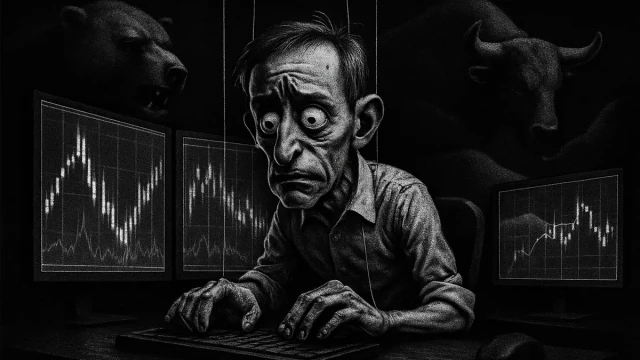
For the retail cohort, the cryptocurrency market has long been sold as a frontier of opportunity, but recent price action is proving that the relentless, 24/7 nature of digital asset trading is taking a significant toll. As sharp, rapid-fire price swings become the market standard, a growing number of individual investors are reporting signs of acute market fatigue, leading to a cycle of panic selling that often defies long-term fundamental analysis.

Unlike traditional equities, which benefit from the cooling-off periods provided by closing bells and weekend market halts, the crypto landscape provides no such reprieve. This constant exposure to volatility, compounded by an increasingly complex macro-economic environment, has created a pressure cooker for those without institutional-grade risk management protocols.

Macro Drivers and the Psychological Toll

The current volatility is not occurring in a vacuum. It is deeply tethered to broader macro-economic shifts, where every shift in central bank rhetoric or inflation data sends ripples through the digital asset ecosystem. This correlation between crypto and legacy risk assets has effectively stripped away the 'decentralized hedge' narrative that many retail participants once relied upon.

When assets decouple from their internal utility and instead track the sentiment of global liquidity, the cognitive load on the individual investor increases exponentially. Traders are no longer just monitoring blockchain metrics or protocol upgrades; they are forced to track interest rate projections, geopolitical tensions, and currency fluctuations. This shift has accelerated a transition from 'investing' to 'reactive trading,' where the fear of missing out (FOMO) is rapidly being replaced by the fear of staying in.

The Anatomy of Panic Selling

Market data increasingly shows that retail investors are prone to capitulating during these high-volatility windows. When prices swing violently, the instinctual response for the under-capitalized participant is to exit positions to preserve remaining liquidity. This 'panic selling' creates a feedback loop: as retail investors offload assets in a rush, they provide the exit liquidity for larger players, effectively cementing their losses and fueling further downward momentum.

This behavior highlights a critical discrepancy in the market: the difference between those who trade with a multi-year horizon and those trapped in the short-term noise. For the latter, the stress of constant monitoring often leads to decision fatigue, where the quality of trade execution degrades as the duration of the market turbulence extends.

Implications for the Modern Trader

For those navigating this environment, the takeaway is clear: volatility is not just a price metric—it is a cost of doing business. Professional traders account for this through position sizing and strict stop-loss discipline. Retail investors, however, often find themselves over-leveraged and under-prepared for the sheer velocity of modern crypto corrections.

Traders must distinguish between asset volatility and portfolio volatility. While the market may be inherently unstable, a well-structured portfolio can withstand the noise. The current market cycle serves as a stark reminder that in an environment defined by macro-driven shifts, risk management is the only meaningful moat against total capital erosion.

What to Watch Next

Moving forward, market participants should keep a sharp eye on liquidation data and exchange inflow/outflow metrics. These indicators often reveal when the retail 'fatigue' has reached a breaking point, potentially signaling a local bottom. As the market continues to mature, the divergence between institutional accumulation and retail exhaustion will likely become the primary narrative driving price action in the coming quarters. Investors should prioritize liquidity and focus on the macro-economic catalysts that are likely to dictate the next leg of volatility, rather than reacting to the intraday noise that characterizes the current landscape.