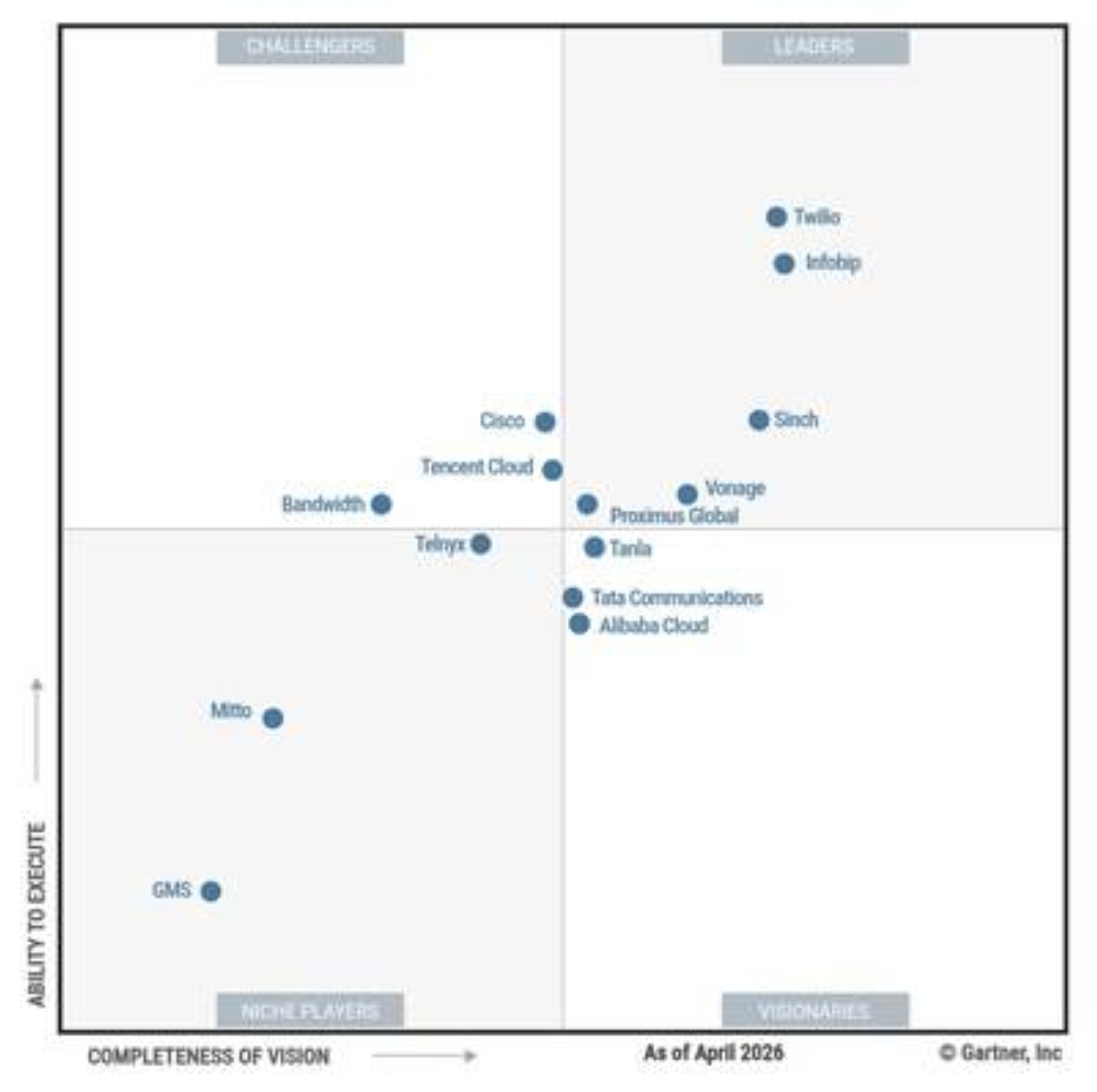
Tencent Cloud has been named a Challenger in the Gartner Magic Quadrant for Communications Platform as a Service (CPaaS) for the fourth consecutive year, the company announced on June 1. The 2026 report, published May 18, positions Tencent Cloud highest in Asia Pacific for Ability to Execute. The recognition comes as Tencent Cloud pushes its AI-powered communications suite deeper into enterprise workflows and expands beyond its core Asia base into the Middle East and North America.
Tencent Cloud's CPaaS portfolio now spans Tencent Real-Time Communication (TRTC), Instant Messaging (IM), Tencent Cloud Contact Center (TCCC), and IoT communications. The company has layered AI across these products: an AI virtual avatar engine called LiveClaw built on TRTC, IM via the Timbot plugin, Text to Speech, ASR, and the OpenClaw AI engine. LiveClaw can switch between roles–AI shopping assistant, customer service agent, teacher, or virtual companion–covering livestreaming and conversational commerce scenarios.
How the Challenger Classification Reads for TCEHY
The Challenger quadrant signal matters for TCEHY because it confirms execution credibility without the full ecosystem breadth of a Leader. Gartner defines Challengers as vendors that execute well but may lack completeness of vision. The Asia Pacific highest ranking for Ability to Execute is the differentiating data point: Tencent Cloud has built more deployment density, lower latency, or stronger local compliance than competitors in that geography.
The naive read versus the practical market read
A simplistic interpretation treats the fourth consecutive Challenger slot as a medal count. The better read compares the position against the Leaders quadrant. Tencent Cloud has not crossed into Leader territory despite four years of advances. The gap may be in global SaaS partner ecosystems, enterprise vertical specialization outside China, or communications API standardization. Investors should assess whether the 2026 map reflects a widening or narrowing gap between Tencent Cloud and the Leaders, which include AWS, Azure, and Google Cloud.
Where the AI layer changes the unit economics
LiveClaw and the broader AI integration represent more than a feature list expansion. CPaaS vendors typically charge per API call or per minute of real-time communication. AI agents that automate customer interactions could compress usage volumes if they replace human-initiated calls. Tencent Cloud's bet is that AI increases session complexity and value per call instead of eliminating calls. The LiveClaw skills ability–where a single avatar handles shopping support, education, or companionship–is designed to keep session lengths high and attach higher pricing tiers for AI-augmented interactions.
The companion Gartner report, Critical Capabilities for Communications Platform as a Service (published May 20), gave Tencent Cloud competitive scores for Conversational Customer Experience and Video use cases. These are the high-growth verticals where AI agents and livestream commerce overlap. If those use cases account for an increasing share of CPaaS spending, Tencent Cloud's positioning could improve relative to generalist cloud vendors.
Global Infrastructure as the Second Scaling Engine
Tencent Cloud is extending beyond its core Asia Pacific base into the Middle East and North America. The company now covers over 70 countries with more than 3,200 acceleration nodes. Its Top Speed Codec and enterprise-grade IM are being deployed for overseas customers in finance, telecom, healthcare, social media, and gaming.
The Amaze Super App case study
Charoen Pokphand Group's Amaze Super App in Thailand uses Tencent Cloud Media Services for end-to-end livestreaming. The setup integrates AI image enhancement, intelligent subtitles, and AIGC effects. The business implication: Tencent Cloud is not simply selling raw bandwidth or compute. It is exporting a full livestream e-commerce stack modeled on Chinese domestic experience. For TCEHY, that raises the potential for higher revenue per customer relative to a simple IaaS contract.
The Middle East and North America risk factor
Global expansion into North America pits Tencent Cloud against AWS, Azure, and Google Cloud – all of which hold Leader positions in the Gartner CPaaS Magic Quadrant. Microsoft and Amazon have decades of enterprise sales relationships, certified partner networks, and compliance frameworks. Tencent Cloud's advantage is lower latency within Asia and pricing that undercuts the hyperscalers in certain volume tiers. The risk is that US-based regulatory scrutiny on Chinese technology vendors could slow adoption among US financial or telecom clients. Any major latency or reliability incident on the global network would damage the brand before it builds enterprise trust in the West.
Confirmation and Invalidation Signals for Tencent Cloud CPaaS
Investors tracking TCEHY need real deployment data rather than press releases. The Gartner report is a directional signal. It is not a transaction record.
What confirms the expansion thesis
- Named enterprise wins in North America or Middle East with contract values above $5 million annually
- A shift from Challenger to Leader in the 2027 Magic Quadrant, which would indicate Gartner's assessment of vision completeness has improved
- Quarterly cloud revenue acceleration in Tencent's earnings reports, specifically the international segment
What weakens the case
- Any major latency or reliability incident on the global network that damages the Tencent Cloud brand
- US or EU policy change that restricts Chinese cloud providers from serving government or regulated financial workloads
- A lack of movement in the Gartner quadrant for another two to three years, suggesting stagnation
The Alpha Score for TCEHY sits at 44 out of 100 with a Mixed label in the Communication Services sector. The score reflects a stock with execution positives–such as this Gartner streak–offset by valuation or market structure headwinds. The Gartner designation alone does not change that equation. It reduces one source of uncertainty: Tencent Cloud's CPaaS product quality is externally validated rather than self-reported.
What Comes Next for TCEHY and Tencent Cloud CPaaS
The next concrete marker is the Q3 2026 earnings release. The international cloud revenue line should show year-over-year acceleration if the global expansion is real. Any customer announcement from a US-based fintech or a Middle Eastern telecom operator between now and then would be a confirmatory catalyst.
The Gartner recognition keeps Tencent Cloud in the consideration set for enterprise buyers. It does not, by itself, drive stock price. The gap between Challenger and Leader is what matters. Closing that gap requires either acquisition of a global CPaaS platform, deeper partnership with a Western SaaS provider, or a new product category that Gartner classifies as visionary.
Tencent Cloud's AI avatar push and livestream export strategy are the most concrete paths to that upgrade. The fourth consecutive Challenger slot says Tencent Cloud executes well in a region it dominates. The question is whether that execution advantage translates into market share in regions where the hyperscalers already have enterprise trust and distribution.
For more on TCEHY, visit the stock page. For broader market coverage, see stock market analysis.