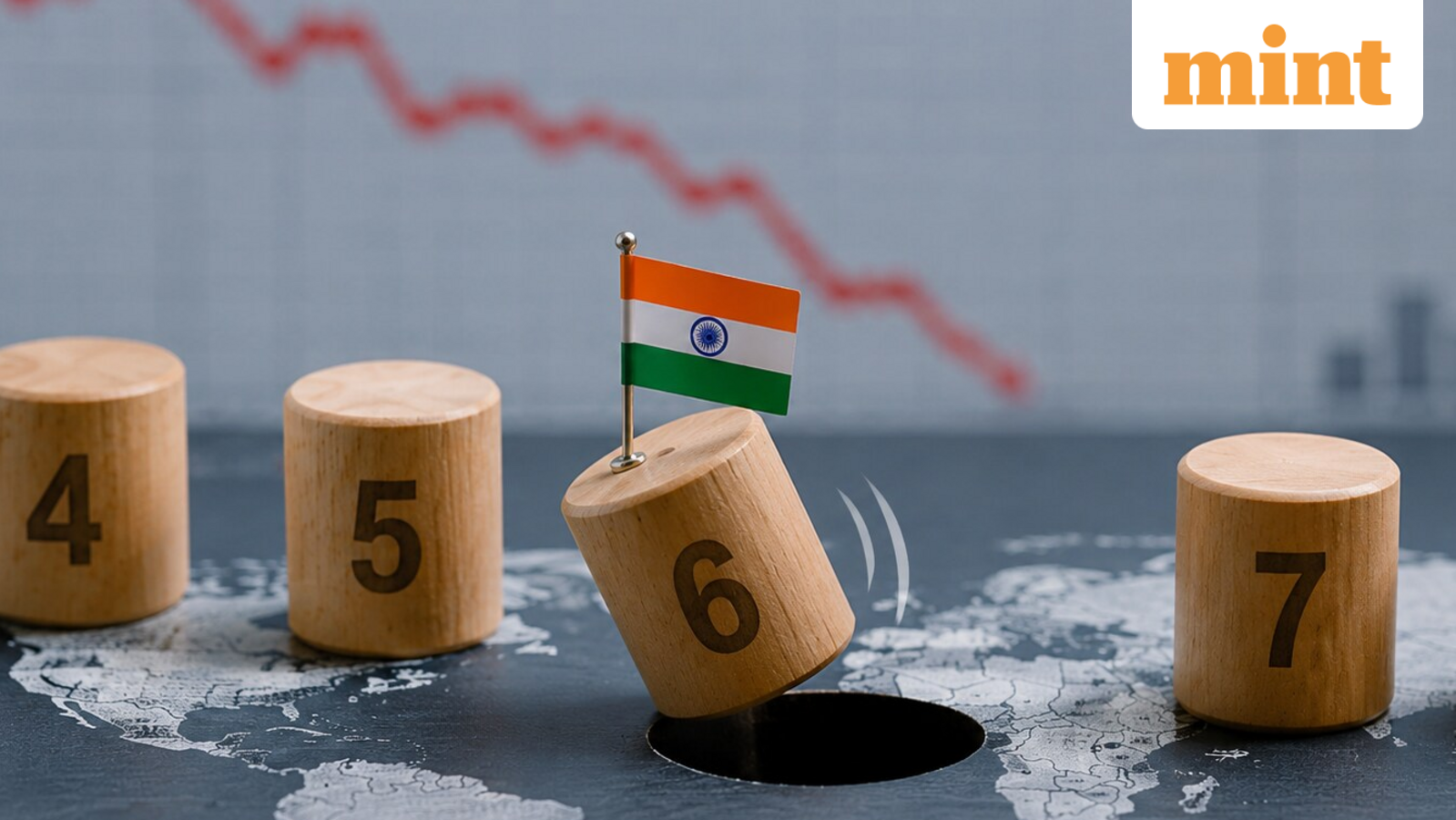
India slipped to sixth place in global market capitalization rankings, overtaken by Taiwan. As of May 26, Taiwan's market cap stood at $4.95 trillion, marginally ahead of India's $4.92 trillion, according to Bloomberg data. The headline shift has triggered concern among retail investors. The structural differences between the two markets matter more than the ranking itself.
Taiwan's outperformance is dramatic on a returns basis. Over the past year, ₹1 lakh invested in the Nifty 50 would have fallen to ₹94,820, while the same amount in Taiwan's TAIEX would have grown to roughly ₹2,04,410. Over five years, the Nifty 50 turned ₹1 lakh into ₹1.53 lakh. Taiwan's market turned it into ₹2.59 lakh.
The mechanism behind those returns carries a risk profile that many investors underestimate. This article breaks down the concentration, the sectoral exposure, and the practical question: which market is better positioned to handle a downturn?
The Concentration Problem: TSMC vs. HDFC Bank
One Stock, 42% of the Index
Taiwan Semiconductor Manufacturing Co. (TSMC) alone accounts for roughly 42% of the TAIEX benchmark. Vaibhav Porwal, Co-founder of Dezerv, described the situation bluntly: "Indices once designed as diversified gateways to developing-world consumption and GDP growth have, over time, drifted into concentrated thematic vehicles. The MSCI EM Index now reads largely as a technology proxy, and within it, Taiwan functions as a near-pure AI play."
Practical rule: If you invest ₹1 lakh in the TAIEX, roughly ₹42,000 goes into a single company. The index's fate is tied to one earnings report, one geopolitical headline about chip export controls, or one demand cycle shift in AI data centers.
India's Broader Distribution
In the Nifty 50, the largest single-stock weight is HDFC Bank at about 10.73%. That means ₹1 lakh invested allocates ₹10,730 to one name, not ₹42,000. Porwal noted that "India is not without concentration of its own. Financial services carry 35.27% of the Nifty 50, a meaningful sectoral tilt. This concentration is of a different order from Taiwan's single-stock dependence."
The remaining 65% of the Nifty 50 is spread across consumption, IT services, energy, capital goods, healthcare, autos, materials, telecom, and utilities. Reliance and HDFC Bank sit in the 7-11% range individually, not the 40%+ range.
The Sectoral Read-Through: AI Proxy vs. Domestic Economy
Taiwan's Single-Narrative Risk
Taiwan's market is effectively a leveraged bet on the global semiconductor capex cycle. Porwal explained that "global capital flow has been heavily driven by massive demand for AI infrastructure and semiconductor supply chains. These flows depend on global technology liquidity conditions and the specific demand for data center expansion."
This creates a fragile setup. If AI spending slows, if export restrictions tighten, or if the global tech cycle turns, Taiwan's benchmark takes a direct hit. No second engine exists to cushion the fall.
India's Multi-Engine Structure
India's advantage, according to Porwal, "lies in its connection to real economic growth rather than a single technological narrative. The current cycle is structurally different: supported by domestic inflows that buffer foreign capital flight, by manufacturing diversification, and by the continued expansion of digital infrastructure."
SEBI Chairman Tuhin Kanta Pandey made a similar point: "India is a very, very diversified market. In Taiwan, there are concentrated stocks, there are very few."
What this means: India's market has a mid- and small-cap universe of hundreds of companies between ₹3,000 crore and ₹30,000 crore in market capitalization, with institutional coverage and meaningful float. Taiwan's equivalent ecosystem exists. Yet it is "permanently in the shadow of the semiconductor complex, where capital, talent, and analytical attention concentrate," Porwal said.
The Capital Flow Mechanism: Why India Lost Ground
Foreign Capital Reallocation
The ranking flip was not random. Porwal attributed the shift to a specific capital flow pattern: "The reallocation of capital away from India was not a slow, natural transition. This capital flight is also heavily catalyzed by geopolitical risks, trade/tariff uncertainties, and a domestic earnings slowdown that made India's high starting valuations unsustainable for foreign capital."
Taiwan benefited from the AI narrative. India suffered from a combination of expensive valuations and an earnings deceleration. Foreign institutional investors rotated out of Indian equities and into tech-heavy emerging markets.
Domestic Inflows as a Buffer
India's structural edge is the depth of domestic institutional flows. Systematic Investment Plans (SIPs) and domestic mutual fund inflows provide a steady bid that foreign capital flight cannot fully reverse. Taiwan does not have a comparable domestic cushion. When global tech liquidity tightens, Taiwan's market has fewer natural buyers.
Risk Event Watch: What Would Confirm or Weaken the Thesis
What Would Make Taiwan's Risk Worse
- A semiconductor export control escalation targeting TSMC's ability to supply advanced chips to specific customers.
- A sharp slowdown in AI capex from major hyperscalers (Microsoft, Amazon, Google, Meta).
- A Taiwan Strait geopolitical event that triggers a risk-off repricing of the entire market.
- A Taiwan dollar depreciation that compounds foreign investor losses.
What Would Reduce Taiwan's Risk
- Diversification of the TAIEX through new listings outside the semiconductor complex.
- A sustained AI demand cycle that validates the current valuation premium.
- Policy measures to broaden the index composition.
What Would Make India's Risk Worse
- A prolonged earnings recession that breaks the domestic inflow narrative.
- A sharp rupee depreciation that accelerates foreign capital outflows.
- A regulatory shock to the financial services sector, which carries 35% of the Nifty 50.
What Would Reduce India's Risk
- Earnings recovery in the consumer and industrial sectors.
- Stable domestic inflows from SIPs and insurance funds.
- Policy continuity on manufacturing and digital infrastructure.
The AlphaScala View: Structure Over Headlines
| Metric | Taiwan (TAIEX) | India (Nifty 50) |
|---|
| Top single-stock weight | 42% (TSMC) | 10.73% (HDFC Bank) |
| 1-year return on ₹1 lakh | ₹2,04,410 | ₹94,820 |
| 5-year return on ₹1 lakh | ₹2,59,000 | ₹1,53,000 |
| Dominant sector weight | Semiconductors | Financial services (35%) |
| Domestic inflow buffer | Minimal | Strong (SIPs, mutual funds) |
Porwal's closing observation captures the practical takeaway: "For investors seeking to compound through multiple cycles without depending on any one industry to keep working, India offers the more forgiving structure. Concentrated thematic plays, by design, are fragile."
Key insight: The ranking flip is a snapshot of capital flows, not a verdict on market quality. Taiwan's returns have been superior. Those returns come with single-stock dependency and single-narrative risk. India's returns have lagged. The structure is more resilient to sector-specific shocks.
For a trader building a watchlist, the question is not which market is better in isolation. The question is which market fits the current risk appetite. If the bet is on continued AI infrastructure expansion, Taiwan offers direct exposure. If the bet is on diversified economic growth with lower tail risk, India's structure is the more forgiving container.
Bottom line for traders: Taiwan's outperformance is real. It is a leveraged bet on one company and one theme. India's underperformance is a valuation and earnings story, not a structural breakdown. The ranking will flip again when the next cycle turns.
Disclaimer: This is purely for educational and informational purposes and should not be taken as investment advice. Always consult a SEBI-registered advisor before making any investment decisions.