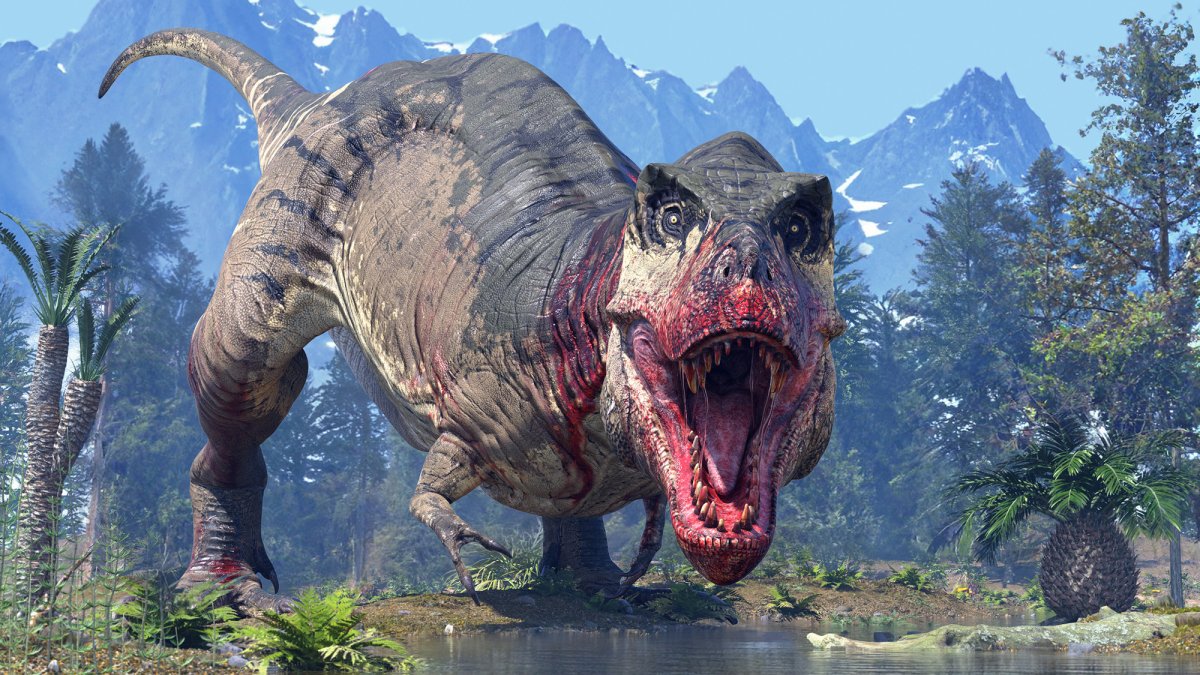
The Field Museum in Chicago spent real money to answer a question most people never thought to ask: what did a Tyrannosaurus rex's breath smell like?
The answer, for anyone who has ever left raw chicken in the trash too long, is not surprising. The museum's 2018 exhibit around Sue, one of the most complete T. rex fossils ever found, included four scents. Three were plant odors from the Cretaceous forest. The fourth was Sue's breath. Exhibition developer Ben Miller told Popular Science the team used a synthetic rotting corpse smell, the kind produced to train disaster response dogs. They toned it down slightly before releasing it on visitors.
"T. rex has fairly widely spaced teeth," Miller said. "It would be eating mostly by swallowing things whole, and the result of that would probably be that it got a lot of bits of meat stuck in its mouth for long periods of time."
The logic is straightforward. A mouth full of rotting meat fragments, left to fester for days or weeks, produces a specific odor. The museum replicated it.
The Children's Museum of Indianapolis took a different approach with its Dinosphere exhibit. A kiosk there asks visitors to pick between three scented containers and decide which one represents something a T. rex would eat. Two were plants – magnolia and pine – which a carnivore would ignore. The third was dung from a duckbill dinosaur, Hadrosaurus. Exhibit developer Melissa Pederson said the museum's scent fabricator recommended mimicking the droppings of a large, living vegetarian. They ended up with elephant dung scent.
Pederson described the jar's odor as "kind of a sweet scent."
Both museums are using smell to solve a problem that natural history exhibits have always faced. A fossilized skeleton is a static object. Visitors see the bones, read the plaque, and move on. Scent adds a layer that the eyes cannot reach. It forces a reaction, often involuntary.
"It's always the goal, in at least some capacity, to evoke emotion in our spaces," Pederson said.
The Field Museum's forest scents – ginger root, tulip poplar, and cypress – are more pleasant and more familiar than the breath. Miller said that by 66 million years ago, flowering plants had largely taken over, so the smell of a Cretaceous forest is not as alien as people assume. The same plant families still exist.
The breath scent is the one that sticks with visitors. Miller said the exhibit has been a hit with kids, who apparently enjoy being disgusted.
Sue herself likely could not smell her own breath. The dinosaur would have had an excellent sense of smell for tracking prey across the ancient landscape. The irony is that the predator with the finely tuned nose probably had the worst breath in the ecosystem.
Pederson said the scent experiments at her museum consistently draw a reaction from families. "In a lot of our spaces, the emotions we try to evoke are surprise and delight. We see a lot of that."
Surprise and delight, plus the faint odor of elephant dung and rotting meat. That is the immersive museum experience in 2025.