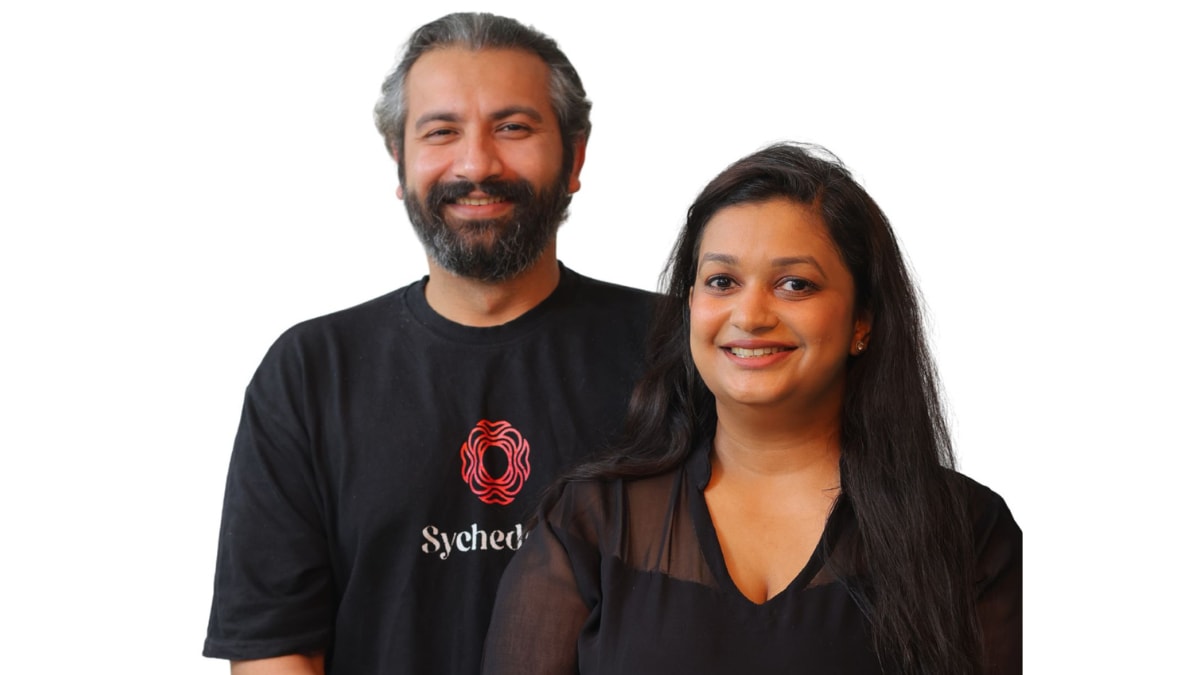
Wearable startup Sychedelic has raised $3.5 million in a seed round from Cultadvisors LLP, TurboStart, Ideabaaz, and Praveek Ventures, with angel investors also participating. The Delhi NCR-based company, formerly known as Neuphony, is developing AI-powered headphones that use real-time biofeedback and transcranial direct current stimulation (tDCS) to reduce stress, improve focus, and support sleep. The funding will go toward marketing, manufacturing scale-up, and research ahead of a global Kickstarter launch in June 2026.
The round is a bet on a specific technical thesis: closed-loop neuromodulation that adapts stimulation based on live biometric input. For investors tracking the mental wellness wearable segment, the open question is whether Sychedelic's approach can achieve enough clinical validation and manufacturing reliability to justify the hardware's complexity.
The Technology: Closed-Loop Neuromodulation with PPG and tDCS
Sychedelic's headphones combine photoplethysmography (PPG) sensors – an optical technology measuring blood flow changes – with adaptive audio and tDCS to monitor and alter the user's cognitive state in real time. Unlike open-loop wearables that deliver a fixed electrical current, this system adjusts stimulation based on live heart-rate and stress indicators.
Why Closed-Loop Matters
The simple read: biofeedback plus electrical stimulation sounds like a bigger version of a smart band. The better market read is that closed-loop systems address the two main failures of earlier neurostimulation devices. First, users adapt to fixed stimulation, reducing long-term effectiveness. Second, without real-time adaptation, the device can deliver current when the brain does not need it, creating discomfort or habituation. Sychedelic's patent applications and CDSCO approval indicate the company has made early progress on a hardware-software loop that few competitors have demonstrated at consumer price points.
The risk: PPG-based wearables are sensitive to motion artifacts and skin tone differences, which can degrade signal quality. The company's claims of 100+ early users over six months suggest internal validation. The data has not been published in a clinical trial registry.
Market Context: The $10.26 Billion Indian Smart Wearables Opportunity by 2031
Sychedelic enters a $10.26 billion Indian smart wearables market (by 2031 estimate) that is shifting from general fitness tracking toward mental wellness. The segment has attracted capital quickly.
The Competitive Stack
Sychedelic's closest competitors are Sputnik Brain, Mave Health, and Dusq. Mave Health's $2.1 million seed round in March signals that the market is still early and fragmented. Temple's $54 million raise from existing Zomato backers illustrates the stark divide: a hardware-first mental wellness startup must prove its product works before accessing capital at the same scale as a founder-driven consumer device.
What Would Confirm the Sychedelic Thesis
Three concrete signals would strengthen the bull case for Sychedelic.
Kickstarter conversion and unit economics. The June 2026 Kickstarter campaign must validate not just demand but the ability to ship a complex electromechanical device at a price that covers BOM plus logistics. Hardware Kickstarter campaigns fail most often on delivery timing, not concept.
Regulatory pathway beyond CDSCO. The company needs an FDA 510(k) clearance or equivalent to enter the US market with medical claims. Without it, the device will be sold as a general wellness product, limiting the price point and the credibility of the "AI-powered" label.
User retention and clinical endpoints. The 100+ early users are a qualitative signal. A follow-up with quantitative metrics (perceived stress scale, sleep latency, focus duration) would separate Sychedelic from the legion of alpha-stage neurotech experiments.
Risk to Watch: Manufacturing Execution and Capital Intensity
Hardware startups at this stage face a capital intensity problem. Sychedelic's $3.5 million seed must cover product development, regulatory fees, marketing, and a Kickstarter campaign. Temple's $54 million round shows what a full hardware stack can cost. If Sychedelic cannot close a Series A within 12–18 months of the Kickstarter, it risks the same scale-up paralysis that kills most neuroscience wearables.
The Manufacturing Bottleneck
tDCS electrodes require consistent conductivity across shipments. PPG sensor calibration varies by skin type. Sychedelic's decision to operate a Delaware entity with a US science advisor and Indian freelance marketers suggests a distributed, low-overhead model. Scaling a hardware supply chain across two countries without a dedicated operations lead is a known failure vector.
Next Event: Kickstarter June 2026
The clearest near-term catalyst is the global Kickstarter launch. Success will depend on pre-sales volume, not just funding. A high-volume campaign can demonstrate manufacturing readiness. A low-volume or extended deadline would signal that the product is not ready for consumer eyes.
For investors tracking the mental wellness wearable space, Sychedelic is a high-specificity bet on closed-loop neuromodulation. The seed round buys time to prove the hardware works at scale. The market validation will come from the Kickstarter backers, not the press release.
For broader market context on early-stage tech trends, see our market analysis.