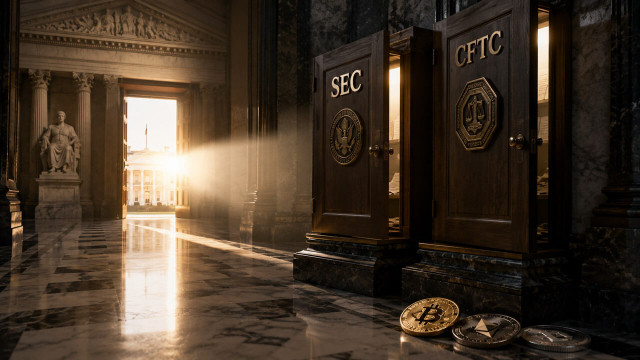
The overturning of Humphrey's Executor gives presidents more control over SEC and CFTC commissioners, making US crypto policy more vulnerable to political shifts.
On June 29, the US Supreme Court overturned the 1935 precedent of Humphrey's Executor, giving President Donald Trump the authority to remove Federal Trade Commissioner Rebecca Slaughter without cause. The ruling's logic extends beyond the FTC to other multimember agencies with similar removal protections, including the Securities and Exchange Commission and Commodity Futures Trading Commission, which oversee digital assets.
Both agencies write rules, grant exemptions, and enforce policy. Their commissioners have traditionally served staggered terms designed to insulate them from direct White House control. The court's decision weakens that buffer.
Trump celebrated the ruling on Truth Social. Asked whether he planned further dismissals across the federal bureaucracy, he said the decision restores the Oval Office's rightful power.
For crypto companies, the change arrives as the regulatory posture shifts. Under former SEC Chair Gary Gensler, the industry argued enforcement was used to set policy without providing workable rules. The current administration has moved toward clearer asset classifications and coordinated supervision between the SEC and CFTC. SEC Chairman Paul Atkins and CFTC Chairman Michael Selig held a joint event in January to discuss harmonization, tied to Trump's promise to make the US the "crypto capital of the world."
Markus Levin, co-founder of XYO, told CryptoSlate the ruling does not change the SEC's or CFTC's legal authority over crypto. It could give future administrations more influence over how those agencies carry out their mandates. A supportive White House can move quickly on market structure rules, stablecoin policy, and tokenization initiatives, he said. A less supportive administration could shift back to enforcement or delay implementation.
The ruling lands while Congress debates the Digital Asset Market CLARITY Act, the most significant crypto market-structure bill now moving through Washington. The Senate Banking Committee advanced it in May by a 15-9 vote. The bill divides digital asset oversight between the SEC and CFTC, establishes disclosure and registration rules, and gives the CFTC a larger role over digital commodities while preserving SEC authority over investment contracts.
If the bill passes, the people leading the SEC and CFTC will become even more important. They will write rules and approve registrations. Exchanges will be policed under new frameworks. Under the old model, staggered terms and removal protections slowed abrupt changes in agency direction. The ruling weakens that safeguard.
In the near term, crypto firms may benefit if the current White House uses its influence to push faster rulemaking and fewer enforcement-driven policy fights. ETF sponsors, stablecoin issuers, and institutional trading firms could gain from a more coordinated federal approach. The risk is the same structure works in reverse. A future administration skeptical of digital assets could replace agency leadership, slow pending rules, reopen enforcement theories, or narrow exemptions the industry had begun to rely on.
That prospect matters for firms mapping long-term investments in US infrastructure. Exchanges and custodians need rules durable enough to support compliance plans and capital commitments across election cycles. The Senate Banking Committee advanced the CLARITY Act by a 15-9 vote. A floor vote has not been scheduled.
Prepared with AlphaScala research tooling and grounded in primary market data: live prices, fundamentals, SEC filings, hedge-fund holdings, and insider activity. Each story is checked against AlphaScala publishing rules before release. Educational coverage, not personalized advice.