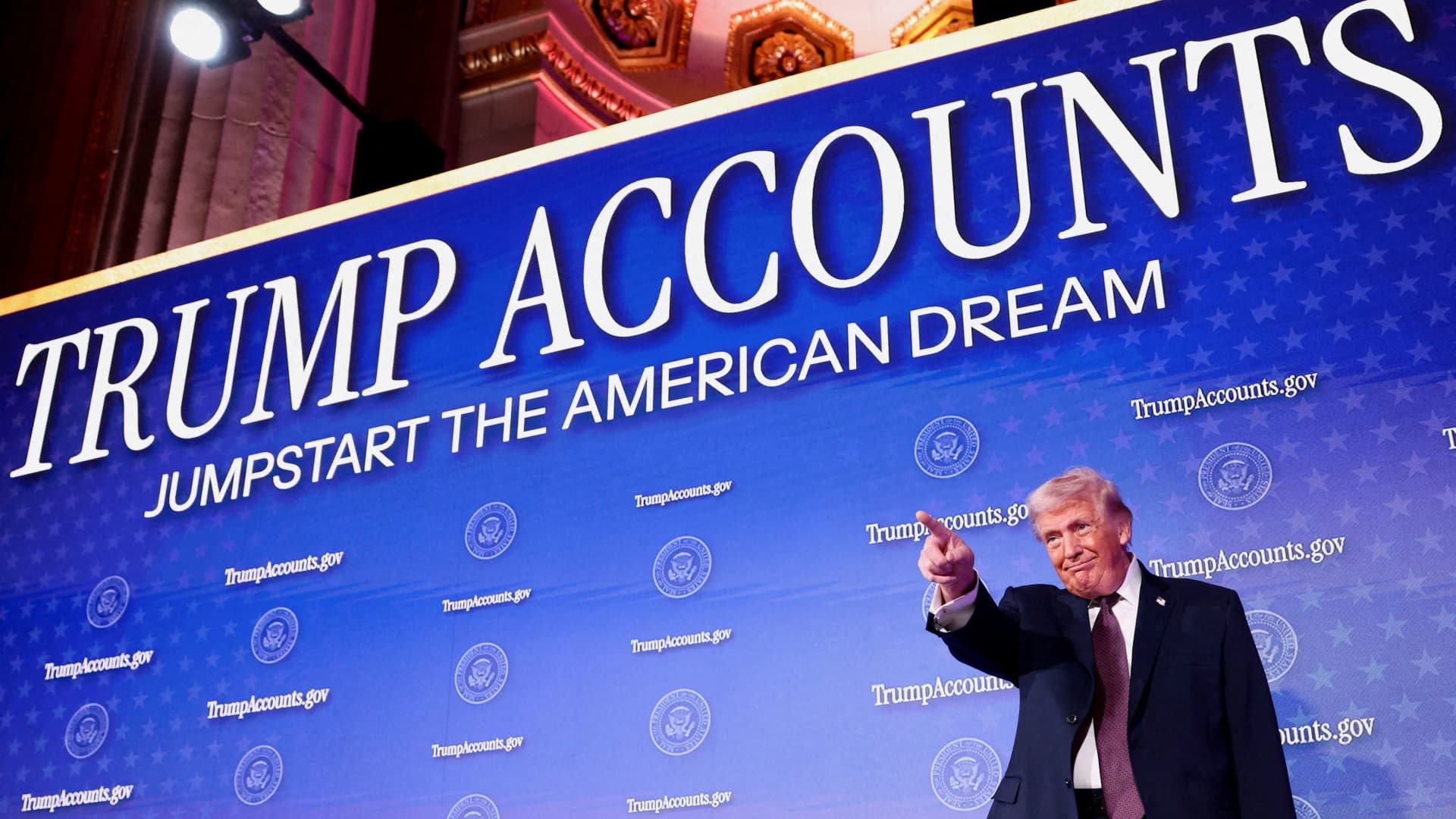
The Trump administration is weighing whether to permit stock donations to Trump Accounts, a move that would hand wealthy donors a double tax benefit: avoiding capital gains tax on appreciated shares while deducting the full fair-market value against income. The potential expansion, first reported by the New York Times, would mark a significant shift from the current cash-only contribution rule and has already drawn attention from hedge fund manager Brad Gerstner, who helped pioneer the investment accounts.
Gerstner signaled his support in a post on X:
"We all want to maximize more multi-billion gifts into kids accts & the gifts may be cash / shares!"
The structure already carries tax advantages: donors can use pre-tax dollars for charitable contributions that benefit a qualified class of children. Permitting stock contributions would layer on the ability to offload highly appreciated shares without triggering capital gains, a benefit long exploited through donor-advised funds and private foundations.
The Tax Mechanism: Capital Gains Avoidance and Fair-Market Deduction
The core appeal for high-net-worth donors is the combination of two tax shields in a single transaction. A donor who contributes appreciated stock to a Trump Account would not pay capital gains tax on the built-in appreciation. At the same time, the donor could deduct the stock's current fair-market value against ordinary income, subject to existing charitable deduction limits.
How the Current Cash-Only Rule Limits Donors
Under the program's present design, contributions must be made in cash. Michael and Susan Dell, for instance, have pledged $6.25 billion to seed Trump Accounts for 25 million children aged 10 and under in ZIP codes with a median income of $150,000 or less. That pledge, while massive, requires the Dells to liquidate assets or use cash reserves, potentially incurring tax costs that a stock donation would avoid.
The Proposed Stock Donation Mechanism
If the Treasury Department permits in-kind stock gifts, donors could transfer shares directly to the accounts. The tax treatment would mirror that of donating appreciated securities to a donor-advised fund: no capital gains tax on the transfer, and a charitable deduction for the full market value. Will McBride, chief economist of the Tax Foundation, described the logic:
The deduction for long-term appreciated capital gain property is generally capped at 30% of adjusted gross income (AGI). That cap would still apply, and the tax benefits of charitable giving for top earners were trimmed by last year's tax and spending bill. The double benefit, therefore, is powerful but not unlimited.
Donor Motivation: Unlocking Appreciated Stock Without Tax
For billionaires sitting on enormous unrealized gains, the ability to donate stock directly solves a liquidity and tax problem. McBride noted:
A cash donation forces a sale and a tax bill. A stock donation bypasses both. The incentive is especially acute for founders and early investors whose cost basis is near zero.
Brad Gerstner's Push for Shares
Gerstner, the hedge fund manager behind the investment-account concept, has been explicit about wanting to accept shares. His X post emphasized maximizing multi-billion-dollar gifts. The Invest America nonprofit advocacy group, which backs the accounts, went further on X, asking:
That wish list hints at the kind of high-appreciation, privately held or publicly traded stock that donors might want to offload. Berkshire Hathaway (BRK.B) is a particularly interesting candidate because its shares have compounded for decades without paying dividends, creating massive embedded gains for long-term holders.
The Dell Pledge and the Scale of the Program
The Dell family's $6.25 billion commitment underscores the scale of wealth that could flow into Trump Accounts if stock donations are permitted. Even a fraction of that sum shifted from cash to appreciated stock would generate substantial tax savings for the donors while seeding accounts for millions of children.
Estate Tax Elimination: The Super-Rich's Real Incentive
While the income-tax deduction grabs headlines, the estate-tax angle may be the larger driver for the ultra-wealthy. Ellen Aprill, senior scholar in residence at UCLA School of Law, explained that donating appreciated stock removes the asset from the donor's taxable estate, and the charitable deduction for gift and estate tax is unlimited.
This is a critical distinction. The income-tax deduction is capped and may be of limited value to someone whose annual income is small relative to their net worth. The estate-tax deduction, however, has no cap, making it a direct tool for reducing the 40% federal estate tax liability.
Why Income Tax Caps Matter Less for Billionaires
Joseph Rosenberg, a senior fellow at the Urban-Brookings Tax Policy Center, cautioned that the stock-donation feature is not a game-changer because wealthy individuals already have private foundations and donor-advised funds. The 30% AGI cap further limits the immediate income-tax benefit. For a billionaire with a relatively modest AGI, the deduction may offset only a fraction of the gift's value in any given year. The estate-tax benefit, by contrast, is immediate and permanent.
Legal Hurdles: Treasury Guidance or Congressional Action?
The path to allowing stock donations is legally contested. Tax experts who spoke with CNBC were divided on whether the change requires legislation or can be accomplished through Treasury guidance or an executive order.
Expert Divide on Executive Action vs. Legislation
Manoj Viswanathan, law professor and co-director of UC Law San Francisco's Center on Tax Law, said he did not think an act of Congress would be required unless the Treasury wants to allow the accounts to hold individual shares of stocks. That suggests a narrower administrative path might be available if the accounts are limited to pooled investment vehicles.
McBride, however, pointed to the political reality: expanding tax benefits for Trump Account donors would face an uphill battle in Congress with a razor-thin Republican majority. A legislative route would require near-unanimous GOP support, a tall order in the current House.
The Index Fund vs. Individual Stock Question
Gerstner suggested on X that "100% of all $$ in Trump Accounts will be in a free index fund that tracks the S&P 500." If the accounts hold only a broad market index, the Treasury might be able to accept stock donations that are immediately liquidated into the fund, simplifying the legal analysis. The Invest America post about individual stocks like SpaceX or Berkshire Hathaway points to a more complex scenario that could require explicit congressional authorization.
Berkshire Hathaway and the Alpha Score 54 Signal
The Invest America X account's specific mention of Berkshire Hathaway (BRK.B) as a stock every child might own puts a real ticker behind the policy debate. For donors considering a gift of BRK.B shares, the stock's current market posture matters alongside the tax arithmetic.
Invest America's Wishlist and BRK.B's Alpha Score 54
AlphaScala's proprietary Alpha Score for BRK.B sits at 54 out of 100, a Mixed label in the Financials sector. The score aggregates momentum, value, and quality signals and currently shows no strong directional edge. A Mixed reading means the stock is not flashing a clear buy or sell signal based on AlphaScala's multi-factor model. You can track the full signal set on the BRK.B stock page.
What a Mixed Score Means for Donors Considering Stock Gifts
For a donor sitting on a large unrealized gain in BRK.B, the Alpha Score 54 does not argue against gifting the shares; the tax benefit is the primary driver. A Mixed score simply indicates that the stock's near-term outlook is not a tailwind that would make holding the shares more attractive than donating them. The decision hinges on the donor's tax situation, estate-planning goals, and view of Berkshire's long-term compounding potential, not on a short-term signal.
Practical Rule for Wealthy Donors
Key insight: The double benefit mirrors donor-advised funds. The real lure for the super-rich is estate tax elimination, not the income-tax deduction.
- The capital gains avoidance is immediate and permanent for any appreciated stock gifted.
- The income-tax deduction is subject to the 30% AGI cap and may be less valuable for donors with low reported income relative to wealth.
- The estate-tax deduction is unlimited, making stock gifts a direct tool for shrinking a taxable estate.
- The legal path remains uncertain: Treasury guidance might suffice for index-fund-only accounts, while individual stock holdings likely need Congress.
- Berkshire Hathaway (BRK.B) is one named candidate for stock gifts; AlphaScala's Mixed score of 54 suggests no near-term market signal to override the tax math.
A White House official told CNBC the administration "is always open to finding new ways to build on the immense success of Trump Accounts" but had no updates. A Treasury spokesperson said the department is "committed to maximizing the impact of Trump Accounts" and driving sign-ups. The next concrete marker is any formal guidance or legislative proposal that clarifies whether stock donations will be permitted. Until then, wealthy donors can plan around the existing cash-only rule while watching for signals from the Treasury or key lawmakers.