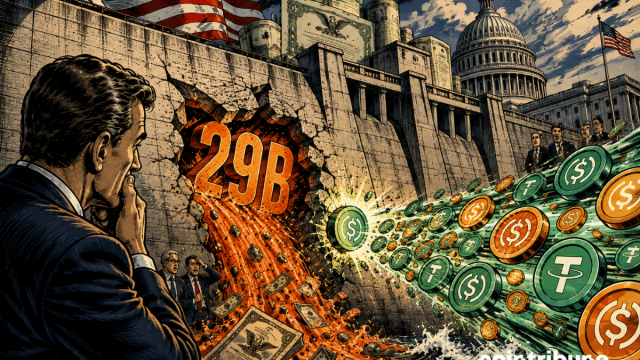
Foreign investors sold $29 billion in short-term US Treasury bills in June, Treasury data show. The outflow followed $43.5 billion in May. Two months together total roughly $72.5 billion.
Capital did not leave the United States. It shifted. The same month, foreign investors bought $181.4 billion in US equities and only $6.8 billion in long-term Treasury bonds. Short-term bills absorbed the selling. Foreign holdings of T-bills fell from about $1.43 trillion in May to $1.40 trillion in June.
The move raises a question Washington is already trying to answer. Stablecoins could become a regular buyer of the same securities foreign investors are reducing.
The mechanics explain why. A user deposits one dollar and receives an equivalent token. The issuer must hold liquid assets to redeem those tokens on demand. Short-term Treasury bills fit that requirement perfectly.
Tether, the largest issuer, held $114.96 billion in directly owned T-bills at the end of the second quarter. It also held $25.62 billion in short-term repurchase agreements. Circle, through its Circle Reserve Fund managed by BlackRock, holds cash, short-term Treasuries, and repos backed by the same bonds. A dollar that enters a stablecoin can land in US public debt without the user ever buying a government bond.
The numbers are not trivial. The $29 billion foreign investors sold in June is about a quarter of Tether's direct T-bill portfolio. If stablecoin supply grows, so does demand for the same securities foreign investors are leaving.
Stablecoin supply has not kept pace. Tether's USDT stood at 184.6 billion at the end of the second quarter, up only 446 million from the previous quarter. The entire stablecoin market was around $302 billion on Aug. 21, according to CoinMarketCap. That pace does not explain $29 billion in new purchases over a single month.
Washington is betting on the future. The GENIUS Act would require regulated stablecoins to maintain reserves in cash, short-term T-bills, or Treasury-backed repos. The Treasury Department published new rules in August preparing for implementation. The more digital dollars circulate, the more issuers must build reserves. A growing share of those reserves will end up in US debt.
June's $29 billion sale is a snapshot. Foreign money rotated out of short-term Treasuries into equities. Stablecoins have not yet absorbed the selling. The regulatory framework being built is designed to make them a structural source of demand, provided the market grows fast enough to replace the buyers that are stepping back.