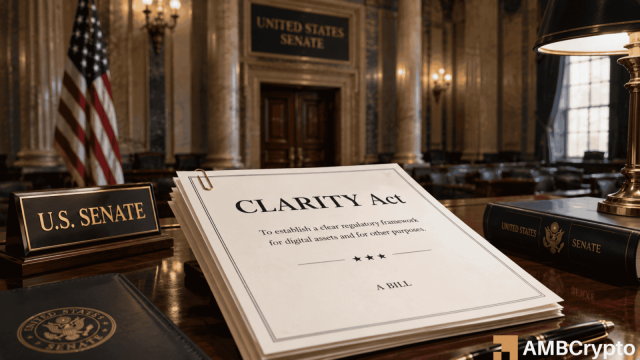
A prohibition on interest or yield payments tied to payment stablecoins has become the central flashpoint in newly released U.S. crypto market-structure legislation. The draft bill, which attempts to build a legal framework for digital assets, exchanges, decentralized finance, and self-custody wallets, has already drawn public clashes between the American Bankers Association, crypto executives, and members of Congress. The outcome will determine whether on-chain dollar liquidity retains its current yield-driven expansion or shrinks back toward the banking system.
The simple read is that a yield ban removes a popular feature. The better market read is that the provision opens a structural fight over whether stablecoins can mirror bank deposits, and the resolution will set the scale of passive dollar liquidity available to crypto markets for the next several years.
The yield prohibition that turned a bill into a battleground
The draft legislation proposes that issuers and digital-asset service providers be barred from offering U.S. users any form of interest-like return merely for holding a payment stablecoin. The restriction targets passive yield–returns that flow to a holder without any additional transaction, activity, or service beyond custody. The bill does not ban all rewards; it draws a specific line that has split the industry and the banking lobby.
Why banks fought for the line
The American Bankers Association recently urged banking executives to lobby lawmakers on stablecoin legislation, warning that yield-bearing stablecoins could pull retail deposits away from traditional banks. Bank balance-sheets rely on low-cost deposit funding, and stablecoins that offer returns comparable to or higher than savings accounts represent a direct leakage from that base. The ABA argument, reflected in the draft, is that a stablecoin paying yield functions as an unlicensed, blockchain-based deposit substitute that bypasses capital requirements, deposit insurance, and other prudential safeguards.
The crypto counter-argument
Crypto executives and pro-crypto lawmakers counter that the industry has already made significant compromises to keep legislation moving and that a total ban on yield is an overreach that hands the banks a structural advantage. Bernie Moreno accused the banking industry of trying to preserve its control over deposits and payment infrastructure through lobbying pressure. The fight is no longer about consumer protection; it is about who gets to own the yield-bearing dollar inside a digital wallet.
What counts as prohibited yield–and what escapes the ban
The draft’s dividing line between idle yield and activity-based rewards is the operational fulcrum for crypto platforms and their users.
- Prohibited: any return that accrues solely from holding a payment stablecoin, whether structured as interest, a rebate, or an automated sweep.
- Permitted: rewards tied to a specific transaction, usage volume, staking activity in a protocol that requires action, or loyalty incentives that do not function like deposit interest.
That dividing line means a DeFi lending protocol that requires users to deposit stablecoins into a lending pool might argue that the yield is compensation for providing liquidity–an active service–not idle custody. A centralized exchange that credits daily interest on an unencumbered USDC balance, however, could fall squarely inside the prohibition.
Bank lobby scores a deposit-defence line; crypto firms call it a trade-off
The bill’s stablecoin yield restriction is the highest-profile concession to the banking industry. The draft also contains several provisions the crypto industry views as favourable. It reduces legal uncertainty for secondary-market token trading, an issue that has generated years of enforcement actions and registration disputes. It provides a clearer path for exchanges and token projects to operate within a federal framework, and it carves out protections for non-custodial wallets and certain DeFi activity.
Retail user trade-off
For a trader, the trade-off is tangible: a bill that broadens institutional access to crypto infrastructure while simultaneously constraining one of the fastest-growing on-chain funding mechanisms–passive stablecoin yield. The result is a mixed outcome for retail users, who may gain greater market certainty but lose one of the simplest yield opportunities that developed outside the banking system during the past three years. Some of that activity could migrate to non-U.S. platforms, fragmenting liquidity and complicating on-ramp flows.
Timeline and friction: when the restriction could land
This is a draft bill, not passed law. Hearings, committee markups, and negotiations between banking and crypto constituencies lie ahead. The timeline is measured in quarters, not days.
Near-term marker
The first sign of how hard the yield ban will stick comes when amendments are floated. If lawmakers introduce carve-outs for yield generated through registered entities or for stablecoin products that segregate yield from the issuer’s balance sheet, the worst-case outcome for crypto liquidity recedes. If the banking lobby holds the line and the prohibition survives largely intact, U.S. holders of payment stablecoins should model a world where passive yield is no longer legally available from any onshore or globally-facing platform that serves U.S. persons.
Second-order liquidity risk
Stablecoin balances on centralized exchanges have historically swollen when yield is available, providing ready ammunition for spot and derivatives markets. Removing that yield makes those balances less attractive to hold, and some portion of the stablecoin supply could migrate off-platform or convert back to bank deposits. Reduced exchange liquidity can widen spreads and amplify volatility during risk-off events. The magnitude depends on how much of the current float was truly yield-driven, a figure that is difficult to measure with precision. A similar fight over deposit-like features has already stalled negotiations on other crypto bills, including those facing banking opposition in the Senate.
What would defuse the risk–and what would make it a permanent fracture
Several scenarios could reduce the market impact of the yield prohibition.
- A final bill that grandfathers existing yield-bearing products or provides a transition period.
- Clear regulatory guidance that treats DeFi liquidity-provider yields as distinct from custodial idle yield.
- A parallel legislative push that forces banks to compete on rate, which would re-level the playing field without banning crypto-native yield.
A fractured stablecoin market would split liquidity across jurisdictional lines, raise compliance costs for exchanges, and reintroduce execution risk during high-volume sessions. The draft is still a negotiating platform, not a final verdict. Every concession on the definition of yield will move the liquidity needle for the next generation of on-chain dollar markets. The broader outcome hinges on whether policymakers treat stablecoins as a closed payment rail or as an open infrastructure that competes directly with the deposit base of traditional banks.