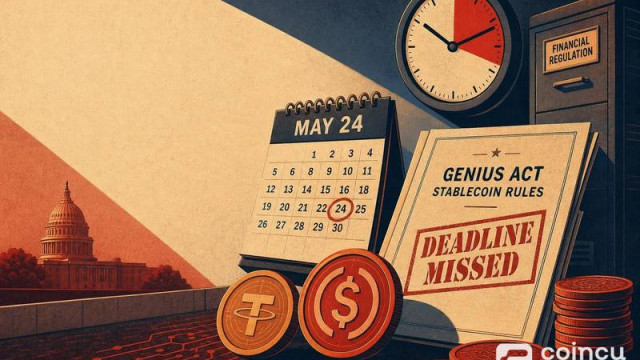
Federal regulators have let the one-year deadline for GENIUS Act stablecoin rules pass with key implementation measures still in proposed form. The July 18, 2026 cutoff came and went without final rules from the Treasury, its Financial Crimes Enforcement Network, the Office of the Comptroller of the Currency, or the Federal Reserve.
The statute, Public Law 119-27, was signed on July 18, 2025. Section 13(a) gave each primary federal payment stablecoin regulator, the Treasury secretary, and each state payment stablecoin regulator exactly one year to issue implementing regulations.
Treasury and FinCEN published a proposed rule on June 22 for permitted payment stablecoin issuer customer identification programs. The comment period stays open until August 21, well past the statutory cutoff. The OCC said in February it had issued a proposed rulemaking to implement the Act and that public comments would shape a later final version.
The Federal Reserve had also been racing the clock. Fed governor Kevin Warsh told Barron's on July 14 that the central bank was working to release its stablecoin rules by the Saturday deadline.
None of those agencies had final measures in place when the deadline expired.
The GENIUS Act builds a licensing regime for payment stablecoin issuers. The implementing rules were supposed to turn that framework into enforceable daily operational standards. Among the pending areas: reserve backing requirements, operational standards for how issuers hold and disclose supporting assets, and the anti-money-laundering compliance mechanics covered by the still-open FinCEN proposal.
The delay does not void the law. The statute remains in force, and supervisory expectations plus enforcement authority can proceed even where final rules lag. Industry analyst Paradigm noted that agencies frequently miss statutory deadlines with limited practical consequences, calling the slippage common rather than fatal.
What it does is leave issuers and exchanges without the detailed federal playbook for examinations, licensing pathways, and disclosure formats the Act promised to standardize. Firms cannot finalize build-out for reserve reporting or customer identification systems until the FinCEN proposal and parallel OCC rule are settled.
The Act has an outside effective date of 18 months after enactment, or January 18, 2027, unless final federal rules trigger an earlier 120-day pathway. That fallback date now centers compliance planning.
USDC, the largest U.S.-oriented stablecoin by market cap, traded at $0.9999 with a market capitalization near $73.3 billion. There was no peg stress tied to the missed deadline. The broader Crypto Fear & Greed Index read 28, in "Fear" territory.
Some firms are building compliance infrastructure against the proposed rules on the assumption they broadly survive in final form. Others are holding back U.S. expansion decisions that hinge on settled reserve and licensing standards.
The dynamic runs parallel to legislative efforts elsewhere in Washington. Coinbase has argued the CLARITY Act would strengthen U.S. crypto rules. It also contrasts with tightening abroad; European stablecoin issuers face tougher standards under MiCA.
Comment periods such as FinCEN's must close before final rules can issue. The fallback effective date of January 18, 2027 applies unless final federal rules trigger the earlier 120-day pathway before then.