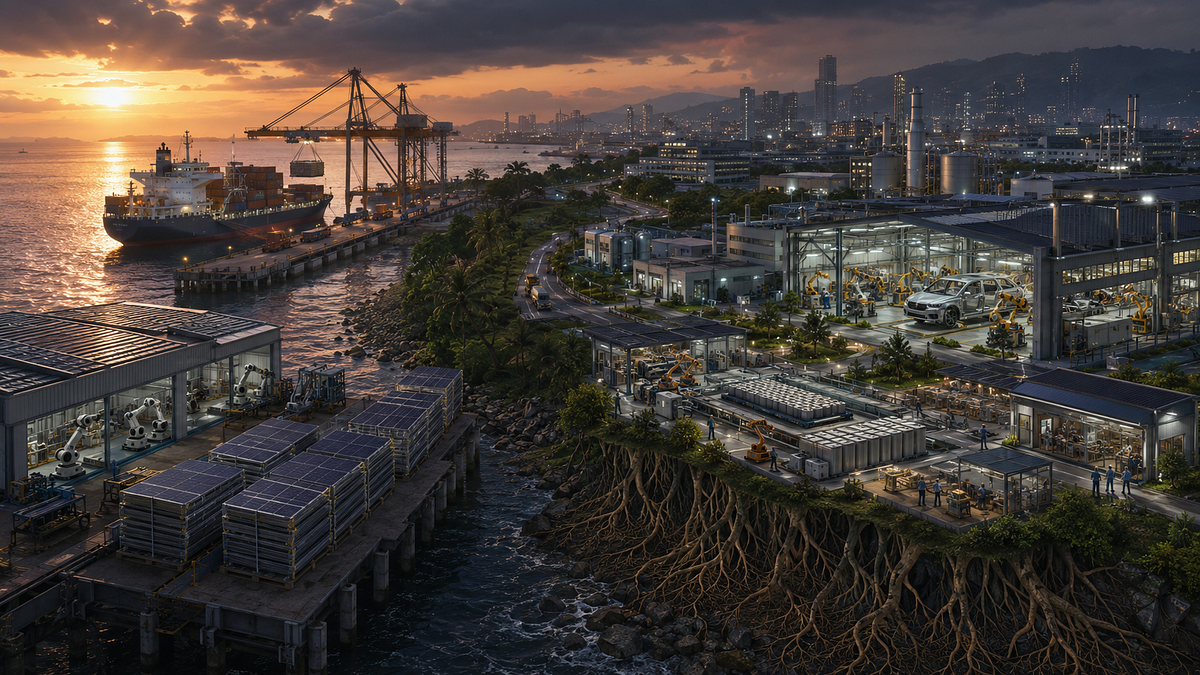
The IEA forecasts solar-module capacity in Southeast Asia could fall to 73 GW by 2030. Battery and EV investment is rising, but the region risks repeating the same mistake unless it builds deeper roots.
Solar manufacturing in Southeast Asia offers a warning. Factories built around temporary trade advantages can disappear when those advantages vanish. The battery and electric-vehicle boom now sweeping the region needs stronger foundations.
The IEA's Southeast Asia Energy Outlook 2026 presents two diverging trajectories. Solar-module capacity is expected to stagnate or decline, while investment in battery components and EV manufacturing rises sharply.
The temptation is to read this as one technology losing momentum and another taking its place. The more useful lesson concerns why factories locate in Southeast Asia, and what might persuade them to remain.
For years, the region benefited from solar manufacturers establishing production facilities in Cambodia, Malaysia, Thailand and Viet Nam. Many were owned by Chinese-headquartered companies and concentrated in downstream activities such as modules and cells. Upstream components continued to move through vertically integrated international supply chains.
The IEA estimates that Chinese-headquartered companies account for around 60% of Southeast Asia's solar-module manufacturing capacity. The expansion generated exports and investment.
Much of that capacity was oriented toward distant export markets. Its competitiveness depended on decisions made outside the region.
Global manufacturing overcapacity, expanding domestic production in the United States and India, and new anti-dumping and countervailing duties altered the industry's economics. Companies began closing facilities or shifting planned investments between countries. Viet Nam's module capacity could fall by 2030 to less than 40% of its 2024 level, the IEA projects.
Across Southeast Asia, solar-module manufacturing capacity stood at around 100 GW at the end of 2024. The IEA projects it could decline to roughly 73 GW by 2030.
This does not mean export manufacturing or foreign investment has failed. Both remain central to the region's development. The solar experience instead shows how quickly manufacturing capacity can be rearranged when its competitiveness depends more on access to one export market than on demand and suppliers rooted in the host region.
Factory capacity is not the same as industrial resilience.
The distinction matters as Southeast Asian governments celebrate a new wave of battery and EV investment.
Battery-cell manufacturing capacity increased from 16 GWh in 2023 to 26 GWh in 2024. Projects already committed could raise it above 80 GWh by 2030. Cathode-material capacity could reach 70 GWh, while current announcements suggest regional anode-material capacity may exceed 200 GWh.
Electric-vehicle manufacturing is expanding as well. Around 90,000 electric cars were produced in Southeast Asia in 2024, more than twice the previous year's output. Plants capable of manufacturing EVs could represent more than one million units of annual capacity by 2030. Some of those facilities also produce internal-combustion vehicles, and the share eventually allocated to EVs is not always specified.
The distance between current output and future nameplate capacity does not prove these factories will be underused. It does show why utilisation should become a more important measure of industrial progress than announcements alone.
Battery and EV manufacturing has the potential to rest on broader foundations than the solar export model. Southeast Asia has a large and growing vehicle market. Indonesia has minerals and expanding battery-material production. Thailand has a mature automotive supplier base. Viet Nam has developed a domestic EV manufacturer, while Viet Nam and Indonesia both have substantial electric two-wheeler industries.
The IEA also links the region's manufacturing ambitions to expanding domestic markets, supportive policies and committed battery investments.
Affordable imports still meet much of the region's electric-car demand. Production facilities may assemble vehicles while importing most high-value components. Investment decisions can remain concentrated at foreign headquarters, leaving host countries with limited control when subsidies or corporate strategies change.
Southeast Asian governments also risk competing against one another for similar factories through tax incentives and local-content requirements. Such competition may attract individual projects while doing little to create a production system that is resilient at the regional level.
A more durable strategy would treat ASEAN as a connected industrial market rather than eleven separate investment destinations. One possible configuration could link Indonesia's battery-material base and Thailand's automotive supplier ecosystem with Viet Nam's growing vehicle-manufacturing capabilities. Other countries could specialise in components, electronics, testing, logistics, recycling or supporting services according to their existing strengths.
The objective should not be for every country to reproduce the entire value chain. It should be to make production across the region more valuable as a network than as a collection of isolated factories.
Regional standards will require that batteries and components move more easily across borders. Shared testing and certification systems could reduce duplication. Clearer rules for recycling and battery traceability would support a regional market extending beyond first production.
Domestic and regional demand are equally important. A factory dependent on one distant export destination remains vulnerable to political decisions in that market. A plant serving several growing ASEAN markets, supported by local suppliers and predictable standards, has more reasons to keep producing and reinvesting.
This does not require closing the region to imports or forcing every component to be made locally. It means creating credible opportunities for regional firms to supply parts, engineering, software, maintenance and logistics as production grows.
Reliable and progressively cleaner electricity would strengthen that industrial proposition. The IEA finds that lower energy and emissions intensity can improve competitiveness and attract investment into clean-technology manufacturing and low-carbon value chains. As companies and importing markets pay greater attention to supply-chain emissions, the electricity behind a battery or vehicle may become increasingly relevant to where production is located.
Industrial success should be assessed through durability rather than factory counts alone. Governments should examine whether facilities continue operating through changing market cycles, whether their customer base is diversified, whether regional suppliers are receiving repeat orders and whether companies reinvest after the initial project. They should also distinguish clearly between announced, committed, operational and utilised capacity.
Foreign manufacturers will remain indispensable. Chinese, Korean and other international companies bring capital and supplier relationships that the region cannot recreate overnight. The strategic task is to connect that investment to markets and infrastructure that remain useful even after the original incentive package expires.
Southeast Asia's solar experience shows how rapidly manufacturing can be rearranged by decisions made elsewhere. The battery and EV boom offers the region another opportunity. Factory announcements alone will not reveal whether the industry has developed deeper roots.
The strongest industrial strategy does not merely give a company a reason to open a factory. It gives the industry a reason to remain.
Prepared with AlphaScala editorial tooling from the source reporting linked above. Indexable analysis may include a cited Alpha Score value. Publishing checks screen each story before release. Educational coverage, not personalized advice.