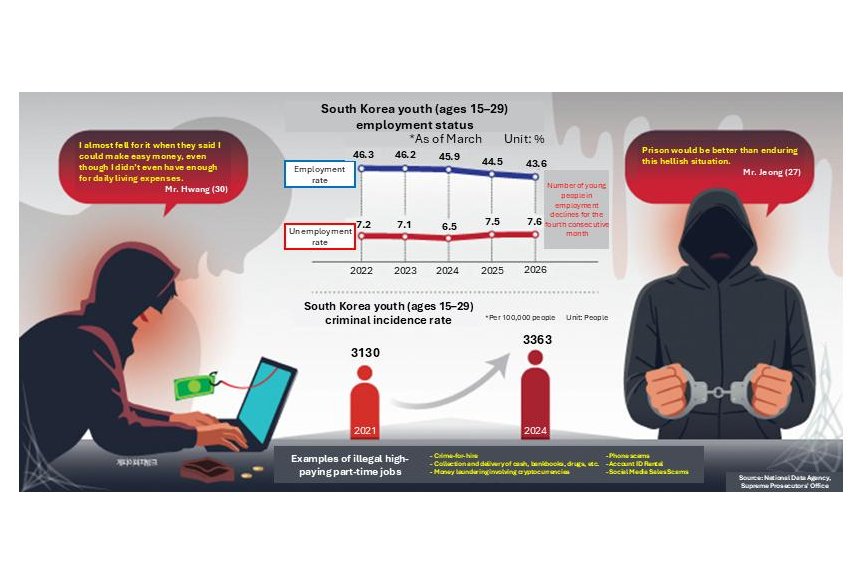
Economic instability among South Korea’s youth population has created a new vector for criminal activity, as illicit organizations increasingly disguise illegal operations as legitimate part-time employment. This shift marks a departure from traditional labor market participation, where financial desperation is now being exploited to recruit young individuals into high-risk, high-reward criminal enterprises. The convergence of declining employment rates and the anonymity provided by online recruitment platforms has facilitated this transition, turning economic hardship into a structural vulnerability for the domestic labor force.
Structural Shifts in Youth Labor Participation
The traditional path for young workers in South Korea is facing significant disruption as legitimate job opportunities fail to keep pace with economic pressures. When formal employment channels become inaccessible, the barrier to entry for illicit work lowers significantly. These criminal entities often utilize the language of standard gig economy roles to mask activities such as money laundering, illegal courier services, or fraudulent financial operations. This trend suggests that the lack of transparent, entry-level job growth is not merely a macroeconomic statistic but a catalyst for social and legal instability.
Impact on Consumer and Financial Sectors
The infiltration of criminal elements into the labor pool creates secondary risks for the broader consumer and financial sectors. As these illicit operations scale, they often mimic the operational structures of legitimate businesses, complicating regulatory efforts to maintain market integrity. This environment necessitates a closer look at how labor market data correlates with emerging crime patterns, particularly in sectors where digital recruitment is prevalent. Investors monitoring the stock market analysis landscape should note that such labor market distortions can lead to increased regulatory scrutiny and operational friction for companies relying on decentralized or gig-based staffing models.
AlphaScala data currently assigns Amer Sports, Inc. (AS) an Alpha Score of 47/100, reflecting a Mixed outlook within the Consumer Cyclical sector. Further details on the company can be found on the AS stock page.
Regulatory and Economic Markers
The next phase of this development will be defined by the government's response to these recruitment tactics. Policymakers are expected to tighten oversight on online job boards and digital communication platforms to curb the spread of these deceptive listings. The effectiveness of these measures will serve as a primary indicator for the stability of the youth labor market. Observers should monitor upcoming legislative updates regarding digital disclosure standards, which may parallel broader shifts seen in other sectors, such as the Regulatory Crackdown on Financial Influencers Shifts Digital Disclosure Standards. The ability of the state to restore confidence in formal employment channels will be the ultimate test for reversing this trend of illicit labor participation.