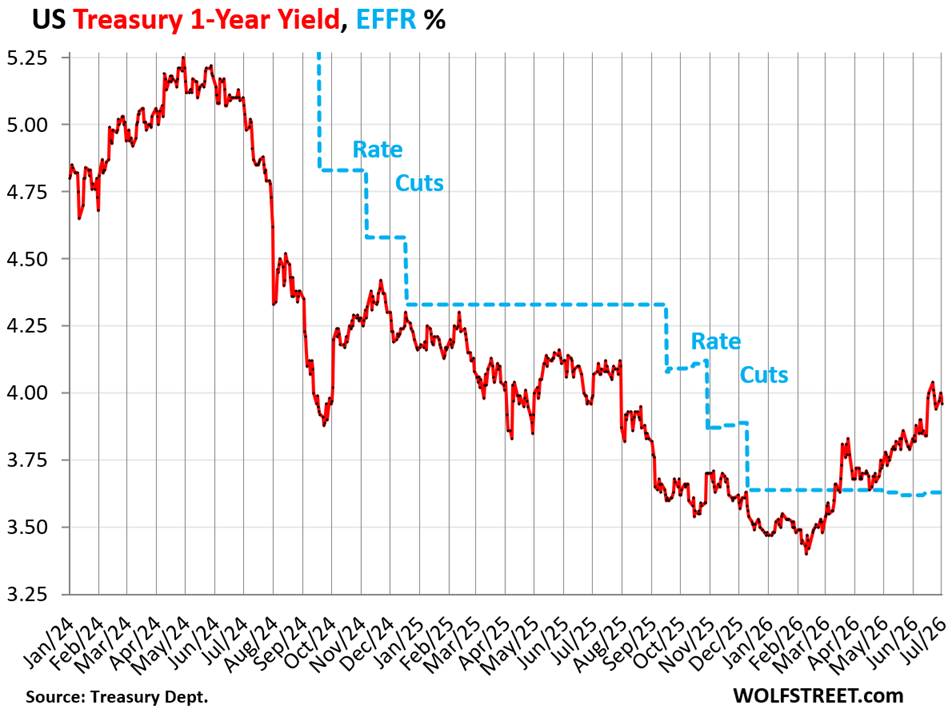
The six-month Treasury yield surged 50bps since January, now 35bps above the Fed's policy rate. Banks raise CD yields above 4%. Next week's 1-year T-bill auction will test whether the market expects a hike before year-end.
The government sold $84 billion of six-month Treasury bills this week at an investment rate of 3.97%, up 17 basis points from the auction two weeks ago. In the secondary market, the six-month yield touched 4.0% earlier in the week before closing at 3.97% on Thursday, according to Treasury Department data.
Since early January, the six-month yield has surged nearly 50 basis points. It now sits 35 basis points above the effective federal funds rate, a reversal from January when it traded below the policy rate. The yield gap indicates the bond market expects at least one rate hike within the next six months, possibly more.
The three-month yield tells a similar story. It closed at 3.82%, 19 basis points above the EFFR, after pushing as high as 24 basis points above earlier in the week. Even inside a three-month window, the market sees a reasonable chance of a rate increase.
The one-year yield has been near or above 4.0% for the past two weeks, up about 60 basis points from early February. Over five months, the one-year yield flipped from pricing rate cuts to pricing rate hikes.
Banks have responded by raising yields on brokered CDs sold through stock brokers. Many CD yields have moved above 4% to compete with T-bills for retail cash.
Fed Chair Kevin Warsh has been telling the bond market to watch the data, not the Fed. The Fed wants the bond market as a clean data input, he said. If the market reacts to what it thinks the Fed will do instead of what the data says, that input gets polluted. The market is watching the data. It sees a jobs market that has not softened and inflation that has not receded to target. At the June 17 FOMC meeting, 9 of the 19 members projected at least one rate hike this year. Warsh did not disclose his own projection. Resistance to hiking at the Fed is fading.
The two-year Treasury yield, a reliable signal for how the Fed interprets incoming data, has surged 76 basis points since early February to 4.14%. In previous cycles, a move of that speed and magnitude has preceded an actual policy change.
The rise in short-term yields will push up borrowing costs across the economy. Credit card rates and auto loans both track short-term Treasury yields. Mortgages follow the 10-year yield, which has stayed rangebound. Banks are already raising CD yields to attract deposits.
Higher yields also strengthen the dollar, which pressures commodities priced in dollars. Emerging-market assets tend to suffer as capital flows back to the US. Gold faces headwinds from rising real yields. Growth stocks, particularly in technology, are sensitive to higher discount rates. The S&P 500 has already felt the pressure from rising yields this year.
The two-year yield has surged 76 basis points since early February while the ten-year yield has risen only 11 basis points. That has flattened the yield curve significantly. A flattening curve is a classic sign that the market expects tighter monetary policy ahead. It also reduces banks' net interest margins, as they borrow short and lend long.
The 10-year Treasury yield rose 11 basis points during the week to 4.49%, roughly unchanged from two weeks ago. It has stayed in the 4%-5% range since 2023, a period that encompasses three rate cuts from the Fed. The 30-year yield closed at 4.98%, up 11 basis points on the week but also roughly unchanged from two weeks ago. The long end completely blew off the rate cuts; they did not register.
What the long end watches is the imagined path of inflation years ahead and the stream of Treasury supply needed to fund deficits that keep expanding. At 4.49%, the 10-year yield looks low relative to 4.25% CPI inflation. The bond market is still betting that inflation eventually drifts back toward 2%.
The next scheduled data point is the 1-year T-bill auction next week. Its yield will provide another read on whether the market expects the Fed to act before year-end.
Prepared with AlphaScala editorial tooling from the source reporting linked above. Indexable analysis may include a cited Alpha Score value. Publishing checks screen each story before release. Educational coverage, not personalized advice.