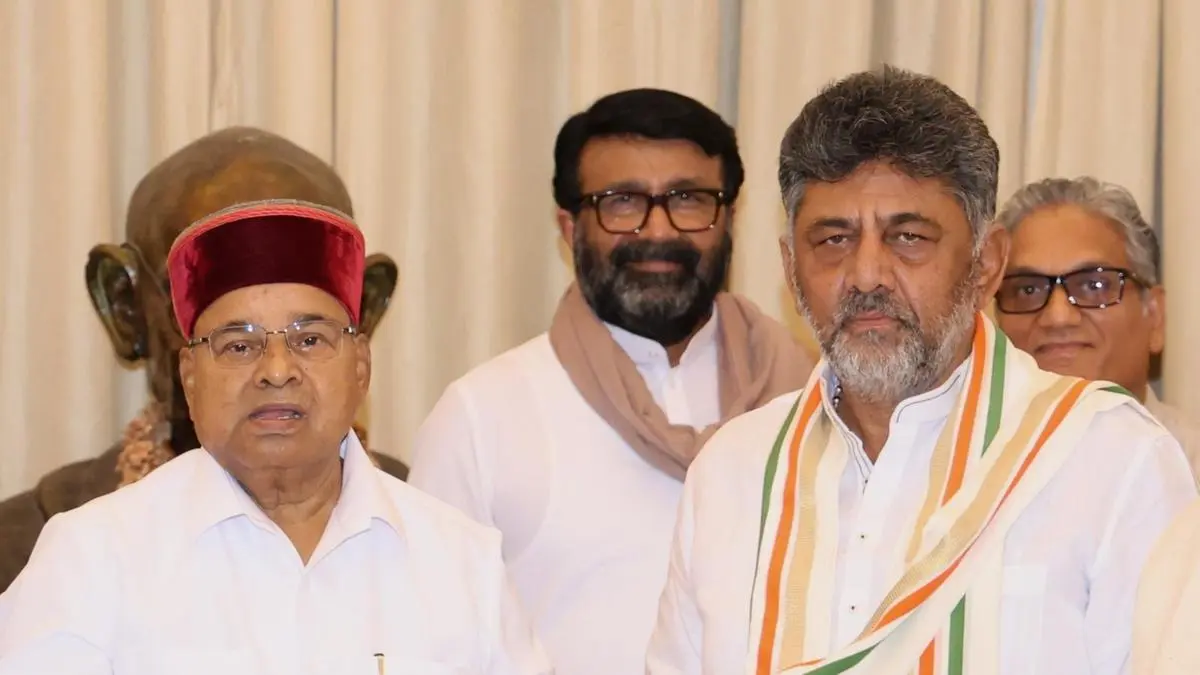
Governor Invites Shivakumar to Take Oath on June 3
Karnataka Governor Thaawarchand Gehlot on Saturday invited D K Shivakumar, the newly elected leader of the Congress Legislature Party (CLP), to take oath as the chief minister of the state on June 3, 2026. The invitation followed a meeting at Lok Bhavan where Shivakumar staked his claim to form a new government, accompanied by outgoing Chief Minister Siddaramaiah and other senior state leaders.
The Governor's letter stated the oath ceremony will take place at 4:05 PM on June 3 at the Lok Bhavan premises. Shivakumar, who also serves as the state Congress president, was elected CLP leader earlier, paving the way for his ascension to the top post.
In his claim letter to the Governor, Shivakumar noted that the Karnataka CLP, consisting of 135 Indian National Congress members, 2 associated members and 1 Raita Sangha MLA, had unanimously elected him as their leader. He requested the Governor to administer the oath to him as Chief Minister and to the others as the Council of Ministers.
Shivakumar previously served as Deputy Chief Minister in the Siddaramaiah government. Siddaramaiah resigned on Thursday, and Governor Gehlot accepted his resignation the next day, dissolving the Council of Ministers.
Why the Leadership Change Alters Karnataka's Business Calculus
The transition from Siddaramaiah to Shivakumar is not an ordinary leadership change within the same party. It signals a shift in the state's political centre of gravity. Siddaramaiah, a veteran of Vokkaliga community politics and a former finance minister with deep ties to the state's bureaucratic machinery, had a specific approach to industrial policy and fiscal management. Shivakumar, a powerful leader from the Vokkaliga community and the state Congress president, carries a different set of political and economic priorities.
The core question for investors is whether policy continuity will hold. The Congress government in Karnataka has pursued a mix of welfare populism, including the Guarantee Schemes (free bus travel, electricity, and cash transfers), alongside efforts to attract tech and manufacturing investment through the Karnataka Industrial Policy. Shivakumar's tenure as Deputy Chief Minister gave him direct exposure to the state's fiscal constraints and the balancing act required between spending commitments and revenue generation.
The Fiscal Arithmetic
Risk to watch: The state's fiscal deficit is under pressure from the pre-election guarantee outlays. The Guarantee Schemes cost the state exchequer an estimated ₹50,000 crore annually. Siddaramaiah had signalled a need to calibrate these schemes to avoid a repeat of the revenue deficit crisis that prompted the Karnataka Fiscal Responsibility Act changes in 2024. Shivakumar has publicly defended the guarantees as non-negotiable during the election campaign.
Practical rule: For sectors exposed to state government spending – infrastructure, construction, FMCG (rural demand), and power distribution – the June 3 swearing-in is a catalyst to watch. If Shivakumar's first cabinet decisions include a confirmation of guarantee scheme continuity without a fiscal roadmap, bond markets and infrastructure contractors may face headwinds.
Which Sectors Face the Most Exposure
The Karnataka state budget influences several listed and unlisted entities directly.
Infrastructure and Construction
Government capex is the primary driver for road, irrigation, and urban development projects in the state. Siddaramaiah's 2025-26 budget allocated ₹12,000 crore for the Bengaluru Infrastructure Development plan, covering flyovers, the Namma Metro Phase 2 and 3, and suburban rail. Companies like Larsen & Toubro (L&T) and Kirloskar Brothers have significant order books tied to Karnataka government contracts. A leadership change creates execution risk: new ministers often re-examine large tenders awarded in the final year of the previous government, citing procedural or financial issues.
Power Distribution
Bangalore Electricity Supply Company (BESCOM) and other state distribution companies are under financial strain from the free electricity guarantee scheme. The scheme provides up to 200 units of free power to domestic consumers. Discoms' payment delays to generators like NTPC and Adani Power have been a recurring issue. Shivakumar's government will need to negotiate with the Karnataka Electricity Regulatory Commission (KERC) on tariff revisions. Any signal of a delay in tariff hikes would pressure state-owned power generators' receivables.
Technology and Startups
Karnataka contributes about 22% of India's software exports and hosts the headquarters of Infosys, Wipro, and a vast startup ecosystem. The state's Information Technology and Biotechnology (IT/BT) department has been a priority for past governments. Shivakumar, as a Bengaluru-centric leader (his constituency is Kanakapura in the Bengaluru region), has direct interest in tech policy. The next IT policy 2026-31 is due for release; continuity of R&D tax incentives, single-window clearance, and land allocation for tech parks is the baseline expectation. Any deviation would be a negative read-through for REITs (like Embassy Office Parks) that hold significant Bengaluru commercial assets.
Sugar and Agro-Processing
Shivakumar's political base includes the sugar belt of Mandya and Ramanagara. The state's sugarcane pricing policy and ethanol procurement by Oil Marketing Companies (OMCs) are direct levers. A Chief Minister from a sugar-growing constituency may push for higher State Advised Prices (SAP) for sugarcane, which benefits mills like Bannari Amman Sugars but pressures the state's subsidy bill.
The Decision Point for Traders
For traders with exposure to Karnataka-sensitive stocks, the June 3 swearing-in is a binary event in a limited sense. The immediate market reaction will focus on two signals.
First signal: The first cabinet expansion and portfolio allocation. Key ministries – Finance, Infrastructure, Energy, and IT/BT – will reveal the government's emphasis. If a known pro-business figure takes the Finance portfolio, the fiscal adjustment path gets clearer. If the Energy portfolio goes to a leader with a strong pro-subsidy stance, discom risk will reprice.
Second signal: The first policy statement or budget review. Shivakumar may use the oath ceremony to signal a continuity line – stressing completion of Siddaramaiah's projects – or a fresh start line – announcing a review of large tenders. The former is market-neutral to positive for construction stocks. The latter is a negative catalyst for order-book visibility.
What Would Confirm or Weaken the Setup
Confirming the positive read-through:
- Appointment of a non-polarising Finance Minister with a fiscal consolidation record.
- Immediate announcement of cabinet meeting to clear pending infrastructure project payments.
- No threat to reopen the IT/BT land grant process underway for Global Capability Centres (GCCs).
Weakening the read-through:
- Announcement of a comprehensive audit of all infrastructure projects awarded after March 2025.
- Portfolio allocation that sidelines experienced ministers in finance and energy.
- A public statement doubling down on guarantee schemes without a revenue source mention.
Bottom Line for Traders
The move from Siddaramaiah to Shivakumar is a leadership transition within the same party. The two politicians are not interchangeable. Shivakumar's political compulsions – he needs to establish his own identity after years as the deputy – could drive a more populist initial stance. The June 3 swearing-in is the alpha event. Traders should watch the portfolio allocation as the first concrete data point for sector positioning. Infrastructure and power stocks with Karnataka revenue exposure should be on watchlist tightening mode until the cabinet is announced.
Comments have to be in English, and in full sentences. They cannot be abusive or personal. Please abide by our community guidelines for posting comments.