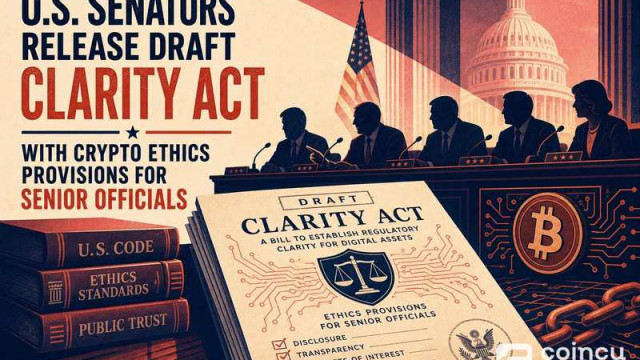
New CLARITY Act draft bars senior officials from paid token issuance, adds disclosure rules, and sunsets after the current presidential term. DOJ gets sole enforcement power.
The U.S. Senate Banking Committee released a new draft of the CLARITY Act on July 22 that pairs crypto market-structure rules with a ban on senior officials issuing or sponsoring digital assets for pay, according to a committee statement and the circulated bill text.
The ethics language sits in a new Division C, running from sections 30101 through 30106. Proposed 5 U.S.C. 13152(a) says a covered individual may not, in exchange for consideration, issue or sponsor a digital asset while serving in office. The rule also reaches the official's spouse, closing an obvious workaround, the bill text says.
Covered individuals include the President, the Vice President, senior executive-branch officials above the filing threshold, Members of Congress, and judicial officers and employees. The definition draws from existing federal disclosure rules under 5 U.S.C. 13103(f).
The ban is not a blanket prohibition on owning crypto. It targets paid issuance or sponsorship. Passive investment holdings remain allowed, subject to disclosure and conflict rules.
Section 30102 adds a financial-disclosure requirement for digital assets sold for remuneration when their fair market value exceeds $1,000 at the close of the preceding calendar year.
Penalties are steep. A covered individual who knowingly and willfully violates the ban must disgorge all profit to the Treasury and pay a civil penalty equal to 10 percent of the consideration received or $500,000, whichever is less.
There is a market consequence as well. If a covered individual is found to have issued or sponsored a digital asset in violation of the ban, that asset may not be listed for trading on a digital asset intermediary. The provision targets the point of sale rather than just the official's conduct.
Enforcement is centralized at the Department of Justice. The draft makes the U.S. Attorney General the sole enforcer for the ethics section and explicitly bars state attorneys general and private parties from bringing actions under it.
The most distinctive drafting choice is a sunset. Section 30105 says the ethics ban has no force and effect on and after noon on January 20, 2029. No one may be penalized after that date for conduct that occurred on or before the sunset. CoinDesk reported the timing aligns with the end of the current presidential term.
The ethics language carries a political charge given ongoing scrutiny of digital-asset ventures tied to President Donald Trump, several outlets have reported. The draft tries to thread that debate by banning paid issuance while permitting disclosed holdings, leaving the broader conflict question unresolved.
Ether traded at $1,913, up roughly 2.1% in 24 hours, as the draft circulated. The Crypto Fear and Greed Index sat at 26, in "Fear" territory, with total crypto market capitalization near $2.3 trillion, according to crypto market analysis.
The draft is not law. It is a legislative text circulated among senators for feedback ahead of committee action. The language can still change before any vote. The Senate is expected to take up the bill after the summer recess, the committee statement said.
Crypto firms, compliance observers, and ethics watchdogs are likely to weigh in on the DOJ-only enforcement design and the carve-out that still permits passive holdings. The senior-official focus may draw attention beyond core crypto audiences. The Senate Agriculture Committee's own crypto bill work continues in parallel, and the pieces may yet be reconciled before any floor action.
Drafted by a large language model from the source reporting linked above, then screened by automated publishing checks. It is not read by a journalist before publication. Some articles cite our Alpha Score. Verify prices and figures against the original source. Educational coverage, not personalized advice.