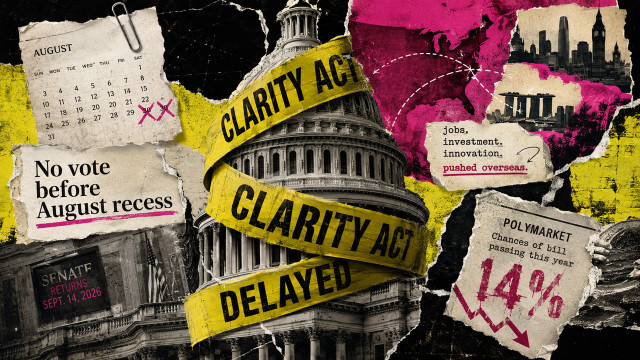
The US Senate abandoned plans to vote on the CLARITY Act before its August recess. Majority Leader John Thune confirmed Aug. 6 that the legislation would wait until lawmakers return Sept. 14, reversing his earlier expectation that the Senate would act before leaving Washington.
“The Dems are insistent on no Clarity vote… I worked with sponsors of the bill…and we're getting that queued up first thing when we come back,” a Thune spokesperson said on X.
Prediction traders marked down the bill's prospects. A Polymarket contract on whether CLARITY will be signed into law by the end of 2026 put the probability at roughly 14%, after odds had risen above 80% earlier this year.
Republican negotiators could not resolve banking and ethics disputes needed to assemble 60 votes to advance the legislation, according to the lawmaker's statement. Sen. Jerry Moran of Kansas indicated he wants changes favored by banks before supporting the bill, making the path to 60 votes more difficult. Banks have pushed lawmakers to restrict rewards that crypto exchanges can pay customers for holding stablecoins. The GENIUS Act already bars stablecoin issuers from directly paying interest. Banking groups argue exchanges could circumvent that restriction by offering similar rewards themselves. Sens. Thom Tillis and Angela Alsobrooks attempted to bridge the divide in May with language distinguishing passive rewards from incentives tied to payments. Banking groups said the compromise did not go far enough, leaving the issue unresolved.
Democratic lawmakers also highlighted separate concerns. Several are demanding stronger safeguards against money laundering and illicit uses of digital assets. They are also seeking restrictions on senior government officials profiting from crypto businesses, an issue sharpened by the Trump family's extensive involvement in the industry. A bipartisan ethics proposal sent to the White House would require Trump to divest from crypto-related businesses, Bloomberg reported. The proposal could also allow him to defer capital gains taxes associated with the divestment, adding another complication. Sen. Chris Van Hollen captured the broader Democratic resistance this week when he said the CLARITY Act was “not ready for prime time,” pointing to unresolved financial-stability and illicit-finance concerns.
Those unresolved disputes will now have to be settled against a calendar that offers senators little room for another failed attempt. The Senate reconvenes Sept. 14. It is scheduled to be away again Sept. 21. Another state work period begins Oct. 5 and runs through Nov. 6, leaving roughly 14 scheduled weekdays in Washington before lawmakers scatter for the final stretch of the midterm campaign. CLARITY will also have to compete for floor time with government funding and other unfinished legislation. Even securing those 60 votes during that window would not finish the process. Any Senate version that differs from the measure already passed by the House would have to be reconciled before final legislation could reach the president's desk.
The larger deadline comes in January, when the current Congress expires. Any legislation that has not completed the process by then would die and have to be introduced again in the next Congress.
Crypto executives and lobbyists are treating September as the next opportunity to salvage legislation. The Digital Chamber CEO Cody Carbone acknowledged disappointment over the failed August push. Negotiations would continue during the recess, he said. “The fight is far from over,” Carbone added, saying the organization would spend the coming weeks trying to narrow the remaining disagreements.
Coinbase CEO Brian Armstrong took a harder line. Lawmakers had already spent a year negotiating the bill and had made substantial concessions, he argued. “No one gets everything. Everyone gets most of what they need. At this point, the only thing left isn't negotiation, it's whether some group will try to stall or block legislation that already has broad bipartisan support.” Armstrong called on Senate leaders to put the bill to a vote, saying millions of Americans who own crypto were watching the process.
Sen. Dave McCormick renewed the economic case for passage. Prolonged regulatory uncertainty could push jobs, investment and technology development outside the US, he warned.
The advocacy campaign now shifts into the recess. Industry groups will have several weeks to press senators and seek compromises on the issues that prevented a 60-vote coalition from forming. When lawmakers return Sept. 14, supporters will finally face the test that August never produced: whether enough Republicans and Democrats can be assembled to move CLARITY through the Senate.