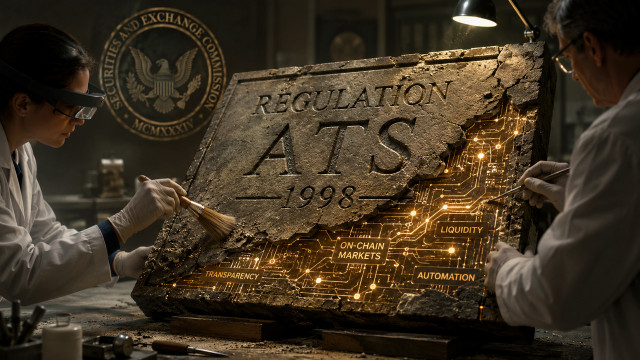
Atkins’s May 8 speech signals a limited exemption for on-chain trading while the SEC holds broader exchange definitions in reserve—setting up a regulatory fork that could split DeFi’s future from centralized platforms.
SEC Chair Paul Atkins, in a May 8 speech, said the agency could consider a limited “innovation pathway” for on-chain trading systems in the near future. That phrasing matters because it breaks from the binary narrative that all crypto platforms will either be promptly classified as securities exchanges or remain entirely outside the SEC’s reach indefinitely. Instead, Atkins sketched a two-track approach: formal rulemaking for the exchange definition will proceed under the traditional notice-and-comment process, while a parallel innovation pathway could give on-chain systems a tailored framework that avoids that full-blown classification.
For anyone trading DeFi tokens or running a protocol, the speech introduces a branching timeline. One path leads to a relatively swift exemption that preserves on-chain activity without the compliance weight of Regulation ATS. The other keeps large swaths of decentralized finance in the fog of an eventual rule that could treat automated market makers and order-book-style smart contracts as national securities exchanges. The SEC is not walking away from that broader effort; it is parking it while it tests a narrower door.
The simple read is “SEC softening on crypto.” The better read is that the Commission is resurrecting a 1990s-era fix. In the late 1990s, the SEC created a similar pathway for electronic communications networks–an innovation window that allowed new trading venues to operate with lighter registration while the overarching regulation caught up. Applied to on-chain trading, an innovation pathway suggests the agency might exempt certain decentralized systems from the full exchange definition if they meet guardrails on transparency, custody, or market integrity.
That is not an endorsement of current DeFi structures. It is an acknowledgment that shoehorning smart contracts into rules written for New York Stock Exchange floor brokers creates more legal risk than clarity. The actual conditions will decide who gets through. If the pathway demands real-world identity verification, transaction monitoring, and a licensed operator, it could look a lot like a regulated alternative trading system and offer little relief. If the conditions focus on code-audit standards and open-access principles, it could unlock a genuine compliance route for protocols that cannot possibly register as traditional exchanges.
The second track–the notice-and-comment rulemaking–is the real tail risk for tokens that anchor large decentralized exchanges. The SEC will define how crypto platforms fit the exchange definition, and that definition will likely capture most on-chain venues unless a specific exclusion is carved out. The innovation pathway, therefore, functions as a pressure-release valve. If it works, a subset of DeFi gets a clear lane. If it stalls or gets written too tightly, the default rule will be the full-exchange designation that came out of the formal rulemaking. The fork in the timeline lands in the next several months, when SEC staff could release an outline of the pathway conditions.
On-chain trading systems–Uniswap, Curve, and their equivalents–rely on permissionless liquidity pools. An innovation pathway that preserves that model while adding compliance wrappers could reduce the discount that DeFi tokens currently carry for regulatory uncertainty. If the pathway arrives in a workable form, expect a re-rating of governance tokens tied to leading automated market makers. If, instead, the pathway is conditioned on removing the permissionless feature, the liquidity pools that make these systems function would face fragmentation between fully permissioned versions and existing ones, and volume would likely migrate toward whichever fork best satisfies regulators first.
The second-order effect hits centralized exchanges. A clear innovation pathway for on-chain trading would siphon liquidity from venue tokens that bet on a future where only centralized platforms can meet compliance standards. At the same time, centralized exchanges that already hold alternative trading system licenses could use the pathway to spin off on-chain arms without triggering an entirely new registration burden. The strategic difference will turn on whether the pathway is narrow enough to exclude incumbent CEX models or wide enough to let them in.
No actual proposal text exists yet. That means the immediate price action in DeFi tokens is a bet on the direction of the first draft. Atkins’s speech gave no timeline beyond “near future,” so the window for speculation is wide. The obvious risk catalysts are an SEC staff concept release outlining the pathway criteria or, on the opposite side, a delay that pushes the broader exchange rulemaking ahead of the carve-out–forcing protocols to confront the cost of full registration before any relief arrives.
For protocols that have already restricted access for U.S. users, the innovation pathway could change the cost-benefit calculation. A limited U.S.-compliant pool that operates under the pathway might allow some domestic flow to return, rebuilding volume that was lost after front-end blocks and IP-based bans were imposed. That possibility alone could narrow the liquidity premium that offshore DeFi has enjoyed over the past two years, even before the exact pathway rules are published. No one should treat Atkins’s signal as a done deal, but the direction of travel is no longer only toward blanket exchange designation.
Drafted by the AlphaScala research model and grounded in primary market data – live prices, fundamentals, SEC filings, hedge-fund holdings, and insider activity. Each story is checked against AlphaScala publishing rules before release. Educational coverage, not personalized advice.