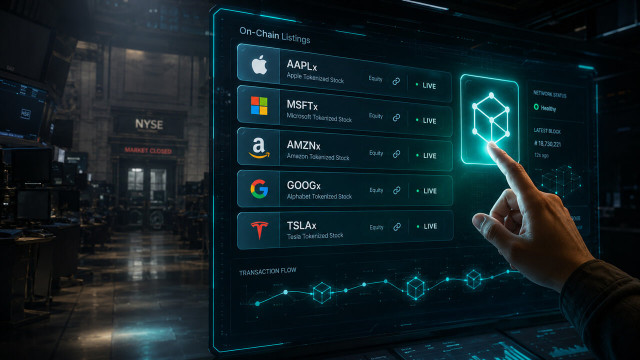
The SEC’s plan to require ownership proof for tokenized stocks creates a binary test for crypto exchanges that list tokenized equities. Exchanges must either demonstrate a verifiable link between each token and a registered custodial share, or face the risk of enforcement action. This requirement shifts the regulatory debate from what a token can represent to what an exchange can prove.
What the SEC Ownership Standard Demands
The SEC’s tokenized stock proposal insists that any platform offering tokenized equities maintain a one-to-one correspondence between the digital token and a share held at a qualified custodian. Traditional broker-dealers already segregate customer assets. The difference here is that the token trades on a blockchain, while the underlying share sits in an omnibus account. The SEC wants proof that each token issued reduces the real share count. Without that proof, the token is an IOU, not a claim on equity.
Exchanges offering tokenized shares of major companies such as Apple, Tesla, and Amazon are directly exposed. The same logic applies to tokenized ETFs and tokenized debt instruments. The SEC has not yet set a rulemaking timeline, but enforcement actions could arrive before formal guidance. The agency has already targeted unregistered securities offerings. This plan extends that enforcement logic to secondary trading of tokenized equities.
Exposure and Next Steps for Crypto Platforms
Crypto exchanges face two immediate consequences. First they must disclose their custody arrangement: which bank or custodian holds the shares, how the token and the share are reconciled, and what happens during a reconciliation failure. Second they must decide whether to delist tokenized stocks until the SEC clarifies the ownership standard.
- Platforms that reveal clear custody audits and daily reconciliation lower their regulatory risk.
- Platforms that cannot or will not disclose risk enforcement action and potential investor lawsuits.
- The affected assets include tokenized shares of large-cap companies and tokenized ETFs trading on platforms such as Binance and smaller decentralized exchanges.
The timeline for implementation is uncertain. The SEC could begin with a high-profile enforcement action against an exchange that lists tokenized stocks without providing ownership proof. That action would set the compliance standard for every platform in the market.
The Ownership Question and Counterparty Risk
Crypto native investors often assume that on-chain custody eliminates counterparty risk. Tokenized stocks invert that assumption. The token removes settlement risk but introduces custody risk at the issuer level. If the custodian holds a pool of 100,000 shares and issues 100,000 tokens, the system works only if the custodian remains solvent and honest. A custodian failure breaks the link. Token holders become unsecured creditors to the custodian’s estate, exactly as in a brokerage collapse.
What reduces the risk: a clear regulatory standard that mandates daily reconciliation, independent custody audits, and a legal framework that treats the token holder as the beneficial owner of the underlying share. What makes it worse: a fragmented regulatory landscape where some jurisdictions require proof and others do not, allowing bad actors to offer tokenized stocks without any custody chain.
AlphaScala’s earlier coverage of Michael Burry’s warning ties directly to this tension. In Burry Warns SEC Tokenized Stock Plan Risks 'Snow Crash' Future, the argument is that a purely digital representation of equity without a custody backstop creates a system that collapses under its own liquidity assumptions. The current SEC plan tests that thesis. Separately, the recent BlackRock’s $1.2B Crypto ETF Exodus in Five Days shows how quickly investor confidence can shift when custody questions arise.
The next decision point is not a vote or a deadline. It is the first enforcement action against an exchange that lists a tokenized stock without providing the ownership proof the SEC demands. For investors holding tokenized equities today, the practical move is to verify whether the exchange publishes custody details and audit reports. If those documents do not exist, the token is a promise, not a claim.