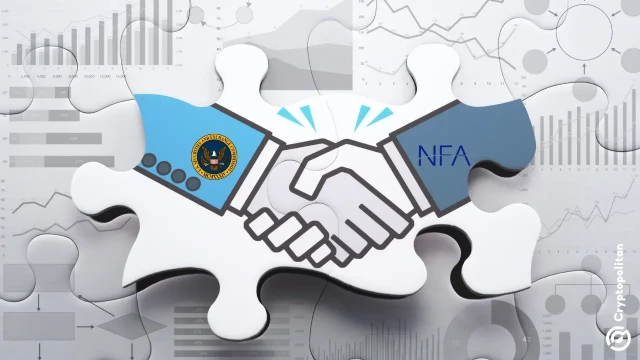
The U.S. Securities and Exchange Commission and the National Futures Association signed a Memorandum of Understanding on May 21 that formalizes joint examination coordination, information sharing, and risk monitoring across securities and derivatives markets. The MOU covers three areas: emerging risk management, examination program coordination, and financial market conditions monitoring.
SEC-NFA Examination Coordination: What Changes
The agreement gives the NFA a formal role in cross-agency oversight that previously relied on informal cooperation. For firms registered with both the SEC and the CFTC – or those that operate dual-regulated entities – the MOU means examiners from two agencies can share findings without separate requests. That reduces procedural friction but also raises the likelihood that a finding in one venue triggers a review in the other.
Information sharing now covers proprietary trading data, customer complaint records, and compliance histories. The NFA, as a registered futures association, oversees commodity pool operators and introducing brokers that also handle securities. The SEC gains direct access to NFA exam results for broker-dealers that carry crypto assets as securities or commodities.
Crypto Exposure in the Crosshairs
The MOU’s primary effect on crypto markets is indirect but material. Many crypto trading platforms hold both securities (token offerings deemed securities by the SEC) and commodities (Bitcoin, Ether futures regulated by the CFTC). The NFA already examines crypto derivatives firms, including those offering Bitcoin (BTC) and Ethereum (ETH) futures. The SEC now has a structured channel to obtain NFA exam data on those firms.
Coinbase (COIN), which operates a regulated exchange and a futures commission merchant, faces dual scrutiny. The MOU does not create new rules but makes cross-agency enforcement more efficient. A compliance gap in spot crypto operations could now appear in SEC reviews of the derivatives side, and vice versa.
What would reduce the risk: Clear regulatory classification of digital assets as either securities or commodities. That would limit the scope of dual examination exposure. The pending CLARITY Act in Congress, if passed, could provide that clarity. The CLARITY Act faces a four-week June window for a Senate vote.
What would make it worse: Aggressive enforcement coordination without a settled legal framework. If one agency finds a violation in a gray-area token, the other can use that finding to justify its own action. The MOU’s emerging risk management clause explicitly covers new products and market structures, which could sweep in decentralized finance (DeFi) protocols that touch both securities and derivatives.
Next Decision Points
The MOU takes effect immediately. The first joint examinations are likely to target firms with significant cross-market activity: platforms that list tokenized stocks, futures on crypto indices, or margin products that blend spot and derivatives. The SEC’s next public guidance on crypto classification – expected later this year – will determine how aggressively the new information-sharing pipeline is used.
For traders, the near-term risk is regulatory surprise. A firm that passes an NFA exam might still face SEC questions based on the same data. That uncertainty could widen bid-ask spreads on crypto derivatives and push some offshore platforms to restrict U.S. customer access. The cross-exchange $6.7M hack that hit Coinbase and Kraken users last month showed how quickly confidence can shift when operational risk surfaces. The SEC-NFA MOU adds a regulatory layer to that same vulnerability.
Watch the CFTC’s enforcement calendar and the SEC’s annual exam priorities for signs of coordinated action. Both agencies publish these in the next quarter. Any mention of the MOU in those documents will be a clear signal that the partnership is moving from paper to practice.