Crypto▼ Bearish
SEC Crypto Proposal Spares Insiders From Mandatory Lockup; Senate Draft Doesn't
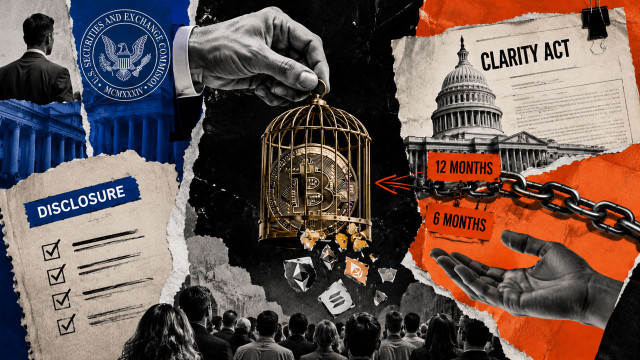
The SEC's plan lets token issuers decide insider sale timing, while the Senate's CLARITY bill would force a 12-month hold. The two paths diverge on who bears the risk.
Continue with
The SEC's new crypto fundraising proposal treats tokens as immediately tradable upon acquisition, leaving insider sale timing to each issuer. The Senate's July 22 CLARITY draft would force a different handling: a 12-month holding period before a token's network clears a control test, then six additional months after certification.
Both frameworks aim at the same concern – early holders with inside knowledge can sell before the public sees the full picture. They split on the fix.
Regulation Crypto Assets under the SEC spends several pages building the case for insider lockups. It cites the information gap between project teams and buyers. It reviews research showing token offerings perform better under vesting or lockup terms. Then it settles on disclosure as the answer. Issuers decide whether to restrict their own insiders. The SEC pushes the question one step further by asking commenters whether it should require a one-year holding period before finalizing the rule.
The Senate draft, in a section titled Special Restrictions on Disposition, simply mandates the hold. The clock starts at 12 months before the network is certified as free of coordinated control. Once that certification lands, the minimum drops to six months. The bill also caps how much an insider can sell in any 12-month stretch, with the SEC left to set the exact number.
The SEC's proposal does not skip sale caps entirely. A Tier 2 offering under the fundraising exemption can raise up to $75 million in a year, and affiliates of the issuer can supply up to $22.5 million of that. Tier 1 tops out at $20 million total, with $6 million available to those same insiders. A separate cap in the issuer's first year limits securities sold by insiders to 30% of the total raise. On a full $75 million Tier 2 offering, that ceiling matches the affiliate cap at $22.5 million.
The caps govern how much insiders can sell through a qualified offering. Timing remains the open question. Under the SEC's draft, an insider can sell the moment a token stops counting as a restricted security. No minimum holding period applies.