The Philippine Institute for Development Studies (PIDS) has signed on as a participant in the newly launched Consortium for Agricultural Policy Research Initiatives (Capri). No single stock gapped on the announcement. The catalyst is structural: eleven Southeast Asian countries agreed to coordinate agricultural policy research, harmonize data, and translate evidence into regulation. For investors tracking food supply chains and commodity exposure, the consortium creates a concrete timeline of signposts between now and the November 2026 launch of a regional agricultural statistics database.
Catalyst: Capri Consortium Launch
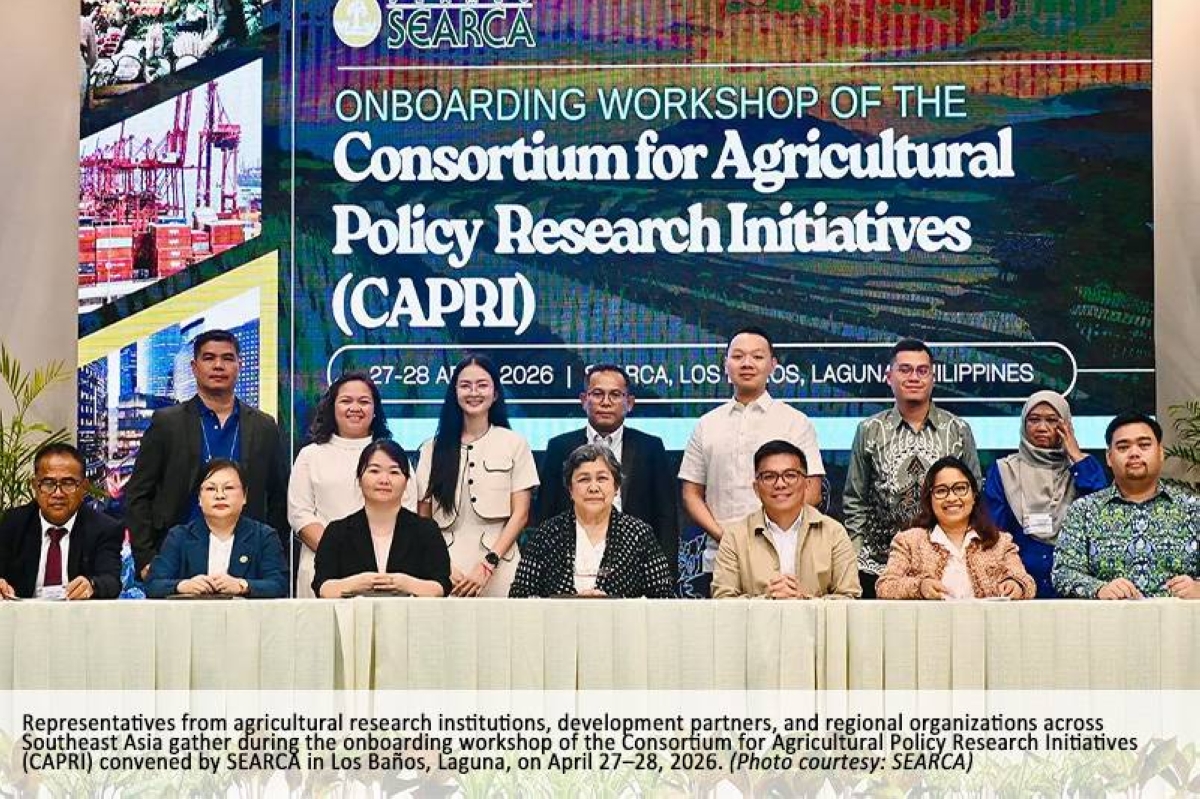
Capri was formally introduced during an onboarding workshop convened by the Southeast Asian Regional Center for Graduate Study and Research in Agriculture (Searca) on April 27–28, 2026. Representatives from eleven Southeast Asian countries attended, alongside officials from Asean and the Southeast Asian Ministers of Education Organization (Seameo). PIDS Senior Research Fellow Sonny Domingo contributed to discussions on regional agricultural policy priorities.
The anchor document
Capri is rooted in Searca's 12th five-year development plan, Sustain Southeast Asia. The consortium's stated goals include addressing food insecurity, climate risks, rural development pressures, labor migration, and aging farming populations. These are long-standing challenges. What is new is the explicit commitment to evidence-informed policymaking across borders rather than ad hoc national responses.
Searca Center Director Mercedita Sombilla described Capri as a platform for generating policy-relevant evidence, aligning research priorities, and translating research into policy and practice. That translation gap has historically been the weak link. Capri is designed to close it by creating thematic working groups under the "Pocket, Plate, Place and People" framework.
Why Harmonized Data Changes the Game
A naive reading treats the consortium as a routine research collaboration with limited market impact. The better read starts with the structural weaknesses in Southeast Asian agricultural policy that Capri aims to fix.
Fragmented data and policy misalignment
Each country in the region collects agricultural data using different methodologies, release schedules, and quality standards. That fragmentation makes it difficult for investors to compare production costs, export competitiveness, or subsidy impact across borders. It also makes it easier for governments to pursue policies that work domestically but create negative externalities for neighbours – a classic collective action problem.
The amplifying factor: climate and trade shocks
When a drought hits the Mekong Delta or a trade restriction is imposed on palm oil, effects cascade through multiple national supply chains. Without harmonized data and shared research, responses tend to be reactive and often counterproductive. The working groups under Capri's "Pocket, Plate, Place and People" framework are designed to model cross-border dynamics in real time.
Key insight: The consortium's value lies not in the research itself but in the standardization of how research is conducted and communicated. That standardization reduces information asymmetry between investors and policymakers. A single harmonized data source lowers due diligence costs for commodity traders and agribusiness analysts.
Confirmation Signposts: What Actually Moves the Thesis
Not every consortium delivers on its promise. Investors treating Capri as a valid catalyst need specific confirmation points before adjusting sector exposure.
Signatory formalization
Founding signatories already include institutions from Indonesia, Lao PDR, Myanmar, Timor-Leste, and Vietnam. Institutions from the Philippines, Brunei Darussalam, Singapore, Malaysia, Cambodia, and Thailand are expected to formalize membership. The confirmation event is each institution submitting signed Membership Agreements. Any country that delays or withdraws weakens the consortium's credibility.
Operational framework deliverables
The workshop affirmed working groups and joint research initiatives. The first concrete deliverable will be a priority list of comparative studies. If by Q3 2026 the working groups have published scoping documents with measurable objectives, the setup gains traction. If the agenda remains vague after six months, treat the consortium as a paper exercise.
The Southeast Asian Agricultural Statistics Database
Searca announced a planned launch for November 2026. This database is the most tangible confirmation point. A publicly accessible, harmonized data set covering production, trade, prices, and labour across eleven countries would be a significant shift. For commodity traders and agribusiness analysts, it reduces the cost of due diligence and allows more precise regional hedges. Delays or scope reductions would signal limited buy-in.
| Confirmation Signpost | Expected Timing | Impact on Thesis |
|---|
| All 11 members sign Membership Agreement | Mid-2026 | Strong positive; validates collective commitment |
| Working groups publish scoping documents | Q3 2026 | Moderate positive; shows operational momentum |
| Agricultural Statistics Database launch | November 2026 | High positive; creates new data infrastructure |
| First joint policy brief or recommendation | H1 2027 | Moderate positive; proves translation-to-policy pipeline |
Risk Factors: Where the Setup Breaks
No institutional collaboration is guaranteed to survive political turnover, funding gaps, or competing national interests.
Political commitment durability
Agricultural policy is inherently political. Governments change, and new administrations may not prioritize regional coordination. The consortium's reliance on Asean and Seameo support provides some insulation. The test comes when a member country faces a domestic agricultural crisis and decides to act unilaterally. If Capri produces a recommendation that a government ignores, the signalling power diminishes.
Funding and staffing
No budget figures were disclosed. Capacity-building, data management, and joint research require sustained financial commitment. If the consortium relies on donor funding with short horizons, long-term stability is questionable. The IFAD-funded project on agricultural transformation and market integration mentioned in the source covers only a subset of activities.
Implementation vs. ambition
Rico Ancog, Searca Deputy Director, framed Capri as “a collective commitment to strengthen agricultural policy research across Southeast Asia, ensuring that evidence informs decisions and drives transformation.” That is the ambition. The risk is that the consortium becomes a talking shop, producing reports no policymaker reads. The November 2026 launch of the statistics database will be the first real test of whether the ambition translates into usable outputs.
Next Event: November 2026 Database Launch
Searca plans to officially launch Capri during its 60th anniversary celebration in November 2026, alongside the agricultural statistics database. That event is the next concrete marker on the calendar.
How to position around the catalyst
The setup is structural, not immediate. No single stock or commodity will gape on the November launch date. The correct approach is to use the database launch as a quality check on the consortium's potential. Monitor the database scope: does it cover non-traditional sectors like aquaculture, coffee, and horticulture, or is it limited to staple crops? A comprehensive, open-access, regularly updated data set is a positive for long-term investments in Southeast Asian agricultural logistics, input suppliers, and food processing companies that operate across multiple countries. A limited or delayed database weakens the thesis.
For traders looking at shorter timeframes, the confirmation signposts listed above provide event-driven entries. Each signatory announcement or working group milestone could generate local interest in exchange-traded products covering the region, such as the iShares MSCI Indonesia ETF (EIDO) or the VanEck Vietnam ETF (VNM), though these are not directly tied to agriculture. The safer play is to wait for the November 2026 launch and evaluate the data set's quality before making sector-level allocations.
Capri changes the information environment for Southeast Asian agricultural policy. The confirmation sequence runs through mid-2026 to the November database launch. Treat headline risk as noise until the statistics database is operational. A fully functioning, harmonized data set is the only output that matters for investors.
For ongoing analysis of sector and market moves, visit the stock market analysis section. Readers new to direct investing can review the best stock brokers before building exposure to the region.