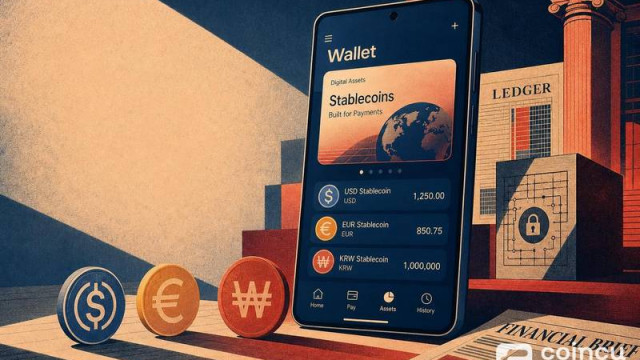
Samsung's mobile wallet may soon support native stablecoins. The feature would let users hold and spend price-stable crypto directly, without a separate app. Details on supported coins and launch timing remain unconfirmed.
Samsung is signaling native stablecoin support for its mobile wallet, a move that would let users hold and spend price-stable crypto assets directly inside Samsung Wallet rather than through a third-party app.
The signal surfaced alongside the company's broader consumer finance push, including the newly introduced Galaxy Card. Coin Edition tied the stablecoin roadmap signal to the same wallet and card expansion.
Details are thin. The evidence confirms the direction but not the supported assets, launch timing, custody model, or regional scope.
Native support means stablecoin functionality built into Samsung Wallet itself. That differs from indirect access, where users route through an external application or a linked service to touch stablecoins. Wallet-level integration typically means fewer steps, no separate app to install, and a single interface for holding and moving funds.
None of the specific rollout mechanics are confirmed, so the exact shape of that integration remains open.
Stablecoins are designed to hold a steady value, unlike volatile tokens whose price can swing between checkout and settlement. Samsung Wallet is a consumer-facing mobile environment, which makes payments the natural use case. Placing stablecoin rails inside that environment points toward everyday actions such as checkout, transfers, and peer-to-peer sends.
The convenience angle is the core appeal: mainstream users who already tap their phone to pay could do the same with a stablecoin balance without learning a new tool.
Samsung is a globally recognized hardware and software brand with large consumer distribution. When a platform of that size adds a crypto feature, it can help normalize that feature for audiences who would never seek out a dedicated crypto app. That distribution and brand-trust advantage is the real story here, more than any single volume claim.
Downstream, it could matter for stablecoin issuers, wallet developers, and competing device makers weighing similar moves. It also echoes how exchanges have leaned on native asset support to broaden access.
Platform support alone does not guarantee mass adoption. Distribution creates the opportunity; usage still depends on execution, incentives, and regulation.
The most important unknowns are practical. The evidence does not specify which stablecoins would be supported, which jurisdictions would get the feature, how assets would be custodied, or when any of it launches. Stablecoin features are especially sensitive to compliance, licensing, and regional restrictions, which means availability could differ sharply by market.
An Open USD Consortium dispute over listing Samsung as a stablecoin partner underscores how contested the details around Samsung's involvement already are.
A final open question is functional scope: whether native support covers storage only, or extends to transfers, payments, and broader wallet actions. That answer will determine how significant the move really is.
Drafted by a large language model from the source reporting linked above, then screened by automated publishing checks. It is not read by a journalist before publication. Some articles cite our Alpha Score. Verify prices and figures against the original source. Educational coverage, not personalized advice.