Back to Markets
Indices● Neutral

RYLD Strategy Shifts as Russell 2000 Volatility Constraints Emerge

RYLD Strategy Shifts as Russell 2000 Volatility Constraints Emerge
ASAONINGRYLD

The Global X Russell 2000 Covered Call ETF faces a structural test as small-cap volatility dictates the viability of its income-generating strategy.

AlphaScala Research Snapshot
Live stock context for companies directly referenced in this story
Consumer Cyclical
Alpha Score
47
Weak

Alpha Score of 47 reflects weak overall profile with moderate momentum, poor value, moderate quality. Based on 3 of 4 signals — score is capped at 90 until remaining data ingests.

Alpha Score
55
Moderate

Alpha Score of 55 reflects moderate overall profile with moderate momentum, moderate value, moderate quality. Based on 3 of 4 signals — score is capped at 90 until remaining data ingests.

Alpha Score
45
Weak

Alpha Score of 45 reflects weak overall profile with strong momentum, poor value, poor quality, weak sentiment.

Financial Services
Alpha Score
75
Strong

Alpha Score of 75 reflects strong overall profile with strong momentum, strong value, strong quality. Based on 3 of 4 signals — score is capped at 90 until remaining data ingests.

This panel uses AlphaScala-native stock data, separate from the source wire linked above.

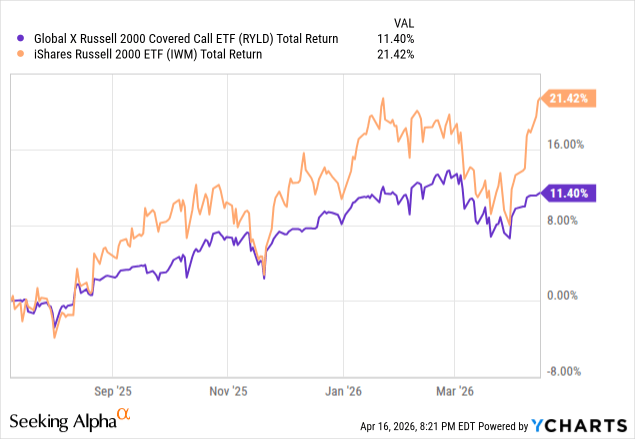
The Global X Russell 2000 Covered Call ETF (RYLD) has entered a period of structural testing as the underlying small-cap index struggles to find a consistent directional trend. By selling at-the-money call options on the Russell 2000, the fund effectively caps its participation in market rallies while collecting premiums that generate a double-digit yield. This mechanism functions optimally in sideways markets, but recent index behavior has highlighted the limitations of a strategy that sacrifices upside potential for immediate cash flow.

Structural Constraints of Covered Call Income

The core value proposition of RYLD rests on the volatility of the Russell 2000. When the index remains range-bound, the premiums collected from the covered call strategy provide a consistent income stream that often outperforms the price appreciation of the index itself. However, the fund faces a recurring hurdle when the Russell 2000 experiences sharp, sudden moves. Because the calls are sold at-the-money, the fund is forced to cap its gains during recovery phases, leaving investors with the downside risk of the underlying assets without the benefit of full participation in the subsequent rebound.

This dynamic creates a specific performance profile that diverges from traditional equity indices. While the market analysis often focuses on growth-oriented tech stocks, RYLD serves as a proxy for investors prioritizing yield over capital preservation or aggressive growth. The fund effectively converts equity volatility into a fixed-income-like distribution, but this conversion is only efficient if the underlying index does not breach the strike prices set by the option writing strategy.

Sector Read-Through and Small-Cap Sensitivity

The Russell 2000 is heavily populated by companies that are more sensitive to interest rate fluctuations and domestic economic conditions than their large-cap counterparts. As these firms navigate shifting credit environments, the volatility of the index remains elevated. For RYLD, this volatility is a double-edged sword. Higher implied volatility increases the premiums the fund can collect, which theoretically boosts the distribution yield. Yet, it also increases the likelihood that the index will swing violently, potentially leading to the assignment of the underlying shares and the loss of future upside.

Investors must weigh the trade-off between the immediate ~12% yield and the potential for total return stagnation. If the small-cap sector enters a sustained bull market, the covered call strategy will systematically underperform a standard index tracker. Conversely, if the broader stock market analysis suggests a prolonged period of economic uncertainty, the income generated by RYLD acts as a buffer against price erosion. The fund is currently positioned to benefit from a lack of conviction in the small-cap space, where the absence of a clear trend allows the option premiums to accumulate without the risk of the index consistently breaking through the call strike prices.

AlphaScala Data and Next Decision Points

Market participants should monitor the relationship between the Russell 2000 implied volatility and the fund's distribution consistency. While tech-heavy indices like those tracked by ON stock page or healthcare-focused entities like A stock page often react to sector-specific catalysts, RYLD is tethered to the broader macro sentiment surrounding small-cap liquidity. The next critical marker for the fund will be the upcoming monthly option expiration cycles, which will determine whether the fund retains its underlying holdings or is forced to reset its position at a higher or lower strike price. Investors should watch for any compression in the option premiums, as this would signal a decline in the fund's ability to maintain its current yield levels without a corresponding increase in index volatility.

How this story was producedLast reviewed Apr 20, 2026

AI-drafted from named sources and checked against AlphaScala publishing rules before release. Direct quotes must match source text, low-information tables are removed, and thinner or higher-risk stories can be held for manual review.

Editorial Policy·Report a correction·Risk Disclaimer