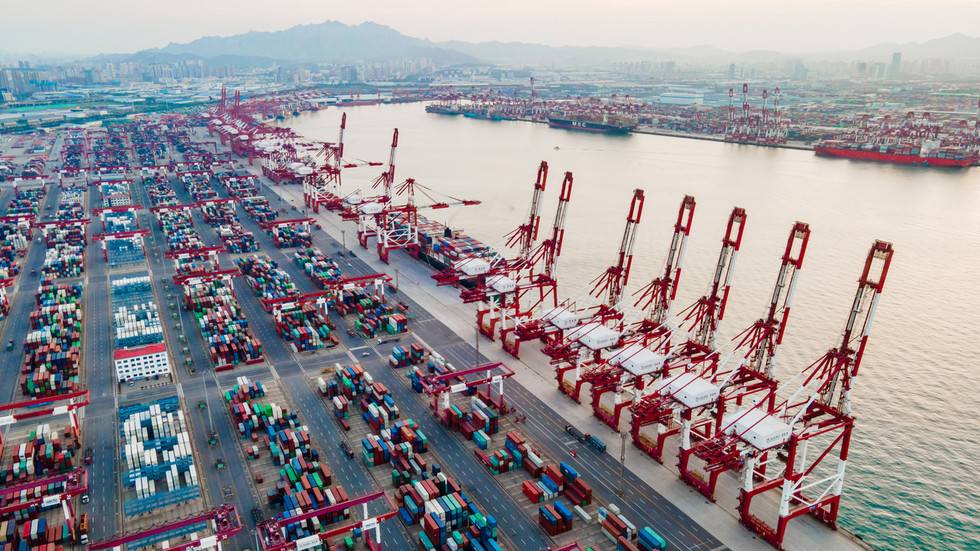
Russian President Vladimir Putin's two-day visit to Beijing, starting Tuesday, deepens a bilateral economic partnership that has reached $240 billion in annual trade. The partnership's core feature – nearly all transactions now in rubles and yuan rather than dollars or euros – directly reduces the effectiveness of Western financial sanctions. For asset allocators, this structural shift creates specific risks around commodity pricing, currency hedging, and sector exposure that are easy to underestimate.
$240B Trade: The Ruble-Yuan Settlement Shift
Bilateral trade between Russia and China has exceeded $200 billion for three consecutive years, hitting $240 billion in 2025. In the first four months of 2026, trade turnover reached $85.2 billion, up nearly 20% year-on-year, according to customs data. China has been Russia's largest trading partner for 16 years, while Russia now ranks among China's top eight trading partners.
Beyond $200B for Three Years
The composition is straightforward: Russia exports energy, raw materials, and agricultural goods; China exports machinery, vehicles, electronics, and consumer products. The escalation of the Ukraine conflict in 2022 and subsequent Western sanctions accelerated this rebalancing. The volume alone is now large enough to alter global trade patterns.
The Mechanism: Dollar Bypass
Nearly all bilateral transactions are now conducted in rubles and yuan. Moscow states this transition reduces reliance on “unfriendly” dollar- and euro-based financial infrastructure. For a portfolio manager, the practical implication is that the standard toolkit for sanctioning a sovereign – freezing reserves, restricting SWIFT access, banning dollar settlements – loses effectiveness when the target has already migrated to an alternate settlement ecosystem.
Energy Integration Reshapes Global LNG Flows
Russia and China declared a “no-limits” partnership in 2022. The energy component is the most concrete pillar. The Power of Siberia pipeline reached full design capacity in December 2024, delivering pipeline gas from eastern Siberian fields. Power of Siberia 2, a planned pipeline via Mongolia, could boost supplies from western Siberian fields that previously served Europe. Combined with existing and future routes, Russian gas exports to China could eventually exceed 100 billion cubic meters annually. Russia has also expanded LNG shipments from Arctic and Far Eastern projects including Yamal LNG, Arctic LNG 2, and Sakhalin-2, using the Northern Sea Route.
Pipeline and LNG Capacity Comparison
| Pipeline / Route | Status | Annual Capacity (bcm) | Notes |
|---|
| Power of Siberia | Full capacity (Dec 2024) | ~38 bcm | Eastern Siberian fields |
| Power of Siberia 2 | Planned | Up to 50 bcm | Via Mongolia; replaces Europe-bound flows |
| Yamal LNG (by sea) | Active | ~16.5 mtpa (LNG) | Arctic LNG; expanding |
| Arctic LNG 2 | Active (partial) | ~19.8 mtpa (full) | Sanctions-hit but operating |
Cheniere's Competitive Pressure
For Beijing, Russian energy offers proximity, competitive pricing, and a hedge against Western pressure. For Moscow, China provides a stable long-term market capable of absorbing large export volumes for decades. The net effect for global natural gas markets is a reduction in LNG spot availability in Atlantic Basin hubs as cargoes shift eastward. Cheniere Energy (LNG), the largest U.S. LNG exporter, faces a more competitive Asian market as Russia increases its share. On the proprietary AlphaScala scale, LNG carries an Alpha Score of 66 (Moderate), reflecting the balancing act between strong demand growth and rising Russian supply competition.
Infrastructure and Joint Technology: Replacing Western Inputs
Beyond energy, Russia and China have expanded cross-border transport links, including railway and highway bridges across the Amur River in the Far East, and the world's first international cross-border cable car connecting Heihe and Blagoveshchensk. A cross-border hydrogen freight corridor for heavy-duty zero-emission trucks is under exploration. These projects align with China’s Belt and Road Initiative (BRI).
$253 Billion in Joint Projects
According to the Russian Direct Investment Fund, more than 90 joint projects worth about 18 trillion rubles ($253 billion) are currently being implemented under the bilateral investment commission across infrastructure, energy, and logistics. A recently updated agreement on the promotion and mutual protection of investments strengthens the legal framework.
Sanctions Acceleration
Western sanctions have pushed both countries to accelerate joint technological development and reduce dependence on Western platforms. China has increased investment in Russian industries ranging from agriculture to telecommunications, including 5G and digital logistics. Every dollar invested in joint-venture projects that replace Western technology is a dollar of sanctions erosion. The timeline for evaluating the impact is three to five years, not one quarter.
Second-Order Risks for Western Portfolios
This partnership is a slow-burning structural shift with discrete points of risk for asset allocators.
- Dollar demand erosion: As ruble-yuan trade scales, global reserves may shift incrementally. The dollar remains dominant. The marginal dollar of demand is moving east.
- Commodity price decoupling: Russian oil and gas flows to China create a price floor independent of Brent or Henry Hub benchmarks. Western oil producers face a ceiling on market share in Asia.
- Sanctions effectiveness decay: If Russia and China can trade $240 billion annually without Western financial intermediation, the threat of future financial sanctions on other countries loses credibility.
- Supply chain substitution: Joint tech development in 5G, aviation, and nuclear energy reduces China’s reliance on Western inputs, potentially slowing the re-shoring narrative that has supported certain industrial stocks.
What Would Accelerate or Weaken This Thesis
Factors That Increase Risk
- A breakthrough on Power of Siberia 2 that locks in a long-term pricing agreement, further integrating supply chains.
- Expansion of yuan-denominated commodity contracts beyond bilateral trade into third-country markets.
- Any Western policy misstep that accelerates the de-dollarization narrative, such as aggressive secondary sanctions that push more countries to seek alternatives.
Factors That Reduce Risk
- A diplomatic resolution to the Ukraine conflict that allows Russia to gradually re-engage with European energy markets.
- Internal economic strain in Russia that limits its ability to finance large infrastructure projects.
- Chinese policy shifts prioritizing domestic demand over external infrastructure commitments.
For now, the $240 billion trade figure and the 20% year-on-year growth in early 2026 are the hard numbers. They show a partnership that is self-reinforcing. The best hedge for a Western-oriented portfolio is not to bet against the partnership. It is to understand which sectors – LNG exporters, industrial machinery makers, and banks with dollar clearing exposure – face the most direct structural headwind. The LNG stock page and broader stock market analysis offer deeper tracking for these themes.