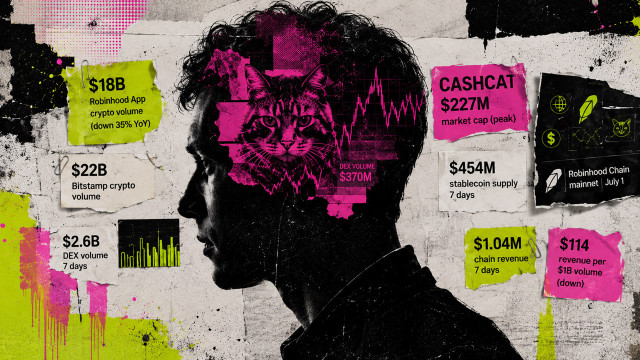
Crypto revenue fell to $100 million, just 12.9% of transaction-based revenue, as options and event contracts propelled Robinhood to a record quarter. The new Robinhood Chain saw $2.6B in DEX volume in a week.
Robinhood's second-quarter 2026 earnings showed a sharp shift in revenue composition. Crypto transaction revenue fell 38% year over year to $100 million, accounting for just 12.9% of the roughly $775 million in transaction-based revenue. Options trading generated $342 million and event contracts added $156 million, with equities contributing $129 million. Together, the three categories made up 81% of the segment.
The crypto revenue decline reflects the changing role of digital assets within the company. In the fourth quarter of 2024, crypto contributed $358 million, or 53% of transaction-based revenue. By the second quarter of 2026, that share had shrunk by a factor of four.
Robinhood reported $40 billion in total crypto notional volume for the quarter. The Robinhood app handled $18 billion, down 35% year over year. Bitstamp, the exchange Robinhood acquired in 2024, supplied the larger share at $22 billion. Bitstamp brings institutional liquidity and international reach, but its revenue per volume is lower. Crypto revenue per billion in notional volume fell from about $5 million in late 2024 to roughly $2.5 million in the latest quarter, according to the company's earnings data.
The company's broader financial infrastructure has expanded beyond the original app. Robinhood Chain, an Arbitrum-based layer-2 network, went live as a public mainnet on July 1. It is designed for tokenized stocks, real-world assets, DeFi lending, and AI-native finance. The first major burst of activity came from a memecoin.
CASHCAT, a token tied to Robinhood's "CashCat" origin story, reached a market cap of over $227 million and sparked a wave of memecoin launches. A Dune dashboard shows spot DEX volume on Robinhood Chain reached nearly $370 million on July 29. Over seven days, the network handled more than $2.6 billion in decentralized exchange volume. Stablecoin supply on the network surpassed $500 million, and chain revenue topped $1 million over the same period, according to DefiLlama.
The memecoin activity has generated real usage, but its sustainability is uncertain. CASHCAT's market value had fallen to $45 million after an 80% drawdown from its peak. That is still larger than the nearly $28 million in tokenized real-world assets on the network. Stock tokens trade on Robinhood Wallet in over 120 countries, available 24 hours a day and usable as collateral in DeFi lending pools. Robinhood describes them as tokenized debt securities that provide economic exposure to the underlying shares, without conferring legal or beneficial ownership. They are not available in the U.S. and restricted in other jurisdictions.
The company's record quarter was driven by options, event contracts, and equities, not crypto. The chain infrastructure shows where Robinhood is placing its next bet. The mix of stock-token holders, lending assets, memecoins, and recurring DEX volume will determine whether the network becomes durable infrastructure or a brief attention spike. Gold subscriptions, which grew 39% year over year to 4.8 million, provide another supporting revenue stream.
Robinhood now earns across a broader financial business that runs partly on crypto rails. The chain's $1 million in weekly revenue, while modest next to the app's earnings, represents a new stream from on-chain activity. The next quarterly report will show whether that activity has sustained.
Drafted by a large language model from the source reporting linked above, then screened by automated publishing checks. It is not read by a journalist before publication. Some articles cite our Alpha Score. Verify prices and figures against the original source. Educational coverage, not personalized advice.