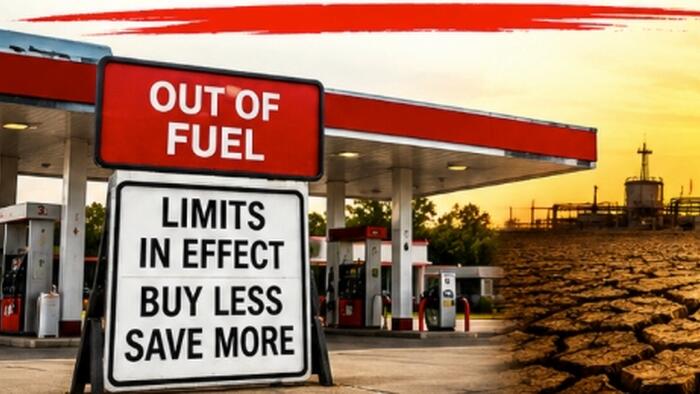
Global oil reserves are falling at the fastest pace on record, and the Strait of Hormuz closure has cut off 25% of seaborne crude. The simple read: prices will keep rising. The better market read: the real risk is physical shortages that force rationing, destroy demand, and trigger a multi-asset repricing.
Record Inventory Draw: 246 Million Barrels in Two Months
Global oil stocks fell by 246 million barrels in March and April combined, according to the source data. The drawdown accelerated in May, hitting a record 8.7 million barrels per day. That pace is not sustainable. Commercial inventories are being depleted faster than at any point in history, and the U.S. Strategic Petroleum Reserve (SPR) is shrinking at a record clip.
The SPR dropped by 9.1 million barrels in the week ended May 22, leaving reserves at 365 million barrels. The prior week's draw of 9.92 million barrels was the steepest on record, surpassing the previous record of 7.41 million barrels set in October 2022 during the Ukraine war. At this rate, the SPR will hit minimum operating levels within weeks.
SPR Weekly Drawdown Comparison
| Week Ended | Draw (million barrels) | Context |
|---|
| May 22 | 9.1 | Reserves at 365M |
| May 15 | 9.92 | All-time record |
| Oct 7, 2022 | 7.41 | Previous record (Ukraine war) |
The Strait of Hormuz: 25% of Seaborne Oil Cut Off
The de facto closure of the Strait of Hormuz is the primary driver. Even under the most optimistic scenario – Iran allowing free passage tomorrow – mines must be cleared first, a process that could take months. Tankers currently trapped in the Persian Gulf would need weeks to reach destinations. Meanwhile, damaged oil and gas infrastructure in Persian Gulf countries will take years to repair.
Key insight: The supply disruption is not a temporary spike. It is a structural loss of production capacity that will take years to restore.
Critically Low Stocks: Shearing's End-June Warning
Neil Shearing, chief economist at Capital Economics, warned in a May 18 research note that at the current pace of drawdown, commercial oil stocks "could reach critically low levels by the end of June." He added that if supply conditions do not improve soon, "prices could rise sharply."
That timeline is now less than five weeks away. The market is pricing in a near-term supply crisis, the mechanism is not just price – it is physical availability.
Asia at Minimum Operating Levels: Currie's July Timeline for the US
Jeff Currie, chief strategy officer of energy pathways at Carlyle and co-chairman of Abaxx Markets, told CNBC on the sidelines of the UBS Wealth Conference in Singapore that headline global inventory figures are misleading. A large portion of stored oil is needed to keep pipelines and storage systems running safely, leaving only a smaller share available for the market.
Asia is already close to these so-called "minimum operating levels." Europe is likely next. The U.S. could face shortages by July, Currie said. That timeline aligns with Shearing's warning: if commercial stocks hit critically low levels by end of June, the U.S. will be the next domino.
What This Means for Prices
Analysts expect U.S. gasoline prices could reach $5 per gallon this summer unless flows resume. Relief is unlikely before autumn. The price signal is not just a speculative premium – it reflects genuine scarcity.
Rationing Begins: Nissan Limits Motor Oil, Australia Prepares Fuel Caps
Rationing is no longer theoretical. Nissan is rationing 5W-30 and 0W-20 Genuine Motor Oils. Starting this week, Nissan's stock of these oils has dropped 30% year-on-year. The brand sent memos to dealers prioritizing warranty, extended warranty, recall repairs, goodwill, and prepaid maintenance customers.
Kim Less, vice president of aftersales at Nissan Americas, said in a May 15 bulletin: "Given these constraints, it is critical to prioritize the use of Nissan Genuine 0W-20 (and 5W-30, where applicable) for warranty, extended warranty, recall repairs, goodwill, and prepaid maintenance."
In Australia, the government has prepared a plan to impose a "maximum transaction value per vehicle per day" – a rationing rule limiting how much fuel a single vehicle can buy at a service station over 24 hours. Documents obtained by Guardian Australia under freedom of information reveal the measure is ready to deploy if local fuel supply shortages worsen.
Risk to watch: If the Strait of Hormuz remains closed, similar rationing measures could spread to Europe and North America. The Australian plan is a template, not an outlier.
Fertilizer and Food: The UN's Multi-Year Crisis Warning
The supply shock extends beyond oil. The United Nations warned that the de facto closure of the Strait of Hormuz risks a global food crisis that could last for years. About half of the global supply of sulphur – a key input for fertilizer – passed through the strait before the Iran war. Global fertilizer companies have slashed production over shortfalls.
Farmers are likely to produce lower yields in coming harvests. Richer economies like Europe are mulling building fertilizer stockpiles, reducing duties on imports, and onshoring production. Poorer economies have limited room to adapt.
The Pharmaceutical Angle
A pharmacist in the UK, Graham Jones of Shrivenham Pharmacy in Oxfordshire, said the current drug shortage is the "worst I've ever known." Medications for heart conditions, stroke risks, eye infections, and bipolar disorder are harder to obtain because of surging global prices and government funding that is not keeping up with costs. The Middle East is a major source of raw materials for pharmaceuticals.
What Confirms or Weakens the Thesis
What would reduce the risk: A rapid reopening of the Strait of Hormuz, with mines cleared and tankers flowing within weeks. That would ease the physical shortage and allow inventories to rebuild. Even in the best case, damaged infrastructure will take years to fully restore, so the supply deficit will persist.
What would make it worse: Any further escalation in the Iran conflict, damage to additional infrastructure, or a prolonged closure of the strait beyond the summer. That would push commercial inventories below minimum operating levels, triggering forced rationing across multiple sectors.
What to watch: Weekly SPR draw data, commercial inventory reports from the EIA, and any government announcements on fuel rationing. The key number is the pace of drawdown – if weekly draws remain above 8 million barrels, the end-June critical level becomes a hard deadline.
For traders, the immediate implication is that WTI crude futures and USO remain exposed to upside price risk. The more important trade is the physical shortage play: gasoline spreads, refinery margins, and fertilizer stocks. The crisis is not just about oil prices – it is about the availability of the commodity itself.
Bottom line for traders: The market is pricing a supply disruption, the real risk is a demand destruction event caused by rationing. That is a different trade. Watch the inventory data, not just the headlines.
For more on the broader energy landscape, see AlphaScala's crude oil profile and analysis of ProPetro's 2.1 GW Caterpillar deal for how oilfield services are pivoting. The Renaissance Trims CVX piece also offers context on institutional positioning in oil majors.