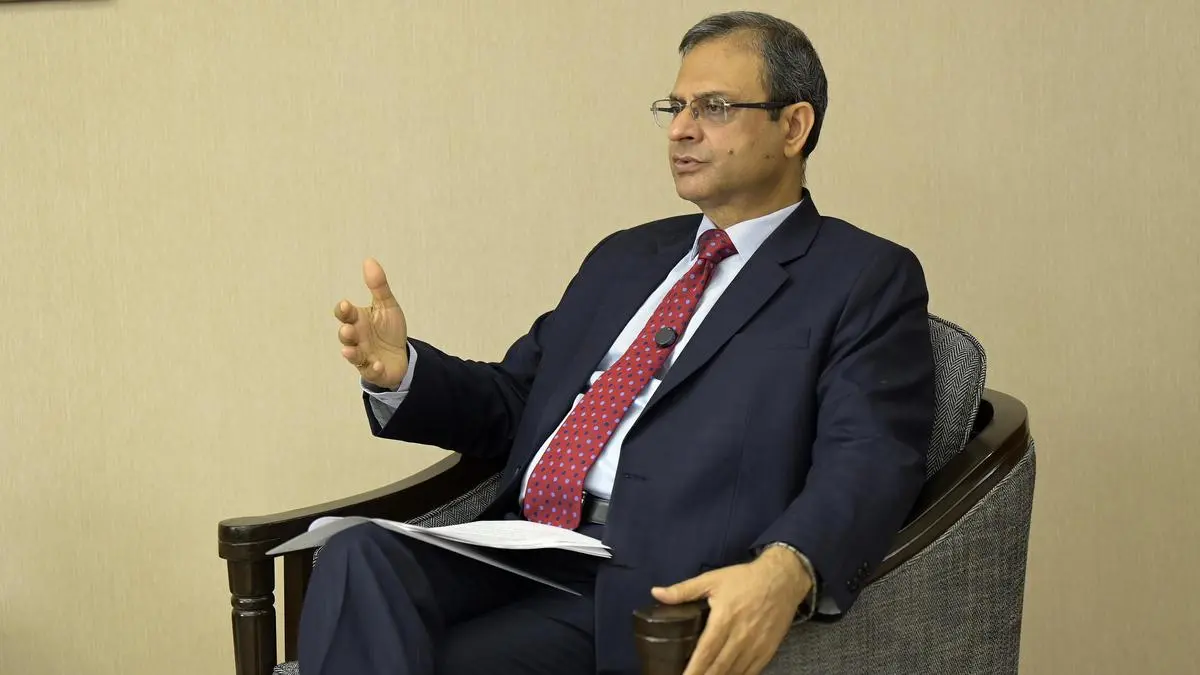
RBI Governor Sanjay Malhotra signalled the central bank could raise interest rates if inflation becomes more generalised. The current repo rate is appropriate, he said, but price stability remains the primary mandate. The next Monetary Policy Committee decision will be data-dependent.
Inflation has breached the midpoint of the 2-6% target band. Malhotra said the risk of higher food and fuel costs translating into broad-based inflation is real, though generalised pressures remain modest for now. “We will take an appropriate decision based on the data available and the outlook,” he said in a Sunday interview at the RBI’s Mumbai headquarters.
On the growth-inflation trade-off, Malhotra said price stability is the foremost priority. “Growth is certainly a consideration. We will do whatever is required first, to maintain price stability,” he said. The RBI has cut rates by 125 basis points in the current cycle. A reversal would tighten financial conditions directly, pushing up bond yields and strengthening the rupee.
The neutral stance allows rate moves in either direction without a prior stance change, Malhotra said. “It may not be necessary to change stance before taking any policy action,” he said.
Rupee Not Overvalued, Capital Inflows Hit $32 Billion
Malhotra defended the rupee against recent depreciation, saying it has performed better than many Asian peers. The weakness is driven by expectations, not India’s fundamentals. India’s current account swung to a surplus of $2.8 billion in April-May 2026 from a deficit of $4.1 billion a year earlier. FDI net inflows reached $6.5 billion in the first two months of the fiscal year, up from $2.5 billion.
He said the rupee is not overvalued and may even be undervalued in real effective exchange rate terms. “Once the situation in West Asia stabilises, one could very well see the rupee appreciate,” he said.
Capital flows mobilised by the RBI’s measures have reached $32 billion, mostly through FCNR(B) deposits. Another $7 billion flowed into government securities since June 5. Malhotra downplayed concerns about recirculation, saying there is no prima facie evidence of significance. Durable liquidity has increased by about ₹1.2 lakh crore since June 5, but government balances rose by ₹2.9 lakh crore, partly masking the inflows. The West Asia conflict has pushed up crude oil prices, adding to external pressures on emerging-market currencies.
The RBI’s CBDC pilot has 1.2 crore retail users and ₹40,000 crore in transactions, Malhotra said. The bank licensing pipeline is thin – one universal bank application pending – but several small finance banks have expressed interest in transitioning. Gold loan non-performing assets remain below 0.2%, with no material risk buildup, the Governor said.
On credit growth outpacing deposit growth, Malhotra said every rupee of credit creates an equivalent deposit, and banks’ capital and liquidity positions are adequate. “Credit growth is higher than that of deposits, but the difference in absolute terms is not so much,” he said.
The next MPC meeting is scheduled for August.