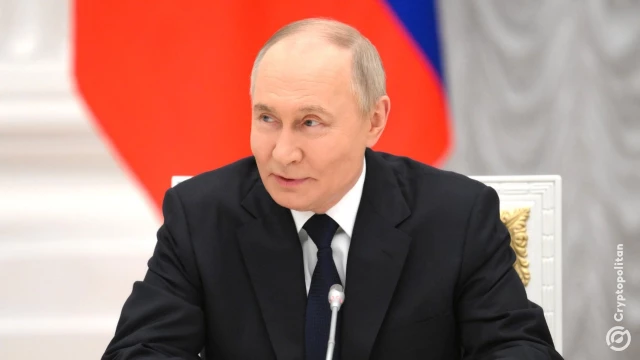
President Vladimir Putin signed Russia's "digital currency" bill into law Tuesday, legalizing crypto transactions for the first time. Investment and trading transactions are legal under the new rules. Direct payments with digital assets stay banned. The nearly 300-page package, titled "On Digital Currency and Digital Rights," takes effect September 1, 2026.
The bill passed the State Duma on July 21 and the Federation Council on the 24th. It was submitted in April, when lawmakers first voted on the proposal. The initial plan called for an earlier summer introduction; the effective date slipped after officials needed to fine-tune some provisions. The government's official portal for legal acts carried the signed text Tuesday, local media reported.
Trading will run exclusively through platforms licensed by the Central Bank of Russia. The law creates a new category of service providers, digital depositories, to handle custody and accounting of crypto holdings alongside existing stock market depositories. Custodians must register with the central bank and hold capital of 50 million to 250 million rubles, more than $3 million at the top end, depending on the activity. They are required to keep full transaction records and screen client transfers for suspicious movement of funds.
Financial brokers and capital management firms will act as intermediaries between Russian investors and crypto platforms, including platforms based abroad. Established exchanges and exchange offices offering non-cash crypto-fiat conversion are covered by the rules, as are custodians and clearing houses. Banks and other intermediaries round out the list of permitted participants.
The tightest restrictions fall on retail investors. Non-qualified investors can buy only a few of the largest cryptocurrencies, and no more than 300,000 rubles a year, under $4,000, through a single intermediary, RBC and Bits.media reported. A knowledge test is mandatory for all investors, who must demonstrate an understanding of the assets and their risks.
Central Bank Deputy Governor Vladimir Chistyukhin said Bitcoin and Ethereum meet the criteria for free circulation. He also named Tether's USDT. Only the largest, most liquid coins can trade on Russia's regulated exchanges, and the central bank requires a long pricing history before an asset qualifies.
The ruble remains the only legal tender in Russia, and the law strictly prohibits crypto payments. Banks are authorized to block any crypto-related transaction. A 48-hour cooling-off rule applies to transfers between crypto wallets and to fiat accounts. For most Russians, the law makes crypto an investment instrument, not a payment tool.
Inside Russia, only custodial wallets opened with authorized institutions can hold and move digital money. Self-hosted wallets are reserved for people and firms involved in foreign economic activities. The exemption lets them trade internationally and bypass fiat sanctions. Use of self-hosted wallets abroad is not restricted.
The legislation does not explicitly mention stablecoins. It supplements Russia's 2021 law "On Digital Financial Assets," which covers tokenized securities and coins issued in the country.
Residents and firms must conduct all crypto transactions through licensed intermediaries after July 1, 2027. The Bank of Russia has already published draft directives detailing how crypto exchange and margin trading will work.
A survey published this week found nearly 70% of Russians see no significant use case for cryptocurrency despite the coming legalization.