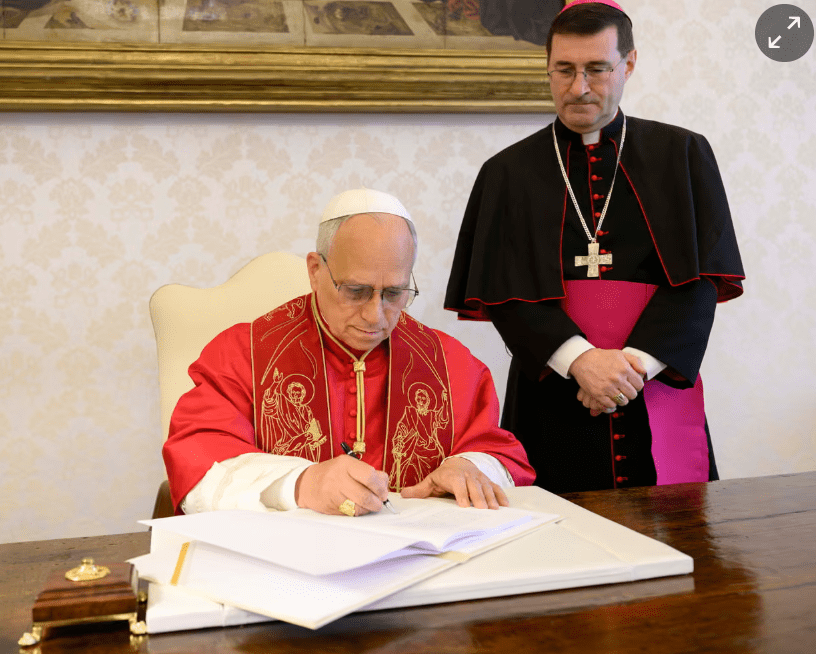
Pope Leo XIV’s 30,000-word encyclical Magnifica Humanitas is not a tradeable event like a Fed decision. For investors tracking AI regulation, the document functions as a structural signal. The Vatican’s social doctrine has historically seeded regulatory movements, including labor rights and environmental standards. This text targets the business model of the five listed companies controlling the AI stack – Microsoft (MSFT), Google (GOOGL), Amazon (AMZN), Meta (META), and NVIDIA (NVDA) – plus private OpenAI.
The Encyclical’s Core Challenge: Design Ethics, Not Use Ethics
The Pope writes that “every technical tool embodies choices and priorities through what it measures, ignores and optimizes, and how it classifies people and situations.” That statement shifts the burden from how companies deploy AI to how they build it. The encyclical calls for “robust legal frameworks, independent oversight, informed users and a political system that does not abdicate its responsibility.”
What the Pope Targets
- Algorithmic opacity in ad-tech, credit scoring, hiring, and content ranking.
- Concentrated power in “private, transnational corporations that monopolize expertise, data, and decision-making authority.”
- Autonomous weapons and irreversible decisions made without human moral judgment.
- Self-regulation as insufficient without shared standards of social justice.
The Vatican invited a co-founder of Anthropic – which markets itself as a “constitutional AI” company – to speak alongside the Pope. That signals a preference for transparency over the black-box approach of many incumbents.
Practical rule: Investors should watch whether Catholic-majority jurisdictions – Italy, France, Spain, Poland, Mexico, Brazil, the Philippines – begin proposing legislation that mirrors the encyclical’s language. That would multiply the compliance surface area.
Exposed Sectors: Big Tech, Media, and Defense
Big Tech Valuation Risk
Meta (META) and Google (GOOGL) face the highest direct exposure. Their core revenue streams – feed ranking, search ranking, ad allocation – are algorithm-driven. Any requirement for explainability or human override would raise operating costs and potentially reduce ad yield. The encyclical’s rejection of “the logic of efficiency, control and profit alone” (quoting Pope Francis) would, if codified, hit these companies’ operating models.
NVIDIA (NVDA) is indirectly exposed. The encyclical does not mention hardware. A slowdown in AI deployment due to regulatory friction would reduce demand for GPUs. The stock’s AI growth premium would face compression.
Microsoft (MSFT) , through its partnership with OpenAI and Azure AI services, sits at the center. The Vatican invited an Anthropic co-founder while implicitly criticizing models that cannot be openly audited. That asymmetry matters: Anthropic may face less regulatory pressure than OpenAI.
Media and Publishing: Truth as a Shared Gift
The encyclical’s treatment of truth directly challenges the current strategy of publishers like The New York Times (NYT) and News Corp (NWSA) . The Pope writes that “truth is a gift to be shared, not a possession to be monopolized.” That cuts against the framing that data is property to be licensed. If the Vatican’s moral framework gains traction, publishers could find their negotiating position weakened.
Key insight: Investors in media stocks should monitor whether Vatican-backed statements endorse open-data or fair-use doctrines. Any such signal would reduce the expected licensing revenue that publishers have baked into their AI strategy.
Defense Contractors and Autonomous Systems
The encyclical’s prohibition on lethal autonomous decisions is the sharpest intervention. “It is not permissible to entrust lethal or otherwise irreversible decisions to artificial systems,” the Pope writes. Defense contractors developing AI targeting – Lockheed Martin (LMT) , Raytheon (RTX) , Palantir (PLTR) – would face reputational and regulatory headwinds if the Vatican’s position gains political cover in Europe or the U.S.
Regulatory Timeline: When the Risk Materializes
Q3 2025: EU AI Act Implementation
The European Commission begins enforcing the AI Act’s high-risk provisions in Q3 2025. If the Vatican’s social doctrine is cited in parliamentary debates – especially in Italy under Prime Minister Giorgia Meloni, who has strong Catholic ties – it would add moral weight to already restrictive rules.
ESG Frameworks and Shareholder Resolutions
The more immediate catalyst is consensus pressure. European pension funds and Catholic-affiliated endowments may incorporate the encyclical’s principles into ESG frameworks. Companies with AI business in the crosshairs could face shareholder resolutions. This would mirror the trajectory of fossil fuel divestment campaigns.
What Would Reduce the Risk
Political Divergence
If the U.S. Congress and the European Commission continue to diverge on AI regulation – with the U.S. favoring light-touch policies and the EU favoring prescriptive rules – the encyclical becomes a regional factor, not a global disruptor. Companies with dominant U.S. revenue share (NVDA, META, GOOGL) would be less affected.
Voluntary Compliance
If AI companies preemptively adopt the encyclical’s transparency and accountability standards – publish model cards, submit to independent audits, create human-in-the-loop mechanisms for high-stakes decisions – the risk of mandatory regulations recedes. The Vatican explicitly invites that path: “Responsibility must be clearly defined at every stage: from those who design and develop these systems to those who use them.” Voluntary adoption would be costly. It would be less disruptive than forced compliance.
What Would Make It Worse
Legislative Reference
If even one major jurisdiction – France or Italy – introduces a bill that explicitly references Magnifica Humanitas as a source of ethical principles, the risk profile for big tech shifts from abstract to measurable. Compliance costs would rise. Litigation would multiply. The most exposed companies would face a valuation haircut on their AI growth premiums.
Public Backlash and Coalition Building
The encyclical gives moral language to critics who already distrust big tech. If labor unions, consumer groups, and political parties adopt its framework, the narrative changes from “regulatory overreach” to “moral duty.” That is harder to lobby against. The Pope’s rejection of universal basic income as a substitute for work dignity aligns with conservative and labor interests, broadening the coalition.
For traders, Magnifica Humanitas is not a catalyst to short META or NVDA tomorrow. It is a reason to track the velocity of regulatory language. If quarterly earnings calls begin to include questions about “alignment with the Vatican’s ethical framework,” the risk has moved from the encyclical page to the income statement.