Picketa Raises $2.1M to Put Plant Tissue Analysis in Farmers' Hands
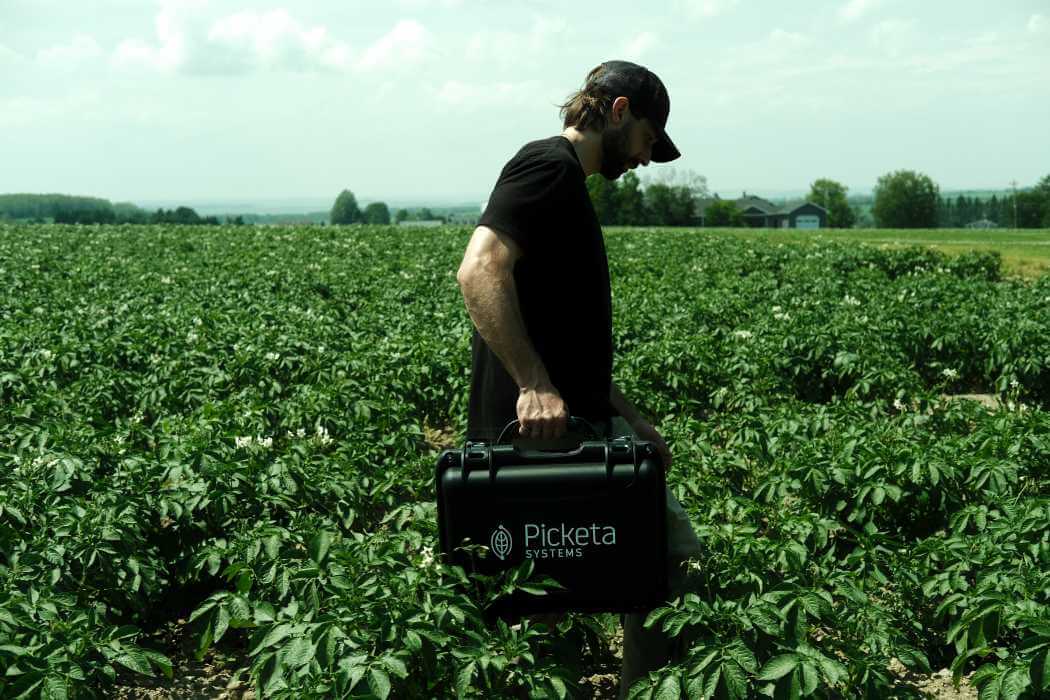
Picketa's LENS device cuts fertilizer waste by up to 20% with on-the-spot tissue analysis. The $2.1M seed round funds scaling production and crop support.
Fertilizer prices have jumped since the Strait of Hormuz closure and the Iran conflict. Every pound of nitrogen costs more. Fredericton-based Picketa just closed a $2.1 million seed round to help farmers stop wasting what they apply.
Picketa's device, the Leaf Evaluated Nutrient System (LENS), does plant tissue analysis in the field. Instead of sending samples to a lab and waiting weeks, a farmer gets results on the spot. The system compares the readings against a database built from thousands of plants at different growth stages. The company says it can cut in-season fertilizer spending by up to 20%.
“It’s a very tough time to be a farmer,” CEO Xavier Hébert-Couturier told Betakit. “A lot of the new chemistry is going into micronutrients and biologicals, which people don’t really know how to use, or when to use, or when to apply. This is why the interest is so high; instead of putting on more nitrogen, the next yield gain is going to be from saving what you don’t need to apply.”
The simple read: a hardware sale. The better read: the database is the moat. Every tissue test feeds the model, making the next prediction more accurate. That network effect is hard to replicate. Picketa started with potatoes, then added corn, canola, soybeans, and wheat – crops that cover a big chunk of North American acreage. The device is now in 45 agriculture retailers. User count has quadrupled in two years. More than 1,000 farms across most of Canada and 16 U.S. states use it, Hébert-Couturier said.
What would confirm the thesis: Picketa scales production to hundreds of units per year, adds five more sales and support staff as planned, and expands crop support to onions, carrots, and celery – the next 20 types on the roadmap. If adoption keeps accelerating in the Midwest and Western Canada, the network effect gets stronger.
What would weaken it: a competitor launches a cheaper, faster alternative. Or the database fails to generalize to new geographies and crops. Or adoption stalls because farmers stick with lab testing out of habit. Picketa's total funding is now about $4.6 million, including a previously undisclosed $700,000 seed extension. That's enough to prove the model but not to outspend a well-funded rival.
The round was led by Tall Grass Ventures, with BDC Seed Fund, Verdex Capital, Skull Diamond and Heart Capital joining as new investors. Returning backers include NBIF, Koan Capital, and East Valley Ventures.
Hébert-Couturier said the goal is to make the LENS as common as a phone for agronomists. “If people want more crops, they can partner with us, and we’ll work to add those crops. If we have a good partner that walks in and wants to do coconuts, we’ll do coconuts.”
For now, the focus is on the Midwest and Western Canada. The next catalyst is production ramp and hiring. If Picketa hits its unit targets, the database grows faster, and the value proposition gets harder to ignore.
Drafted by a large language model from the source reporting linked above, then screened by automated publishing checks. It is not read by a journalist before publication. Some articles cite our Alpha Score. Verify prices and figures against the original source. Educational coverage, not personalized advice.