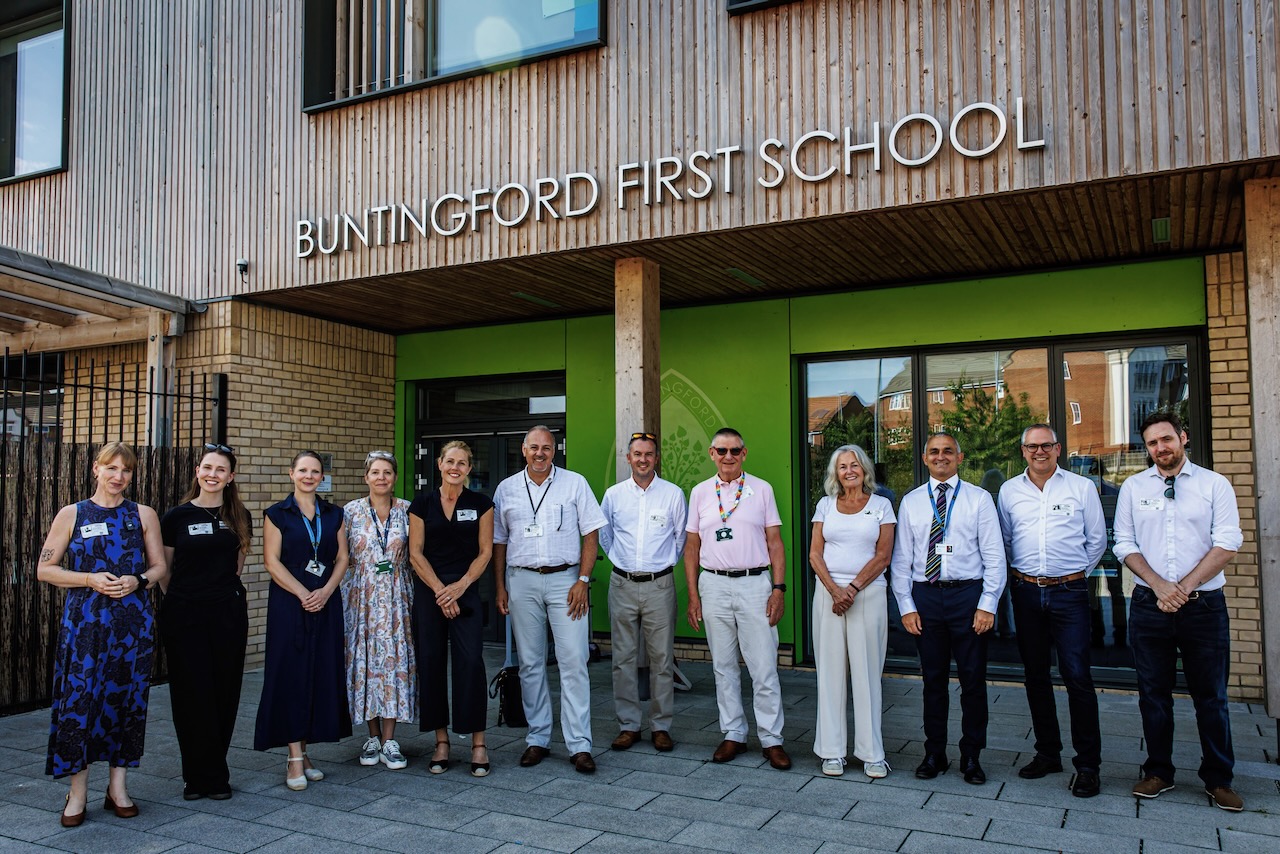
Buntingford First School stayed open through last summer's heat wave while many schools shut. The building earned Passivhaus certification this week, confirming it meets the strictest net-zero building standards.
The performance numbers explain why. In its first year, the school used 39.44 kWh per square metre annually, more than 20 units below the Low Energy Transformation Initiative's target. Between September 2024 and December 2025, the building produced more electricity than it consumed, saving 11.7 kg of CO2. On embodied carbon, the project came in 50% below LETI's 600 kg per square metre ceiling.
The design relies on a cross-laminated timber frame. Morgan Sindall Construction, the contractor, said that frame saved 1,160 tonnes of carbon and cut construction traffic by 90%. The renewable-energy side uses 184 photovoltaic panels and air-source heat pumps, eliminating fossil-fuel use. Triple-glazed windows, efficient MEP systems, and PIR lighting improve efficiency. The building eliminated thermal bridging in the facade and kept airtightness below 0.6 air changes per hour. Recycled materials reduced concrete use, saving roughly 200 tonnes of CO2.
The sector readthrough is about procurement standards. Hertfordshire County Council, which owns the school, has a 2030 carbon-neutral target. The council explicitly framed Buntingford as a blueprint. Future school tenders in the county – and potentially others following the same rating – will likely demand similar specs: CLT frames, heat pumps, on-site solar, and low-embodied-carbon concrete.
Morgan Sindall, which built the school through its Northern Home Counties business, generates roughly 70% of revenue from public-sector clients. If the Passivhaus model spreads through local-authority procurement, its order book stands to benefit. Other listed contractors with timber-frame capability, MEP efficiency divisions, or PV installation arms face similar tailwinds.
Emma Curtis, Morgan Sindall's area director in the region, described the project as a blueprint. "It shines a spotlight on what can be achieved when sustainability and pupil needs are placed front and centre," she said.
One detail that resonates with facilities managers: during the heat wave, the building's peak-lopping system – which uses PV-generated power to cool intake air – kept interior temperatures below 26 degrees Celsius without air conditioning. That kind of resilience gives school boards a reason to pay the Passivhaus premium.