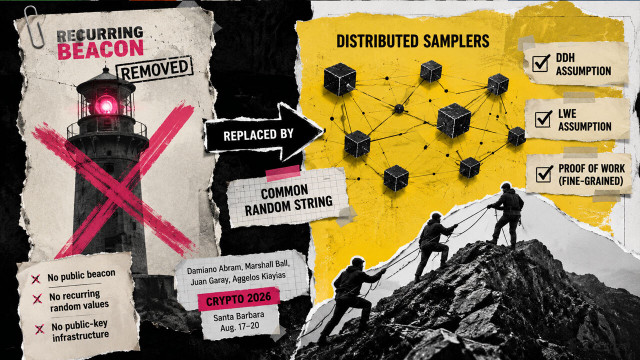
A Crypto 2026 paper replaces the recurring random beacon with distributed samplers, removing a dependency in earlier permissionless consensus designs.
A paper accepted for Crypto 2026 in Santa Barbara claims to resolve a theoretical gap in permissionless consensus by replacing a public beacon that supplies participants with fresh random values at regular intervals. The University of Edinburgh research record lists Damiano Abram, Marshall Ball, Juan Garay, and Aggelos Kiayias as authors of “Permissionless consensus from a common random string.” Crypto 2026 runs from Aug. 17 through Aug. 20.
The problem the paper addresses is how parties can reach Byzantine agreement without knowing in advance who is participating, except for an upper bound on the number of participants, and without relying on a public-key infrastructure. Bitcoin helped motivate this line of research, but the new work is not presented as a Bitcoin upgrade or a change for any live network.
A 2024 construction by Ball and collaborators combined proofs of work with fine-grained complexity assumptions. That model also gave every participant access to a beacon that delivered a fresh public random value at regular intervals. The new paper says it removes that recurring service with d-wise independent distributed samplers. In plain terms, the samplers keep multiple executions secure at the same time without requiring the beacon to keep producing new public randomness.
For this permissionless consensus construction, the replacement still needs shared setup. Participants use a common random string, although the abstract says it does not need to be structured or sampled precisely when the protocol begins. The sampler constructions rely on the decisional Diffie-Hellman and learning with errors assumptions. The authors combine those samplers with proofs of work grounded in fine-grained complexity to build multi-verifier signatures of work, which the consensus protocol uses as a modular component. Removing the beacon thus changes one dependency in the earlier design rather than eliminating cryptographic assumptions.
The result remains theoretical. The public material does not state the protocol’s numerical corruption threshold, exact synchrony and communication conditions, concrete costs, or benchmark performance. Details from the 2024 construction cannot be assumed to carry forward. The available evidence does not support comparisons with Bitcoin’s security model or claims that the protocol is ready for deployment.
The accepted manuscript remains embargoed until Aug. 20 at 00:00 BST, according to the Edinburgh record. What is public supports a specific advance: a recurring randomness beacon is replaced by distributed samplers and a common random string, while DDH, LWE, and fine-grained proof-of-work assumptions remain part of the construction.
For a deeper look at how theoretical developments might eventually touch live blockchain security, see our crypto market analysis.
Drafted by a large language model from the source reporting linked above, then screened by automated publishing checks. It is not read by a journalist before publication. Some articles cite our Alpha Score. Verify prices and figures against the original source. Educational coverage, not personalized advice.