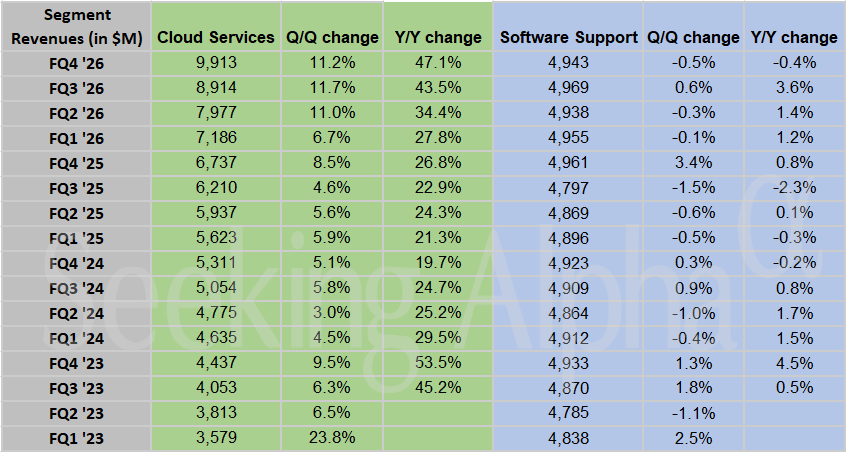
Oracle's cloud revenue rose 47% from a year earlier in the fiscal third quarter, the company said Monday. Cloud infrastructure revenue hit $2.1 billion.
Total cloud revenue reached $5.1 billion. The cloud applications segment, which includes Fusion and NetSuite, accounted for the remaining $3 billion. Oracle's overall revenue rose 7% to $13.3 billion, slightly above consensus.
Oracle's health-tech unit Cerner contributed $1.5 billion in revenue, up 5% from a year earlier. Oracle acquired Cerner in 2022 for $28.3 billion. The migration of Cerner's on-premise customers to Oracle's cloud is roughly 70% complete, CFO Jeff Epstein told analysts.
Operating margins widened to 44% from 42% a year ago. Oracle cited lower hardware costs and a higher mix of cloud subscription revenue. Free cash flow came in at $3.1 billion, down from $3.4 billion a year earlier. Oracle attributed the decline to higher capital spending on data centers for AI workloads.
Remaining performance obligations, a measure of contracted but unbilled revenue, reached $98 billion, up 29% from a year ago. That backlog gives Oracle a multiyear revenue runway.
For the fiscal fourth quarter, Oracle guided total revenue growth of 5% to 7%. Cloud revenue growth is expected at 22% to 24%, implying roughly $5.5 billion. Capital expenditures will roughly double this fiscal year to $10 billion, Oracle said. The bulk will go toward GPU clusters for AI training and inference.
Oracle's multicloud partnership with Microsoft, announced in 2023, now covers 60-plus Azure regions where customers can run Oracle databases directly on Microsoft's cloud. A similar deal with Google Cloud went live in January. These arrangements let Oracle sell database licenses without building data centers in every region.
Oracle shares have gained 18% year to date, outperforming the S&P 500. The stock trades at 28 times forward earnings, above its five-year average of 22 times. Oracle carries a Moderate Alpha Score of 56 out of 100, indicating the current valuation prices in much of the near-term cloud acceleration.
The steep capital cost attached to Oracle's AI-driven cloud growth is one area analysts have flagged. The $10 billion capex plan for fiscal 2025 would consume roughly 80% of projected free cash flow, leaving less room for buybacks and dividends. Oracle spent $4.5 billion on buybacks in the first nine months of fiscal 2024, down from $7.2 billion a year earlier.
Oracle's next quarterly report is expected in June.