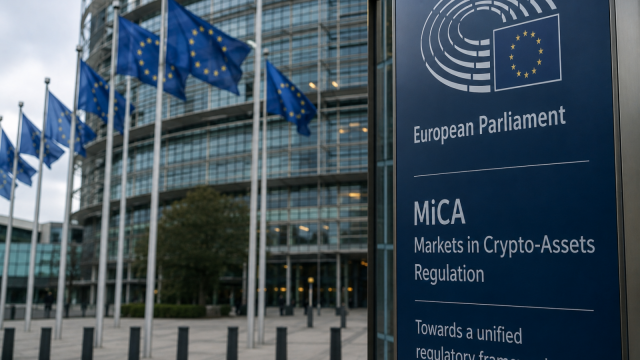
The European Union has approved roughly 230 licenses under the Markets in Crypto-Assets Regulation. That covers about one in five of the more than 1,200 crypto businesses that once operated under separate national registrations across EU member states. The gap matters because the transition period expires in July. Any firm without a MiCA license cannot serve EU customers after that.
Germany leads with 56 approved licenses. The Netherlands follows with 26. France has 21. Those three countries account for nearly half of all approvals. France, specifically, shows why the deadline bites. Industry participants said roughly 40% of crypto service providers previously registered in the country have not applied for a MiCA license at all. Some withdrew their applications. Others forged partnerships with licensed firms. A few are preparing to exit the market entirely.
The July cutoff completes the EU's first dedicated rulebook for digital assets. MiCA brings crypto exchanges and wallet providers under a unified supervisory structure similar to what traditional financial firms face. A company approved in one member state can passport its services across all 27, provided it meets common standards on capital and customer asset protection.
The licensing data tells you who is positioned to stay. Smaller jurisdictions that hosted crypto firms under national regimes – Malta and Estonia, for example – are seeing less activity. Firms that cannot meet the compliance bar face a choice: partner with a licensed entity, relocate to a jurisdiction that still offers a path, or leave Europe entirely.
The market has already started picking winners. Coinbase and OKX moved quickly to attract Binance's EU users when MiCA passed. The scramble shows the stakes. A single license unlocks 450 million potential customers. Firms that miss the deadline lose that access and hand market share to those that made the cut.
The July deadline itself is the next hard date. Enforcement will test how aggressively national regulators act against unlicensed firms still serving EU customers. Some may try to operate from outside the bloc, routing services through third parties. The commission has said it expects member states to apply the rules consistently. The EU Parliament's push for a broader crypto review suggests the regulatory work does not stop with MiCA.
For the firms that did secure a license, the hard work starts after July. Compliance with ongoing reporting and capital requirements is a recurring cost, not a one-off approval. The consolidation the industry sees now is the first phase. The second phase will separate firms that can manage the ongoing burden from those that cannot.