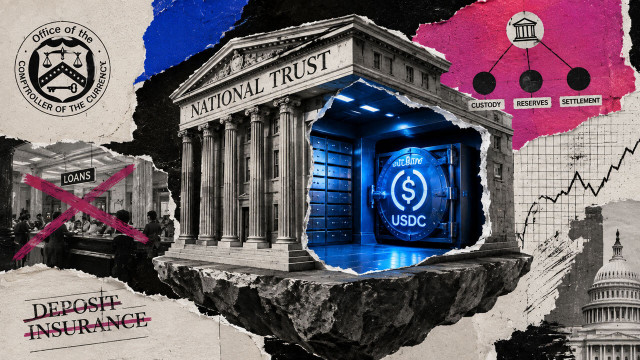
Circle now holds a federal bank charter. The charter does not allow ordinary checking accounts, FDIC-insured savings, or mortgages.
Circle National Trust is part of a new federal cohort built around custody, fiduciary administration, stablecoin reserves, and settlement. Ripple, BitGo, Fidelity Digital Assets, Paxos, Bridge, Crypto.com, Coinbase, Morgan Stanley and World Liberty Financial have all received some form of Office of the Comptroller of the Currency approval since December. Most are still completing conditions required before opening.
Washington is giving crypto companies the regulatory shell of banking while separating it from the business model Americans usually associate with a bank. The result is a narrow institution that supervises assets and transactions without relying on the classic formula of collecting deposits and turning them into loans.
That legal form of a non-bank bank predates crypto. The OCC said it already supervised roughly 60 national trust banks when it approved five digital-asset applications in December. Its Morgan Stanley decision put assets under administration at uninsured national trust banks at $7.2 trillion as of March 31, including $1.7 trillion in custody and safekeeping accounts. Crypto has found a way to use that old form to capture the parts of finance best suited to tokens.
A commercial bank combines several functions under one roof. It gathers deposits, runs payment accounts, extends credit, and holds assets for customers. Deposit insurance supports confidence in the funding base, while lending produces much of the income.
A national trust bank starts from a different position. Its center of gravity is fiduciary work: holding property for another party, administering assets, executing instructions, and maintaining records. The OCC's trust-bank guidance says most national trust banks do not offer loans, accept deposits, or carry FDIC insurance.
That model fits digital assets well. Institutions need a regulated entity to safeguard private keys, segregate customer property, administer tokenized assets, and connect transfers with conventional settlement. Stablecoin issuers also need reserve custody and redemption operations that can withstand federal examination. None of those jobs requires a retail branch network or a mortgage book.
Circle is already well regulated and well positioned in the US market. The OCC granted final approval on July 10 for First National Digital Currency Bank, which will operate as Circle National Trust. At opening, it plans to provide fiduciary digital-asset custody for Circle and its affiliates. Custody for selected institutions and management of USDC reserves are listed as possible future capabilities.
The OCC's published decisions separate final approvals from preliminary or conditional ones. A conditional decision allows an applicant to organize the institution and satisfy capital, governance, compliance and operating requirements. Opening comes later, once those conditions are met.
The approved companies are only the visible edge of a wider application queue. Comptroller Jonathan Gould said on Aug. 19 that 23 of the 40 de novo charter applications received over the preceding 18 months included digital-asset activity in their business plans. He also said the OCC expects to issue its final GENIUS Act rule by November.
Crypto is present in a majority of the agency's recent new-bank pipeline, even before the pending applications reach a public decision.
The December group covered three routes. BitGo, Fidelity, and Paxos each sought conversions of existing state trust companies. Ripple proposed a new national trust bank. Circle proposed the entity that later received final approval. The OCC approved all five conditionally in one announcement, making the federal direction hard to dismiss as a sequence of unrelated applications.
World Liberty is the newest entrant. Its Aug. 14 decision is preliminary. If completed, the trust company would bring USD1 issuance and reserve custody into one federally supervised entity.
The appeal to crypto companies is clear. A national charter replaces a fragmented custody map with one federal supervisor. It gives institutional clients a familiar examination regime, brings reserve and custody operations closer to the issuer, and reduces reliance on third-party banks for critical steps. It also makes a sales claim possible that an offshore license or patchwork of state permissions cannot match: the entity holding the asset is supervised as a national bank.
Crypto spent years presenting banks as intermediaries that software could remove. Now its largest companies want charters because a token relocates institutional trust to whoever controls the keys, the reserves, the redemption process, and the ledger connecting them.
Commercial lenders retain deposit gathering, credit underwriting, and the legal ability to create loans. Crypto trust banks compete for custody, settlement, and asset administration. Those functions can look secondary beside a loan book until tokenized money and securities begin moving through them at scale.
Consider a stablecoin issuer that can issue the token, hold reserve assets through its supervised affiliate, custody institutional assets, and settle transactions. It still needs access to the broader banking and Treasury systems. It needs fewer outside firms between the customer and the product. Each removed intermediary keeps more fee income, data, and operational control inside the issuer's group.
Traditional custody banks are the most exposed. Their advantage has long rested on trusted asset servicing and connections to market infrastructure. A crypto-native trust bank is making the same claim for tokenized assets, with software and stablecoin distribution already inside the corporate family. Payment processors face a related risk if settlement migrates from account-to-account messages toward direct transfers of tokenized dollars.
Commercial banks also retain a crucial advantage. They turn deposit funding into 30-year mortgages and small-business loans. A trust bank focused on custody cannot replicate local credit creation simply by holding Treasury bills and digital assets. The new model separates the profitable control layer around tokenized property from the lending layer that supports the real economy.
That separation is responsible for the biggest policy trade-off. Federal supervision can make custody and stablecoin operations safer. Migration from bank deposits into tokens can also deprive lenders of low-cost funding.
Consumers should read the label narrowly. OCC supervision is valuable. Deposit insurance still depends on the liability, the legal entity holding the asset, and its insolvency treatment.
America is pulling banking apart and assigning custody, reserves, and settlement to specialized institutions while leaving deposits and lending elsewhere. The companies that control digital finance may carry bank charters without doing the work that made banks central to the old system. Their power will come from holding and moving the asset, not from lending against it.
Armed with a classical education and an eye for news, Andjela dove head deep into the crypto industry in 2018 after spending years covering politics.
Also known as "Akiba," Liam Wright is a reporter, podcast producer, and Editor-in-Chief at CryptoSlate. He believes that decentralized technology has the potential to change the world.