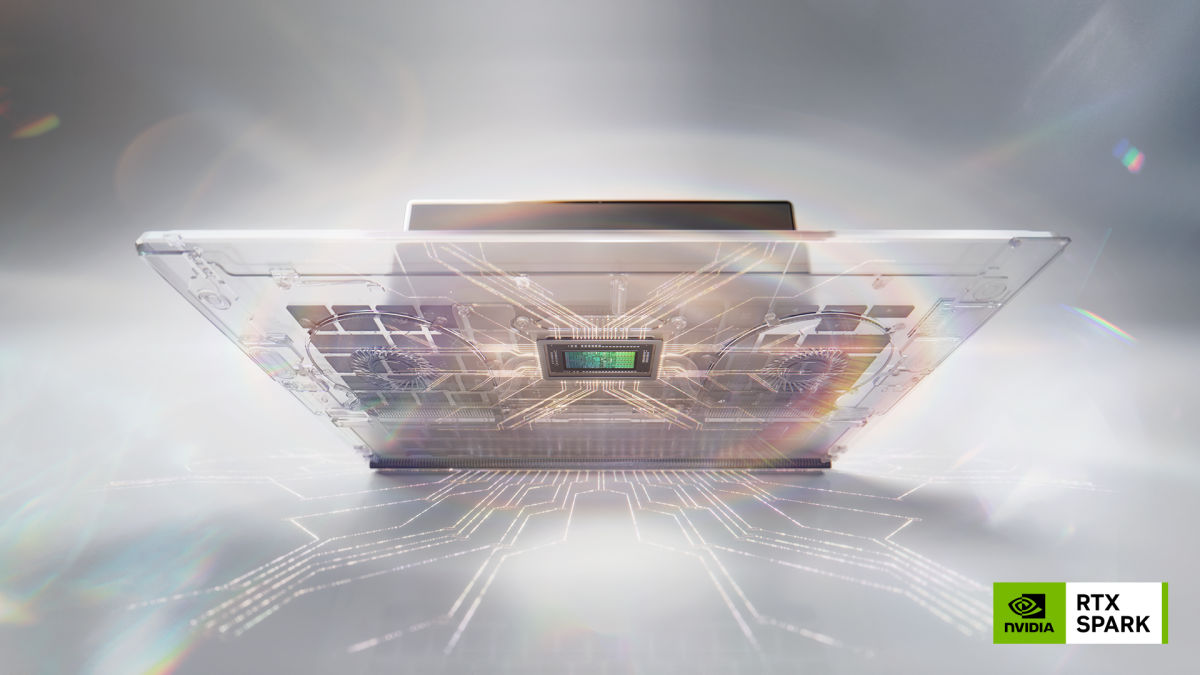
NVIDIA launched the RTX Spark superchip at GTC Taipei, embedding its datacenter-class AI stack into a laptop form factor. The chip delivers 1 petaflop of AI compute, 128GB of unified memory, and a full CUDA and RTX software stack in machines as slim as 14 millimeters and as light as three pounds. Microsoft is building new Windows security primitives and agent runtimes around the platform. This combination poses a direct structural threat to Intel and AMD in the laptop CPU market and tests NVIDIA’s ability to extend its growth into personal computing.
Jensen Huang, founder and CEO of NVIDIA, described the shift: “For forty years, you launched apps. Click. Type. With RTX Spark and Microsoft Windows, you ask – and the PC does the work.” The hardware and software integration is designed to make on-device AI agents the primary interface for Windows users.
RTX Spark’s Technical Edge Over Existing Laptop Chips
The chip combines a Blackwell RTX GPU with 6,144 CUDA cores, fifth-generation Tensor Cores supporting FP4 precision, and a 20-core Grace CPU connected via NVLink-C2C. The Grace CPU was co-designed with MediaTek, which contributed power efficiency and connectivity for the Arm-based design.
Unified Memory as the Key Differentiator
Existing laptop platforms from Intel (Lunar Lake) and AMD (Strix Point) use separate memory pools for CPU and GPU, limiting AI workload capacity. RTX Spark’s 128GB unified memory allows large language models up to 120 billion parameters to run locally with 1 million tokens of context. No current competitor laptop chip offers this capability within a comparable thermal envelope.
Full-Stack Software Compatibility
NVIDIA’s advantage extends beyond silicon. CUDA, TensorRT, OptiX, DLSS 4.5 (with a second-generation transformer model), Reflex, and G-SYNC all run natively on RTX Spark. Over 1,000 games and applications already support RTX features. Adobe is rearchitecting Adobe Premiere and Photoshop specifically for RTX Spark, with up to 2x faster AI, editing, and effects performance. Shantanu Narayen, chair and CEO of Adobe, said: “Together, we are building AI-native creative experiences for RTX Spark that deliver the performance, intelligence and responsiveness people need to create at the pace of their ambition.”
The Competitive Risk for Intel and AMD
Intel and AMD have been gradually adding AI accelerators to their laptop CPUs. Intel’s Lunar Lake includes a neural processing unit (NPU) capable of about 40 TOPS. AMD’s Strix Point offers roughly 50 TOPS. RTX Spark delivers 1,000 TOPS (1 petaflop) while running the same CUDA software stack used in NVIDIA’s datacenter GPUs. The gap is not incremental – it is architectural.
The Software Moat Limits Competitor Response
NVIDIA’s commitment from Adobe, Blackmagic Design, Blender, CapCut, ComfyUI, OTOY, and game developers such as KRAFTON, NetEase, Remedy Entertainment, Riot Games, and XBOX means that any competitor hardware must attract developers to rebuild or port those integrations. That cycle takes years, during which NVIDIA can cement RTX Spark as the standard for AI-native Windows PCs.
Pricing and Margin Implications
NVIDIA has not disclosed pricing. Component costs – a Blackwell GPU, a Grace CPU, 128GB unified memory, and advanced packaging – suggest RTX Spark laptops will be priced above typical consumer machines, likely in the $2,000-$3,000+ range. That caps initial volume but creates a premium segment where NVIDIA captures the full margin stack, while Intel and AMD compete on lower-margin commodity chips.
Execution Risk: Fall Availability and Developer Adoption
RTX Spark laptops and compact desktops will be available this fall from ASUS, Dell, HP, Lenovo, Microsoft Surface, and MSI, with Acer and GIGABYTE following. The hardware pipeline appears solid, with major OEMs already developing designs.
What Would Confirm the Thesis
- Enterprise procurement patterns – If Dell or Lenovo report corporate orders for RTX Spark desktops as AI workstations, it signals demand beyond enthusiast and creative professional niches.
- Competitor response timeline – If Intel or AMD announce a unified memory superchip within six months, the moat is narrower than NVIDIA claims.
- Agent app adoption – Strong early downloads of Hermes Agent (from Nous Research) or OpenClaw on RTX Spark hardware would validate the on-device AI use case.
What Would Weaken the Thesis
- Supply constraints – A new chip with a custom MediaTek collaboration and advanced packaging could face yield issues, delaying fall shipments.
- Price resistance – If RTX Spark laptops remain above $2,500, the market stays limited to professionals and gamers, limiting total addressable market.
- Windows agent adoption stalls – Consumers may not use on-device AI agents at scale, reducing the need for dedicated hardware.
- Microsoft competition – Satya Nadella called RTX Spark “a real breakthrough,” but Microsoft could eventually develop its own Windows AI chip, reducing NVIDIA’s exclusivity.
The Fall Launch Window and Developer Pipeline
Microsoft Build on June 2-3 will showcase Windows agent capabilities, including new security primitives and NVIDIA OpenShell runtime. OpenShell provides a policy layer that lets users define agent permissions, route queries to local or cloud models, and anonymize personal data in cloud-bound requests.
Key Developer Milestones
- Adobe Premiere and Photoshop updates are expected alongside hardware availability.
- Hermes Agent and OpenClaw are releasing Windows apps optimized for RTX Spark.
- Over 100 Windows software providers are adopting the platform.
Dillon Rolnick, CEO of Nous Research, said: “RTX Spark and NVIDIA OpenShell give Hermes users a powerful and secure environment for agents to run and work alongside you. You realize you’re buying a full-fledged assistant, not a typical laptop.”
NVIDIA’s Alpha Score of 73/100 (Moderate) at $211.14 (down 1.45% on the session) suggests the market is still weighing the revenue potential of this new product cycle against its execution risks. The RTX Spark announcement extends NVIDIA’s total addressable market from datacenter into personal computing. For traders, the next concrete catalyst is Microsoft Build on June 2, where Windows agent tooling will be demonstrated. If developer adoption and OEM pricing align, RTX Spark could become a new growth pillar. If execution falters, the stock may reprice the premium already baked in.