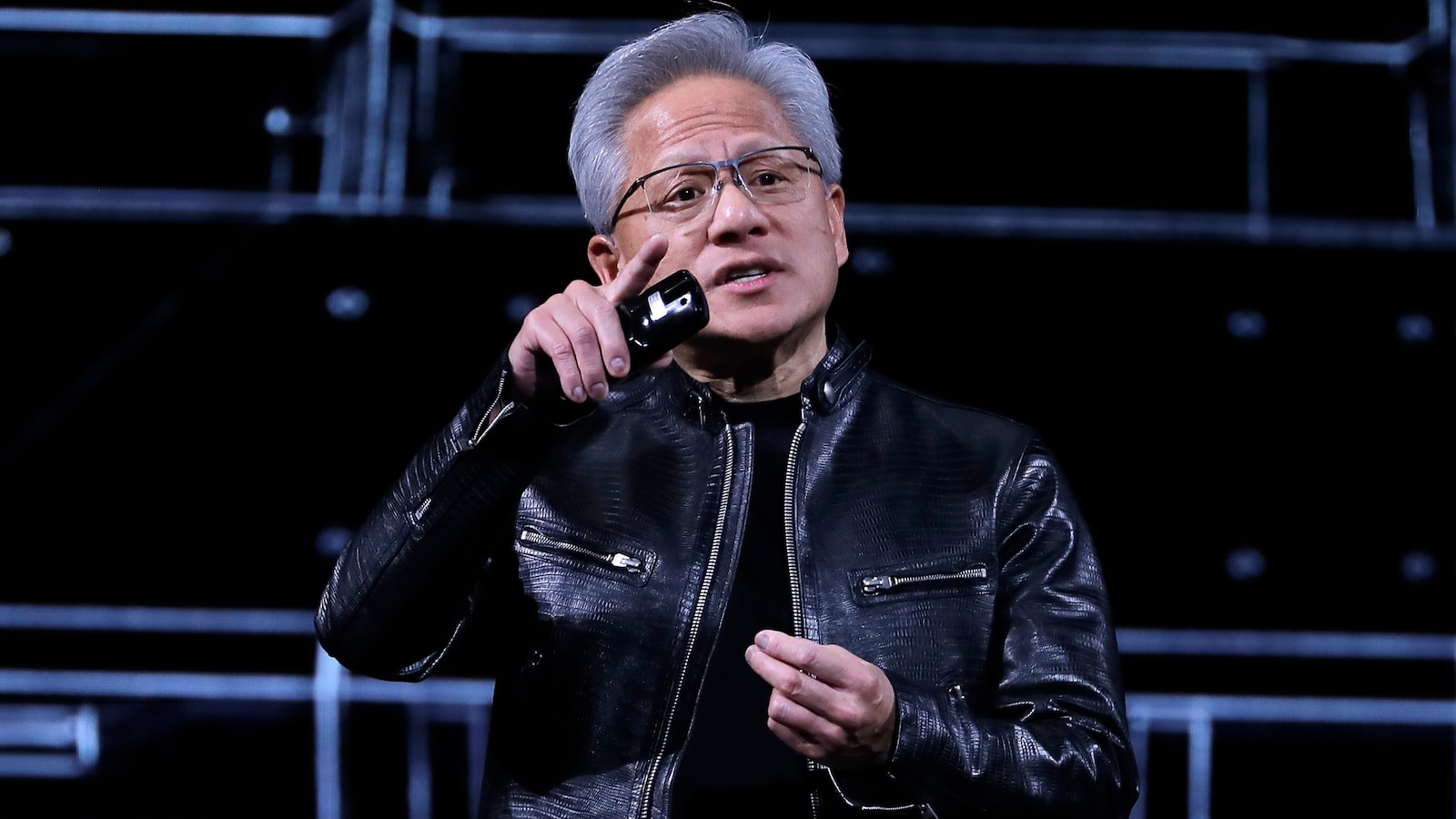
Nvidia on Monday unveiled the RTX Spark superchip at its GTC event in Taipei, a combined CPU and GPU package designed to bring advanced AI processing to Windows laptops and desktops. CEO Jensen Huang framed the release as a generational shift. "This is going to be the new PC," he said during his keynote. The first models from Microsoft and Dell are expected to roll out in the fall of this year. NVDA shares rose nearly 4% in early U.S. trading. Intel and AMD both fell more than 3%.
The move marks Nvidia's first serious push into the personal computer market since its early graphics card days. It arrives at a moment when demand for local AI agents is accelerating. The RTX Spark superchip integrates CPU and GPU capabilities into a single package, allowing Windows machines to run "highly capable AI models" and complex workloads locally, according to a Microsoft statement. This architecture is designed to support autonomous AI agents that can read files, conduct research, and interact with users through voice and vision.
Why the RTX Spark Superchip Changes the PC Calculus
The simple read: Nvidia enters a new market
At first glance, Nvidia is doing what it does best: applying its GPU architecture to a new form factor. The company already dominates the data center AI chip market, with its Vera CPUs now in full production for customers including Anthropic, OpenAI, and SpaceXAI. Extending that technology to personal computers looks like a natural expansion.
The better read: This is a structural challenge to Intel and AMD
The RTX Spark superchip directly competes with Intel's Core Ultra and AMD's Ryzen AI processors, both of which have been positioning for the AI PC wave. Nvidia's advantage is its software ecosystem – CUDA, TensorRT, and the broader AI developer stack that Intel and AMD have struggled to replicate. If developers optimize AI agents for Nvidia's architecture first, PC buyers may choose Nvidia-powered machines for compatibility, not just performance.
Lian Jye Su, chief analyst at Omdia, said the move is significant because "for consumers, it means more choices, which is always a good thing." Neil Shah of Counterpoint Research described it as "revolutionizing how PCs would look like in the next 10 years."
The AI Agent Thesis: From Cloud to Local Processing
Huang's keynote emphasized that the new PCs are designed for "autonomous AI agents" that operate locally rather than relying on cloud servers. This distinction matters for latency, privacy, and cost. A local AI agent can process voice commands, analyze documents, and control applications without sending data to a data center.
What this means for the hardware stack
Running AI agents locally requires sustained compute performance, not just burst inference. The RTX Spark superchip is engineered for continuous workloads, which is a different thermal and power profile than traditional laptop CPUs. Nvidia claims the chip can handle "complex workloads" that current Intel and AMD processors cannot sustain.
Risk to watch: Adoption velocity
The PC market has been slow to adopt new form factors. Windows on ARM, touchscreens, and 2-in-1 devices all promised reinvention yet delivered modest market share shifts. Nvidia's RTX Spark superchip faces the same adoption risk. If software developers do not build AI agents that require local processing, the hardware advantage may not translate into sales.
The Humanoid Robot Reference Design: A Longer Bet
Huang also revealed a humanoid robot reference design called "Isaac GR00T." Standing nearly six feet tall, the robot uses the chassis of Chinese robot maker Unitree's H2 and is equipped with five-fingered dexterous hands from Singapore-based Sharpa. Nvidia positioned the design as a blueprint for higher education research, not a commercial product.
Why this matters for the Nvidia ecosystem
The reference design extends Nvidia's platform strategy. By providing hardware blueprints and software tools, Nvidia can capture developer mindshare in robotics without manufacturing robots itself. This mirrors the approach that made CUDA the standard for AI development. If robotics researchers standardize on Nvidia's Isaac platform, the company gains a long-term revenue stream from simulation, training, and inference hardware.
Valuation and Competitive Positioning
Nvidia is already the world's most valuable company, ahead of Apple, Alphabet, and Microsoft. The RTX Spark superchip announcement does not change the near-term revenue trajectory – data center chips still drive the overwhelming majority of earnings. It does signal that Nvidia sees the PC as a strategic battleground for AI adoption.
The Intel and AMD response
Intel and AMD have both invested heavily in AI PC features. Intel's Core Ultra includes a neural processing unit (NPU) for on-device AI. AMD's Ryzen AI processors offer similar capabilities. The difference is software. Nvidia's CUDA ecosystem is deeply entrenched in AI development, and the RTX Spark superchip brings that ecosystem to the desktop. Intel and AMD will need to demonstrate that their NPUs can run the same AI workloads with comparable performance.
AlphaScala data check
NVDA carries an Alpha Score of 73 out of 100, rated Moderate, with the stock trading at $224.36, up 6.26% on the session. The score reflects strong momentum and market positioning, though the PC market expansion introduces execution risk. AMD scores 59 out of 100, also Moderate, reflecting competitive pressure from Nvidia's PC push. For traders tracking the AI hardware theme, the RTX Spark superchip creates a new vector for sector rotation.
The Next Decision Point for Traders
The fall launch window for RTX Spark-powered PCs is the next concrete catalyst. Between now and then, watch for three signals:
- Developer adoption: Are AI agent frameworks optimizing for Nvidia's local architecture? If major AI agent platforms announce Nvidia-first support, the thesis strengthens.
- Intel and AMD counter-moves: If Intel or AMD announce partnerships with major AI agent developers, the competitive picture shifts.
- PC OEM commitment: Microsoft and Dell are confirmed launch partners. The breadth of OEM adoption will determine whether RTX Spark becomes a standard or a niche.
Huang's claim that this is "the first across the lineup of PC reinvention for 40 years" is ambitious. The market will test that ambition against the reality of PC upgrade cycles, software readiness, and competitive response. For now, Nvidia has drawn a clear line from data center AI to desktop AI. The question is whether consumers and developers follow.