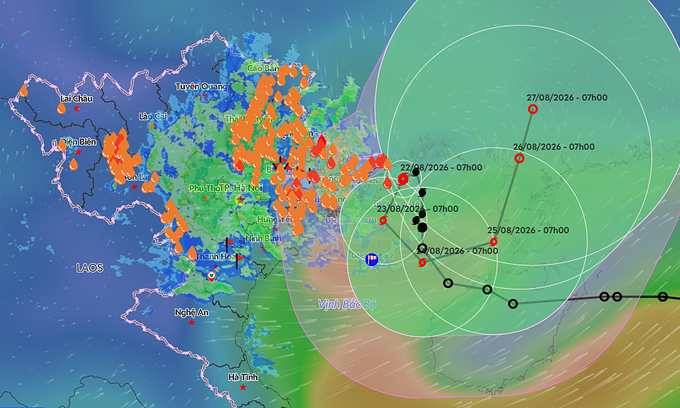
The storm stalled over the Gulf of Tonkin on Saturday, its center about 130 km northeast of Bach Long Vi Special Zone, the National Center for Hydro-Meteorological Forecasting said. Maximum sustained winds hit 74 kph, with gusts of 89–102 kph. The system moved north at only 5 kph and was expected to stay nearly stationary or drift slowly westward over the next few hours.
By 4 a.m. on Aug. 23, the storm is forecast to hold its strength over the northern Gulf of Tonkin, about 170 km east of Hai Phong and 80 km northeast of Bach Long Vi, before turning south at roughly 3 kph. Its irregular path is expected to continue through Aug. 24. At 4 a.m. that day, the storm is forecast to be around 110 km east of Bach Long Vi and 230 km east-southeast of Hai Phong, moving southeast at 3–5 kph. By Aug. 25, the system is expected to turn east-northeast, with its center remaining over the eastern Gulf of Tonkin, about 200 km from Bach Long Vi.
International forecasting agencies published similar projections. The Hong Kong Observatory expects the storm to strengthen, with winds reaching about 85 kph, before looping through the Gulf of Tonkin, moving closer to the Quang Ninh coast and gradually weakening. Japan’s weather agency issued a comparable outlook, forecasting winds of around 65 kph before the system dissipates.
Vietnam’s national weather agency warned that the storm’s circulation could bring widespread and prolonged rainfall. From Aug. 22 through the night of Aug. 24, northeastern Vietnam, southern Phu Tho and Thanh Hoa are expected to receive 100–200 mm of rain, with some areas recording more than 400 mm. Quang Ninh and Hai Phong are forecast to see the heaviest rainfall, with totals of 250–350 mm and more than 600 mm in some locations. Lang Son and Bac Ninh could receive 200–300 mm, while isolated areas may see more than 500 mm. Forecasters warned that heavy rain could continue beyond the night of Aug. 24.
The rainfall raises the risk of flooding in urban areas, industrial zones and low-lying communities. Mountainous areas face increased danger from flash floods and landslides, and rivers and streams could rise rapidly. The storm’s broad circulation may also trigger thunderstorms, tornadoes and powerful wind gusts in some areas.
Weather conditions across the Gulf of Tonkin, including Bach Long Vi, Van Don, Co To, Cat Hai and Hon Dau, are expected to worsen significantly. Winds could reach around 61 kph across much of the gulf, while areas near the storm’s center may experience sustained winds of 74 kph and gusts of up to 102 kph. Waves are forecast to reach 2–4 meters. The rough seas pose serious risks to fishing boats, cargo ships and tourist vessels, which could capsize or suffer damage. Aquaculture cages and rafts, anchorage areas and coastal infrastructure are also vulnerable.
Along the mainland coasts of Quang Ninh and Hai Phong, strong winds could damage roofs and temporary structures, uproot trees and disrupt electricity, telecommunications and transport services.
Prime Minister Le Minh Hung issued an official dispatch Thursday ordering ministries, agencies and local governments to closely monitor the storm and take proactive disaster-prevention measures. Local authorities were instructed to secure vessels operating in the Gulf of Tonkin, inspect vulnerable areas and evacuate residents from locations at high risk of severe flooding or landslides. Traffic restrictions must also be enforced at flooded crossings and on damaged or unsafe roads.
The Ministry of National Defense and the Ministry of Public Security have been asked to prepare forces to support local authorities when needed, while the Ministry of Construction will coordinate repairs to roads damaged by landslides to restore access to isolated communities.