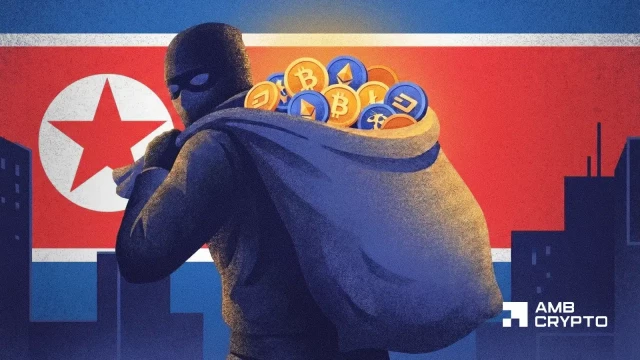
North Korea’s state-linked hacking groups have stolen an estimated $6.75 billion in cryptocurrency across 263 incidents from 2016 to early 2026, according to a new report from security research firm CertiK. The scale and consistency of the thefts mark a shift from opportunistic cybercrime to a structured state revenue mechanism. The simple read is that the Democratic People’s Republic of Korea (DPRK) steals crypto. The better market read is that these operations now follow predictable laundering patterns that create recurring liquidity events in Bitcoin and mixer-related tokens, with direct implications for exchange security, regulatory pressure, and cross-chain risk.
CertiK’s analysis frames the activity as an integral part of North Korea’s fiscal apparatus. The report states:
Our report analyzes nearly a decade of activity, finding that DPRK-linked actors have stolen an estimated $6.75 billion across 263 incidents between 2016 and early 2026.
The finding elevates the threat from a cybersecurity nuisance to a systemic risk for crypto market infrastructure. For traders and platform operators, the takeaway is that North Korean thefts are not random; they are a persistent, well-funded, and increasingly sophisticated drain on the ecosystem.
North Korea’s $6.75 Billion Haul Becomes State Revenue
In 2025, North Korea was responsible for $2.06 billion in losses, or 60% of the sector’s $3.4 billion in total yearly crypto thefts. The pattern has continued into 2026, with DPRK-linked actors accounting for $620 million out of $1.1 billion in stolen funds year-to-date, a 55% share. TRM Labs, another security firm, estimates the true share is even higher, at about 76% of YTD losses, suggesting underreporting or attribution gaps in other data sets.
Key insight: North Korea’s thefts are no longer opportunistic hacks. They represent a state-level revenue operation that systematically moves stolen funds through Bitcoin, creating recurring sell-pressure events.
The revenue stream is not a one-off windfall. It is a decade-long accumulation that now rivals the country’s traditional illicit income sources. The consistency of the attacks means that every major protocol upgrade, new chain launch, or hot wallet expansion becomes a potential target. The market cannot price this as a tail risk; it is a recurring operational cost embedded in the crypto ecosystem.
2026 Escalation: Bybit, KelpDAO, and Drift
Last year’s largest single heist was the $1.5 billion Bybit exploit, linked to the notorious Lazarus Group. In 2026, the biggest plunder so far is the $294 million KelpDAO hack, executed by a new North Korean group separate from Lazarus. The $285 million Drift breach was carried out by TraderTraitor, another DPRK-linked actor. The diversification of hacking groups indicates an institutionalised division of labour within North Korea’s cyber operations.
| Incident | Loss | Attributed Group |
|---|
| Bybit (2025) | $1.5 billion | Lazarus Group |
| KelpDAO (2026) | $294 million | New DPRK group (unnamed) |
| Drift (2026) | $285 million | TraderTraitor |
These incidents are not isolated. They form a pattern of targeting high-liquidity decentralised exchanges and protocols where large pools of assets sit in smart contracts or hot wallets. The shift from exchange-level breaches to protocol-level exploits reflects an adaptation to improved centralised exchange security. For traders, the implication is that DeFi platforms with large total value locked (TVL) now carry a state-actor risk premium that is not yet reflected in yields or insurance costs.
In-Person Infiltration: The Drift Breach
The Drift breach introduced a new attack vector. TRM Labs confirmed that the $285 million exploit followed in-person meetings between North Korean proxies and protocol employees. The firm described the technique as ‘unprecedented’ in the country’s lengthy crypto hacking campaign. This moves the threat from remote code exploitation to social engineering at the human layer, where technical audits and smart contract security provide no defence.
Practical rule: when a state actor can place operatives inside a development team, no amount of code auditing can fully mitigate the risk. The Drift case means that hiring practices, background checks, and physical security now matter for protocol security as much as smart contract audits.
The infiltration method also complicates attribution and response. A rogue employee with legitimate access can drain funds without triggering the same on-chain alarms as an external exploit. The market impact is twofold: first, it erodes trust in anonymous or pseudonymous teams; second, it increases the likelihood that insurance funds and treasury diversification will become mandatory for large protocols, raising operational costs.
Laundering Through Bitcoin and Mixers
After a heist, North Korean groups typically go quiet for a period before launching a laundering campaign. The standard playbook involves swapping stolen assets into Bitcoin and moving them through crypto mixers such as Thorchain or Tornado Cash, decentralised exchanges, and OTC desks. Sophisticated monitoring firms can sometimes track these on-chain flows. The sheer volume and the use of privacy tools make recovery extremely difficult.
For the Bitcoin (BTC) profile market, these laundering cycles introduce intermittent sell pressure that is not driven by fundamental sentiment. When large thefts occur, the eventual conversion into BTC and subsequent mixing can create temporary liquidity spikes. Traders monitoring large wallet movements tied to known DPRK addresses may gain a short-term edge, though the obfuscation layers make this a noisy signal.
The reliance on mixers also puts regulatory pressure on privacy-preserving protocols. Every major North Korean laundering event strengthens the case for stricter oversight of mixers, which in turn affects the tokens and governance models of those platforms. The crypto market analysis implications extend beyond the immediate theft: the policy response to state-actor laundering can reshape the legal landscape for privacy tools across the entire sector.
What Would Reduce the Systemic Risk
Several developments could materially lower the threat level. The U.S. government is considering extending threat intelligence shared with financial firms to crypto companies. If implemented, this would give exchanges and protocols earlier warning of specific DPRK tactics, wallet addresses, and infiltration attempts. Early threat monitoring across blockchains is already improving, with firms like CertiK and TRM Labs building real-time detection systems.
Better coordination between centralised exchanges and DeFi protocols on blacklisting and freezing funds could also raise the cost of laundering. The current fragmentation means that stolen funds can hop across chains and platforms faster than coordinated responses can mobilise. A unified threat-sharing framework, perhaps modelled on the Financial Services Information Sharing and Analysis Center (FS-ISAC), would close some of these gaps.
For individual platforms, the Drift breach underscores the need for operational security that goes beyond code. The following measures can limit damage from a compromised insider:
- Multi-signature controls requiring multiple approvals for large transfers
- Time-locked withdrawals that delay execution and allow intervention
- Decentralised key management to avoid single points of failure
Protocols that implement these measures proactively may see a lower risk discount applied to their tokens.
What Would Worsen the Threat
The emergence of new North Korean groups beyond Lazarus and TraderTraitor suggests the DPRK is scaling its cyber operations. If the state continues to invest in training and deploying multiple independent teams, the frequency and diversity of attacks will increase. The in-person infiltration technique, if replicated, could become a template for targeting other protocols with distributed teams and remote work cultures.
A worsening geopolitical environment could also accelerate the thefts. North Korea’s crypto revenue is used to fund its weapons programs and circumvent sanctions. Tighter sanctions or increased international pressure may incentivise even more aggressive cyber campaigns. For the crypto market, this means the state-actor risk is correlated with geopolitical tension, not just with the technical security posture of individual platforms.
Mixers are facing regulatory crackdowns. North Korean groups may shift to new privacy tools or cross-chain bridges that are harder to monitor. The cat-and-mouse dynamic between launderers and blockchain analysts means that the current playbook is not static. Traders and platform operators who assume the threat will remain within known patterns risk being blindsided by the next adaptation. Key escalation vectors include:
- Scaling of multiple independent hacking teams
- Replication of in-person infiltration across more protocols
- Geopolitical escalation driving more aggressive campaigns
- Evolution of laundering tools beyond current mixers
Bottom line for traders: North Korea’s crypto thefts are a structural feature of the market, not a cyclical one. The $6.75 billion cumulative haul, the diversification of hacking groups, and the move to in-person infiltration all point to a threat that is growing in sophistication and scale. The practical response is to factor state-actor risk into platform selection, custody decisions, and exposure to mixer-dependent tokens.