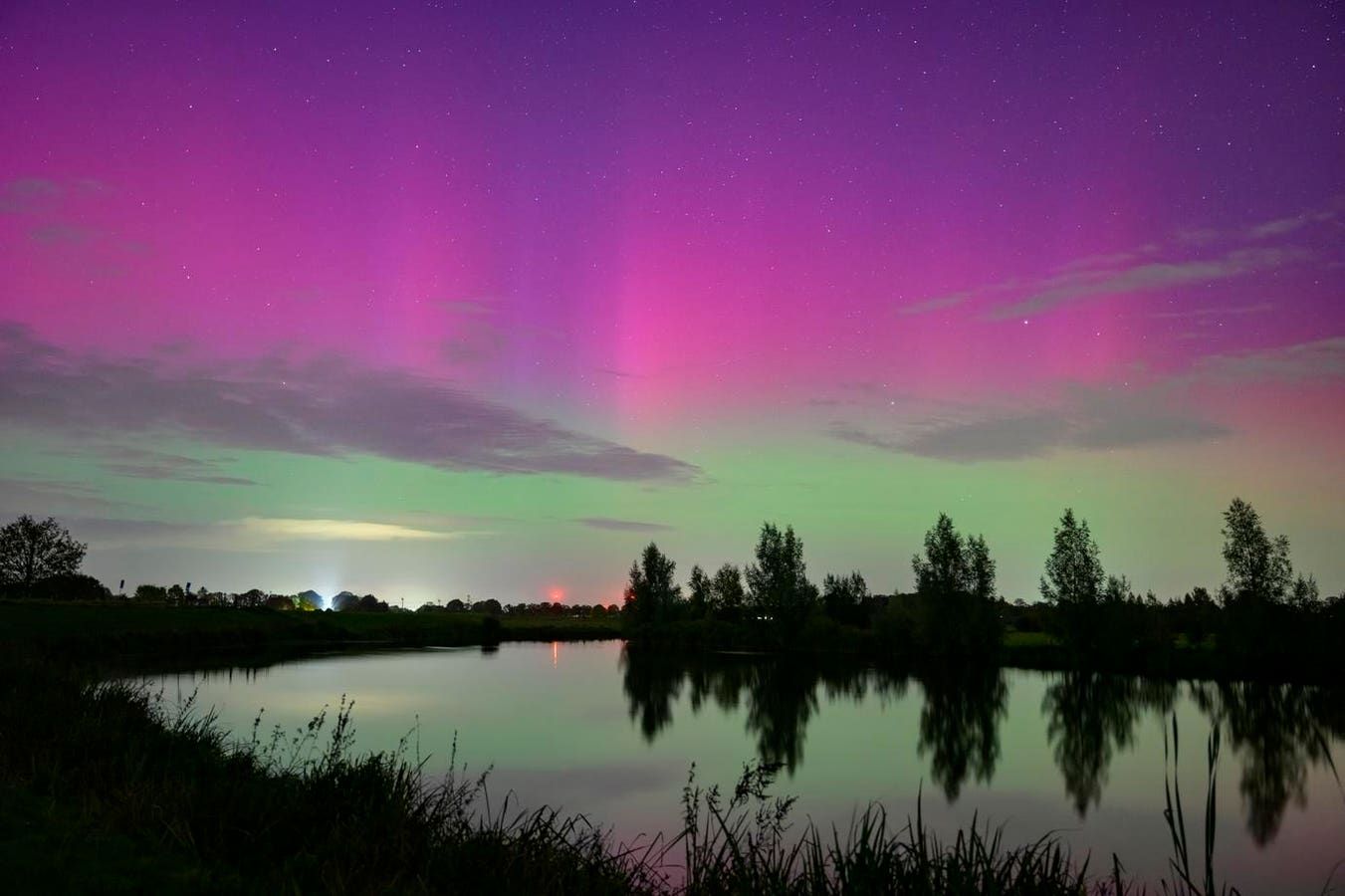
A coronal mass ejection that left the sun on July 30 is expected to strike Earth's magnetic field Sunday night, Aug. 2, bringing aurora borealis potential to at least 10 northern U.S. states.
Spaceweather.com said the CME departed after a weak solar flare that persisted for many hours. The National Oceanic and Atmospheric Administration's Space Weather Prediction Center forecasts a G2-class geomagnetic storm for Sunday, followed by a G1 storm. "G1-G2 (Minor-Moderate) geomagnetic storms are likely on 02 Aug due to the influence of a CME that left the Sun on 30 Jul," the NOAA forecast stated.
The UK Met Office's Space Weather Operations Center projected a similar scenario. Its forecast said "a stronger enhancement is probable late 01 August or early 02 August (UTC) due to a Coronal Mass Ejection arrival from the 30 July Coronal Mass Ejection."
A G2 storm could push faint aurora into northern parts of Oregon, Wyoming, Nebraska, Iowa, Illinois, Indiana, Ohio, Pennsylvania, New York, Vermont and New Hampshire. At G1 strength, the viewing band typically hugs the Canadian border. Potential areas include Washington, Idaho, Montana, North Dakota, Minnesota, Wisconsin, Michigan, Maine, Vermont and New Hampshire. Widespread visibility across the central or southern U.S. is not expected under the current forecast, NOAA said.
Short summer nights and a full moon this week will make faint aurora harder to see with the naked eye. Smartphone cameras using Night Mode or long-exposure settings can pick up green, red or purple colors before the human eye registers them, the forecasters noted.
Aurora visibility depends on several factors, the most important being the orientation of the interplanetary magnetic field, known as Bz. When Bz points south, charged particles connect more efficiently with Earth's magnetosphere. That can brighten the display and push it farther south than forecast models predict. If Bz stays northward, the display may remain weak or confined to higher latitudes.
Skywatchers should look toward the northern horizon during the darkest part of the night and find a location away from streetlights. Real-time visibility can be checked via NOAA's 30-minute aurora forecast or apps such as Aurora Now, My Aurora Forecast or Glendale Aurora.
The aurora arrives as noctilucent clouds appear across the northern hemisphere, a comet brightens and two meteor showers peak weeks before a total solar eclipse.
NOAA forecasters noted that a G1 storm can sometimes make the aurora visible from northern U.S. locations close to the Canadian border. The CME's arrival time will determine how deeply the storm penetrates. Forecasters at both NOAA and the UK Met Office said the July 30 CME's trajectory and speed remain uncertain enough that the storm intensity could shift up or down by one class.
A G2 storm produces Kp 6 conditions on the planetary K-index scale, which measures magnetic disturbance. At Kp 6, the aurora oval expands southward enough that cities like Seattle, Minneapolis and Detroit could see low-horizon displays under clear skies. At Kp 5 (G1), the oval typically stays near the Canadian border.
The full moon rises near midnight this week, reducing contrast for faint aurora. The moon's brightness washes out the weaker greens and purples that characterize low-intensity displays. Photographers using long exposures on tripods can still capture the colors by stacking multiple frames or using higher ISO settings, the forecasters said.
Cloud cover remains the wildcard for many regions. The Midwest and parts of the Northeast face mixed cloud forecasts for Sunday night, according to early weather models. The Pacific Northwest and northern Rockies appear to have the best chance of clear skies. Skywatchers should check local forecasts before traveling to dark-sky locations.
NOAA's Space Weather Prediction Center updates its 30-minute aurora forecast in real time on its website. The agency also provides a three-day geomagnetic storm forecast that refreshes every eight hours. Mobile apps that pull NOAA data can push alerts when the Kp index rises above a user-set threshold.
The solar cycle is currently approaching its expected peak, which increases the frequency of CMEs and aurora events. The sun's activity level has exceeded earlier forecasts, producing more G2 and G3 storms than initially predicted for this phase of Solar Cycle 25.