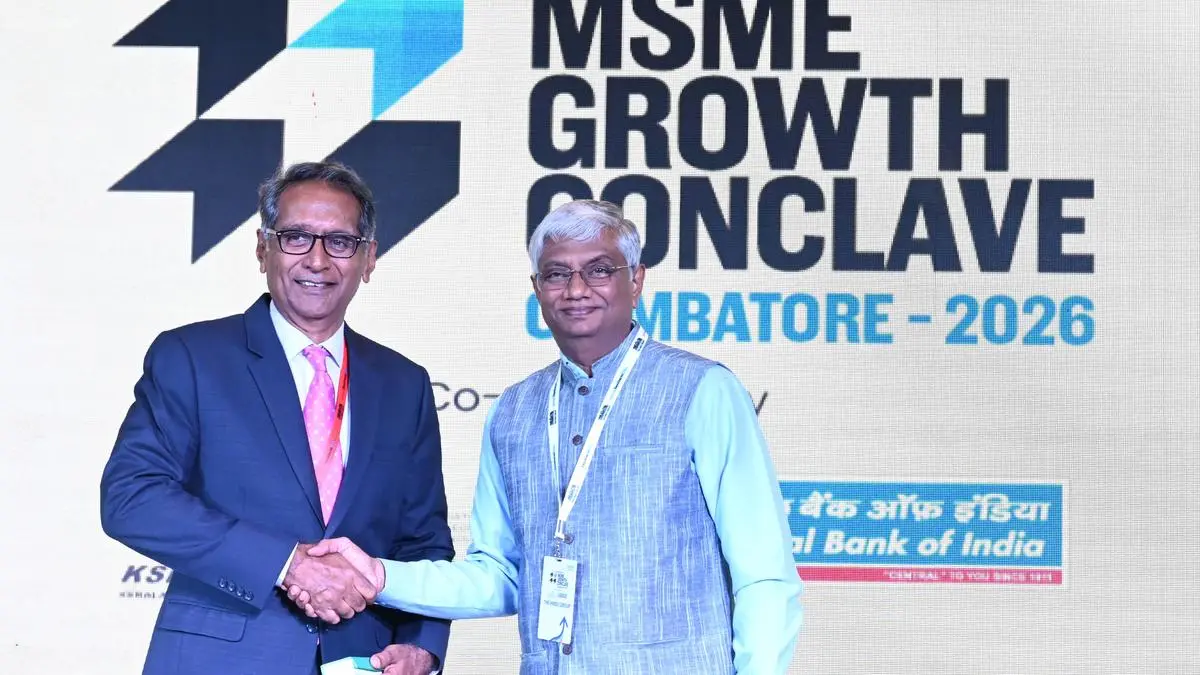
The Hindu businessline's fifth MSME Growth Conclave in Coimbatore last Saturday gave investors a specific lens for picking Indian small-cap and industrial stocks. The message from the keynote speakers was direct: the next leg of margin expansion will not come from cheap labor or government subsidies. It will come from innovation, automation, and finding customers' unstated needs.
Jairam Varadaraj, managing director of ELGI Equipments, opened by telling companies to stop building 'Me-too' products and start building 'Me-First' ones. He said companies should build capabilities based on 'know why' – deep scientific understanding – rather than just 'know how'. Indian companies must look beyond the domestic market, which is relatively small, and compete globally on intellectual property, not cost, he said.
That is a direct read-through for any portfolio holding small-cap industrials or auto-ancillary names. Varadaraj's argument implies that R&D spending as a share of revenue will separate winners from laggards. Companies that file more patents and invest in proprietary technology will command higher margins. Those that continue to compete on price in commoditized contract manufacturing will see margins stay below 8%.
Ravichandran Purushothaman, chairman of CII Southern Region and president of Danfoss India, identified two structural cost-push factors: skilled manpower shortages and rising electricity costs. A third risk, erratic order inflows, hits cash flow visibility. He called on MSMEs to invest in digital technologies, automation and energy-efficient solutions to improve productivity. Rather than concentrating on asset ownership, entrepreneurs should build businesses around knowledge, IP and scalable business models, which he described as the 'new money' that would define future competitiveness. He also stressed the importance of corporate governance, stock market listing and stronger cash generation instead of focussing solely on topline growth, he said in a conversation with businessline's Richa Mishra.
Purushothaman's comments point to a shift in how the market should value small companies. Book value or asset-heavy multiples may give way to metrics like R&D intensity and recurring revenue. Companies that have already scaled past the financing friction – those with audited financials and bank relationships – may enjoy a competitive moat.
A panel on clean mobility framed the EV transition as an opportunity, not a threat, for MSMEs. India's vehicle ownership rate is still low. That leaves a large addressable market for electric vehicles. Suppliers to the EV supply chain – components, batteries, charging infrastructure – could see order growth that outpaces the broader auto cycle.
The panel on financing pointed to a persistent bottleneck. Micro and small industries still struggle to access credit because of awareness gaps and bureaucratic hurdles. That is a negative signal for the smallest end of the MSME segment. Companies that have already scaled past that friction, however, may enjoy a competitive moat.
For an investor looking at Indian small-cap or industrial stocks, the conclave's message breaks into two watch lists. What would confirm the shift: a sustained uptick in R&D spending as a share of revenue across the MSME industrial cohort, faster patent filing rates at the Indian Patent Office, and rising export revenue share for companies that have historically sold only domestically. What would weaken the thesis: companies continuing to compete solely on price, skilled labor availability deteriorating further, and electricity costs rising faster than companies can offset with automation.
The next concrete marker is the Union Budget, likely in July, where MSME-focused credit guarantee schemes and power tariff subsidies may be adjusted. Any expansion of the Emergency Credit Line Guarantee Scheme would directly address the financing bottleneck flagged by the panel.
Companies that manage vendor risk effectively – a topic covered in Why Vendor Risk Becomes a Strategic Edge, Not a Checkbox – will have an advantage in building resilient supply chains.
Varadaraj said Indian companies must look beyond the domestic market and compete globally on intellectual property, not cost.