The Product Ladder: From Indices to 24/7 Spot
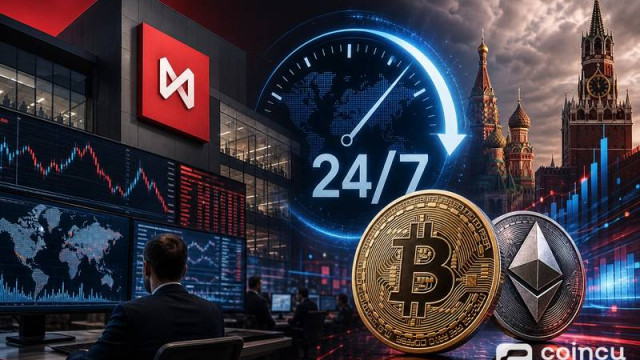
Moscow Exchange (MOEX), Russia's largest securities venue, is exploring a 24/7 cryptocurrency spot trading launch. The development, reported on May 15, 2026, places MOEX at the center of Russia's evolving digital-asset infrastructure. This remains an exploratory phase. No go-live date, asset list, or trading rules have been announced.
The reported product is specifically spot trading, meaning direct purchase and sale of cryptocurrencies. MOEX already offers index-linked derivatives. The exchange has been building a visible product ladder throughout 2026.
62,000 Clients Already Trading Crypto Derivatives
On May 13, MOEX began calculating and publishing four new digital-currency indices for Solana, XRP, TRON, and BNB. That brought its total crypto index count to six, with plans to reach ten. All crypto indices, including Bitcoin and Ether, now update every 15 seconds during the trading day and during additional weekend sessions.
New futures on the Solana, XRP, and TRON indices began trading on May 14, available only to qualified investors. These contracts expand a derivatives suite that has already attracted more than 62,000 clients who have traded crypto-asset contracts on MOEX.
The pattern is clear: MOEX moved from crypto indices to crypto futures to weekend index sessions. Each step extended both the product range and the hours of availability. A 24/7 spot market would be the next logical extension.
Weekend Index Sessions Paved the Way
The round-the-clock component is the differentiating detail. Traditional exchanges, including MOEX's current equities and derivatives markets, operate on fixed schedules with overnight and weekend closures. Cryptocurrency markets on platforms like Binance and Coinbase run continuously.
If MOEX launches continuous spot trading, it would match the format that global crypto-native exchanges already offer. The significance is not the format itself. It is who is offering it: a state-regulated securities exchange operating under Bank of Russia oversight, not a private offshore platform.
MOEX's 2026 trading schedule already includes additional weekend sessions for securities and derivatives markets. The venue is gradually extending trading availability beyond traditional hours. The move from weekend sessions to full 24/7 operations would represent a structural shift, not an incremental one.
The Regulatory Gate: Bill No. 1194918-8
The timing of MOEX's exploration aligns with legislative progress in Moscow. Russia's State Duma passed the first reading of bill No. 1194918-8, On Digital Currency and Digital Rights. The framework would route crypto trading through approved intermediaries under Bank of Russia oversight. It would keep the existing ban on crypto payments in place while legalizing exchange-based trading.
If enacted, the bill could allow regulated crypto trading as early as July 2026. Enforcement provisions would phase in across 2026 and 2027. That legislative timeline is the clearest prerequisite for any future MOEX spot market.
Without this regulatory framework, MOEX cannot offer direct crypto trading regardless of its technical readiness. The bill's progress through subsequent readings will determine whether the exchange's infrastructure investments translate into a live product.
The regulatory approach mirrors a broader global pattern where traditional exchanges seek to bring crypto activity within existing financial infrastructure rather than building entirely new systems. For related context on how global frameworks are diverging, see the CLARITY Act Passes Committee; US Crypto Rules Trail EU and Singapore analysis.
The Digital Depository Model
According to unconfirmed reports from a single financial-market source cited in the RBC reporting, MOEX's planned digital depository model would mirror Russia's National Settlement Depository. Users would not directly hold wallets on the exchange. That structural detail has not been independently verified.
If confirmed, this model would differentiate MOEX from global crypto exchanges where users control private keys. A depository-based system would place custody risk with the exchange. That structure may appeal to institutional clients. It also introduces centralization concerns familiar to crypto-native traders.
Unknowns That Define the Risk: Asset List, Settlement, Investor Access
Several critical details remain unknown. MOEX has not disclosed which cryptocurrencies would be available for spot trading. Bitcoin and Ether are the most likely candidates given they already have MOEX indices. The asset list has not been confirmed.
Settlement mechanics are undefined. Whether trades would settle in rubles, stablecoins, or directly in crypto assets has not been specified. The account structure remains under discussion with brokers. Existing brokerage accounts might support crypto. New account types might be required.
The qualified-investor restriction is another open question. MOEX's current crypto futures are limited to qualified investors. Whether spot trading would carry the same restriction or open to retail participants has not been addressed.
No timeline exists for moving from exploration to a public pilot or launch. The gap between discussing infrastructure with brokers and processing live trades involves regulatory approval, technology buildout, and broker integration. Each of those steps could take months.
Market Context: Risk-Off Sentiment Meets Infrastructure Building
The MOEX exploration is unfolding during a period of broader market caution. Bitcoin traded at $79,070 at press time, down roughly 2.6% over the prior 24 hours. The Fear & Greed Index sat at 31, in the Fear zone.
Total crypto market capitalization stood at approximately $2.72 trillion. Bitcoin dominance sat at 58.2%. The risk-off sentiment in global crypto markets contrasts with the infrastructure-building activity at MOEX. The exchange is focused on long-term market structure rather than short-term price movements.
For broader context on how exchange risk and regulatory shifts affect crypto markets, see the crypto market analysis section.
What Would Confirm or Weaken the Setup
Two factors will determine whether MOEX's spot ambitions materialize. The first is the regulatory bill's passage. The second is the exchange's resolution of the open unknowns.
Factors That Would Strengthen the Thesis
- The State Duma passes the digital currency bill in second and third readings without significant amendments.
- MOEX announces a formal pilot program with a specific asset list, settlement mechanism, and timeline.
- The platform opens spot trading to retail investors, not just qualified investors.
Factors That Would Weaken the Thesis
- The digital currency bill stalls or fails in subsequent readings, pushing the regulatory timeline into 2027.
- MOEX confirms the qualified-investor restriction will apply to spot trading, limiting addressable volume.
- The digital depository model faces pushback from traders who prefer self-custody.
- Crypto-native exchanges like Binance or Coinbase preempt MOEX with deeper liquidity on Russian-ruble pairs.
The next concrete milestone to watch is the State Duma's second reading of the digital currency bill. That vote will either accelerate MOEX's planning or reset the timeline to zero.
For now, MOEX's exploration is a signal of intent, not a trading opportunity. The infrastructure is being built. The regulatory path is being laid. The actual product remains contingent on both.
Disclaimer: This article is for informational purposes only and does not constitute financial or investment advice. Cryptocurrency and digital asset markets carry significant risk. Always do your own research before making decisions.